| L(s) = 1 | + (0.5 + 0.866i)2-s + (−0.499 + 0.866i)4-s + (−2.72 + 1.57i)5-s + 7-s − 0.999·8-s + (−2.72 − 1.57i)10-s + 1.09i·11-s + (3 + 1.73i)13-s + (0.5 + 0.866i)14-s + (−0.5 − 0.866i)16-s + (−2.05 + 1.18i)17-s + (−0.5 + 4.33i)19-s − 3.14i·20-s + (−0.949 + 0.548i)22-s + (0.550 + 0.317i)23-s + ⋯ |
| L(s) = 1 | + (0.353 + 0.612i)2-s + (−0.249 + 0.433i)4-s + (−1.21 + 0.703i)5-s + 0.377·7-s − 0.353·8-s + (−0.861 − 0.497i)10-s + 0.330i·11-s + (0.832 + 0.480i)13-s + (0.133 + 0.231i)14-s + (−0.125 − 0.216i)16-s + (−0.497 + 0.287i)17-s + (−0.114 + 0.993i)19-s − 0.703i·20-s + (−0.202 + 0.116i)22-s + (0.114 + 0.0662i)23-s + ⋯ |
\[\begin{aligned}\Lambda(s)=\mathstrut & 2394 ^{s/2} \, \Gamma_{\C}(s) \, L(s)\cr =\mathstrut & (-0.736 + 0.676i)\, \overline{\Lambda}(2-s) \end{aligned}\]
\[\begin{aligned}\Lambda(s)=\mathstrut & 2394 ^{s/2} \, \Gamma_{\C}(s+1/2) \, L(s)\cr =\mathstrut & (-0.736 + 0.676i)\, \overline{\Lambda}(1-s) \end{aligned}\]
Particular Values
| \(L(1)\) |
\(\approx\) |
\(0.7355194043\) |
| \(L(\frac12)\) |
\(\approx\) |
\(0.7355194043\) |
| \(L(\frac{3}{2})\) |
|
not available |
| \(L(1)\) |
|
not available |
\(L(s) = \displaystyle \prod_{p} F_p(p^{-s})^{-1} \)
| $p$ | $F_p(T)$ |
|---|
| bad | 2 | \( 1 + (-0.5 - 0.866i)T \) |
| 3 | \( 1 \) |
| 7 | \( 1 - T \) |
| 19 | \( 1 + (0.5 - 4.33i)T \) |
| good | 5 | \( 1 + (2.72 - 1.57i)T + (2.5 - 4.33i)T^{2} \) |
| 11 | \( 1 - 1.09iT - 11T^{2} \) |
| 13 | \( 1 + (-3 - 1.73i)T + (6.5 + 11.2i)T^{2} \) |
| 17 | \( 1 + (2.05 - 1.18i)T + (8.5 - 14.7i)T^{2} \) |
| 23 | \( 1 + (-0.550 - 0.317i)T + (11.5 + 19.9i)T^{2} \) |
| 29 | \( 1 + (3.67 - 6.36i)T + (-14.5 - 25.1i)T^{2} \) |
| 31 | \( 1 + 3.46iT - 31T^{2} \) |
| 37 | \( 1 + 2.51iT - 37T^{2} \) |
| 41 | \( 1 + (3.94 + 6.84i)T + (-20.5 + 35.5i)T^{2} \) |
| 43 | \( 1 + (-3.22 - 5.58i)T + (-21.5 + 37.2i)T^{2} \) |
| 47 | \( 1 + (6.12 + 3.53i)T + (23.5 + 40.7i)T^{2} \) |
| 53 | \( 1 + (1.22 - 2.12i)T + (-26.5 - 45.8i)T^{2} \) |
| 59 | \( 1 + (-0.550 - 0.953i)T + (-29.5 + 51.0i)T^{2} \) |
| 61 | \( 1 + (1.55 - 2.68i)T + (-30.5 - 52.8i)T^{2} \) |
| 67 | \( 1 + (8.02 + 4.63i)T + (33.5 + 58.0i)T^{2} \) |
| 71 | \( 1 + (-35.5 + 61.4i)T^{2} \) |
| 73 | \( 1 + (5.89 + 10.2i)T + (-36.5 + 63.2i)T^{2} \) |
| 79 | \( 1 + (6 - 3.46i)T + (39.5 - 68.4i)T^{2} \) |
| 83 | \( 1 + 5.65iT - 83T^{2} \) |
| 89 | \( 1 + (0.949 - 1.64i)T + (-44.5 - 77.0i)T^{2} \) |
| 97 | \( 1 + (7.34 - 4.24i)T + (48.5 - 84.0i)T^{2} \) |
| show more | |
| show less | |
\(L(s) = \displaystyle\prod_p \ \prod_{j=1}^{2} (1 - \alpha_{j,p}\, p^{-s})^{-1}\)
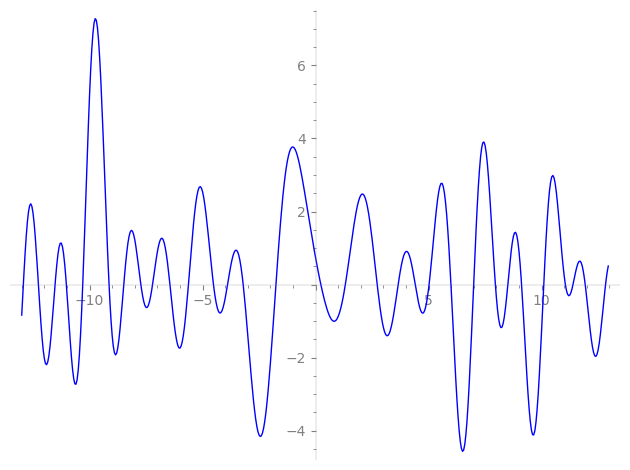
Imaginary part of the first few zeros on the critical line
−9.136632540966265284243489163265, −8.484893052527445522230186833153, −7.72921206285010031980937968840, −7.21202686800626954028352377989, −6.44275900234660704288863668565, −5.62481830268956273229446293381, −4.51690959450779595826340786113, −3.89305218970925027697875112736, −3.20245457035456001731236666262, −1.75368025902883813475066299922,
0.23348430358978960315335738370, 1.31723942714824743017401401724, 2.72749133310527732589422660523, 3.65467749295113135804823049637, 4.40935534947337102013351788652, 5.02203731132555292827490234423, 5.98998058254459746421769391024, 6.99410556258477418984250159264, 7.955508337207359862616812074491, 8.507055974146734267468072185545