| L(s) = 1 | + (−0.866 + 0.5i)2-s + (−0.5 + 0.866i)3-s + (0.499 − 0.866i)4-s + (1.73 − i)5-s − 0.999i·6-s + 0.999i·8-s + (1 + 1.73i)9-s + (−0.999 + 1.73i)10-s + (4.33 + 2.5i)11-s + (0.499 + 0.866i)12-s + (3 − 2i)13-s + 1.99i·15-s + (−0.5 − 0.866i)16-s + (−1 + 1.73i)17-s + (−1.73 − i)18-s + (3.46 − 2i)19-s + ⋯ |
| L(s) = 1 | + (−0.612 + 0.353i)2-s + (−0.288 + 0.499i)3-s + (0.249 − 0.433i)4-s + (0.774 − 0.447i)5-s − 0.408i·6-s + 0.353i·8-s + (0.333 + 0.577i)9-s + (−0.316 + 0.547i)10-s + (1.30 + 0.753i)11-s + (0.144 + 0.249i)12-s + (0.832 − 0.554i)13-s + 0.516i·15-s + (−0.125 − 0.216i)16-s + (−0.242 + 0.420i)17-s + (−0.408 − 0.235i)18-s + (0.794 − 0.458i)19-s + ⋯ |
\[\begin{aligned}\Lambda(s)=\mathstrut & 1274 ^{s/2} \, \Gamma_{\C}(s) \, L(s)\cr =\mathstrut & (0.653 - 0.756i)\, \overline{\Lambda}(2-s) \end{aligned}\]
\[\begin{aligned}\Lambda(s)=\mathstrut & 1274 ^{s/2} \, \Gamma_{\C}(s+1/2) \, L(s)\cr =\mathstrut & (0.653 - 0.756i)\, \overline{\Lambda}(1-s) \end{aligned}\]
Particular Values
| \(L(1)\) |
\(\approx\) |
\(1.492103822\) |
| \(L(\frac12)\) |
\(\approx\) |
\(1.492103822\) |
| \(L(\frac{3}{2})\) |
|
not available |
| \(L(1)\) |
|
not available |
\(L(s) = \displaystyle \prod_{p} F_p(p^{-s})^{-1} \)
| $p$ | $F_p(T)$ |
|---|
| bad | 2 | \( 1 + (0.866 - 0.5i)T \) |
| 7 | \( 1 \) |
| 13 | \( 1 + (-3 + 2i)T \) |
| good | 3 | \( 1 + (0.5 - 0.866i)T + (-1.5 - 2.59i)T^{2} \) |
| 5 | \( 1 + (-1.73 + i)T + (2.5 - 4.33i)T^{2} \) |
| 11 | \( 1 + (-4.33 - 2.5i)T + (5.5 + 9.52i)T^{2} \) |
| 17 | \( 1 + (1 - 1.73i)T + (-8.5 - 14.7i)T^{2} \) |
| 19 | \( 1 + (-3.46 + 2i)T + (9.5 - 16.4i)T^{2} \) |
| 23 | \( 1 + (4.5 + 7.79i)T + (-11.5 + 19.9i)T^{2} \) |
| 29 | \( 1 + 29T^{2} \) |
| 31 | \( 1 + (-4.33 - 2.5i)T + (15.5 + 26.8i)T^{2} \) |
| 37 | \( 1 + (2.59 - 1.5i)T + (18.5 - 32.0i)T^{2} \) |
| 41 | \( 1 + 5iT - 41T^{2} \) |
| 43 | \( 1 - 4T + 43T^{2} \) |
| 47 | \( 1 + (-11.2 + 6.5i)T + (23.5 - 40.7i)T^{2} \) |
| 53 | \( 1 + (7 - 12.1i)T + (-26.5 - 45.8i)T^{2} \) |
| 59 | \( 1 + (-5.19 - 3i)T + (29.5 + 51.0i)T^{2} \) |
| 61 | \( 1 + (6.5 + 11.2i)T + (-30.5 + 52.8i)T^{2} \) |
| 67 | \( 1 + (-2.59 - 1.5i)T + (33.5 + 58.0i)T^{2} \) |
| 71 | \( 1 - 71T^{2} \) |
| 73 | \( 1 + (0.866 + 0.5i)T + (36.5 + 63.2i)T^{2} \) |
| 79 | \( 1 + (-7.5 - 12.9i)T + (-39.5 + 68.4i)T^{2} \) |
| 83 | \( 1 - 6iT - 83T^{2} \) |
| 89 | \( 1 + (5.19 - 3i)T + (44.5 - 77.0i)T^{2} \) |
| 97 | \( 1 + 7iT - 97T^{2} \) |
| show more | |
| show less | |
\(L(s) = \displaystyle\prod_p \ \prod_{j=1}^{2} (1 - \alpha_{j,p}\, p^{-s})^{-1}\)
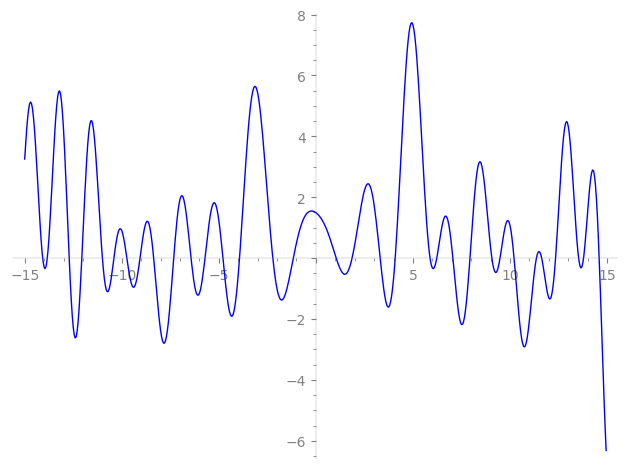
Imaginary part of the first few zeros on the critical line
−9.737411801685598889211044968132, −9.059153208777203026190368539610, −8.356388161265102471638291628482, −7.32443099051038840191868457657, −6.43069064528753630204140200699, −5.71229523537798997911376689156, −4.78777986126239038279735444238, −3.93428050591016947574146427348, −2.21864160866540545587045206303, −1.16348064775005788398869821073,
1.04451311946762261412267215593, 1.86319657180959436432095696308, 3.31032114880092759666674612648, 4.08352473379743349453666624895, 5.87954195348273319911378416871, 6.22542977255707360494809971865, 7.05552699103440014361041191323, 7.934391569490228664054886574515, 9.064049454752289689220834236374, 9.483906162459854711072815867505