| L(s) = 1 | + (−0.669 + 0.743i)2-s + (−0.913 + 0.406i)3-s + (−0.104 − 0.994i)4-s + (1.78 − 0.379i)5-s + (0.309 − 0.951i)6-s + (0.913 − 0.406i)7-s + (0.809 + 0.587i)8-s + (0.669 − 0.743i)9-s + (−0.913 + 1.58i)10-s + (0.5 + 0.866i)11-s + (0.5 + 0.866i)12-s + (−0.309 + 0.951i)14-s + (−1.47 + 1.07i)15-s + (−0.978 + 0.207i)16-s + (0.104 + 0.994i)18-s + ⋯ |
| L(s) = 1 | + (−0.669 + 0.743i)2-s + (−0.913 + 0.406i)3-s + (−0.104 − 0.994i)4-s + (1.78 − 0.379i)5-s + (0.309 − 0.951i)6-s + (0.913 − 0.406i)7-s + (0.809 + 0.587i)8-s + (0.669 − 0.743i)9-s + (−0.913 + 1.58i)10-s + (0.5 + 0.866i)11-s + (0.5 + 0.866i)12-s + (−0.309 + 0.951i)14-s + (−1.47 + 1.07i)15-s + (−0.978 + 0.207i)16-s + (0.104 + 0.994i)18-s + ⋯ |
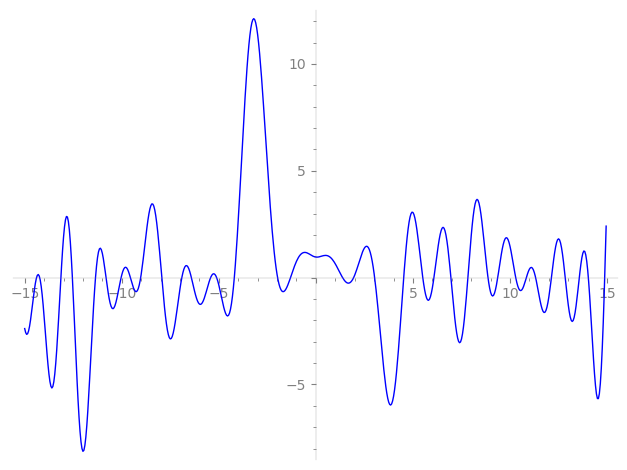
\[\begin{aligned}\Lambda(s)=\mathstrut & 1848 ^{s/2} \, \Gamma_{\C}(s) \, L(s)\cr =\mathstrut & (0.746 - 0.665i)\, \overline{\Lambda}(1-s) \end{aligned}\]
\[\begin{aligned}\Lambda(s)=\mathstrut & 1848 ^{s/2} \, \Gamma_{\C}(s) \, L(s)\cr =\mathstrut & (0.746 - 0.665i)\, \overline{\Lambda}(1-s) \end{aligned}\]
Particular Values
| \(L(\frac{1}{2})\) |
\(\approx\) |
\(0.9614063721\) |
| \(L(\frac12)\) |
\(\approx\) |
\(0.9614063721\) |
| \(L(1)\) |
|
not available |
| \(L(1)\) |
|
not available |
\(L(s) = \displaystyle \prod_{p} F_p(p^{-s})^{-1} \)
| $p$ | $F_p(T)$ |
|---|
| bad | 2 | \( 1 + (0.669 - 0.743i)T \) |
| 3 | \( 1 + (0.913 - 0.406i)T \) |
| 7 | \( 1 + (-0.913 + 0.406i)T \) |
| 11 | \( 1 + (-0.5 - 0.866i)T \) |
| good | 5 | \( 1 + (-1.78 + 0.379i)T + (0.913 - 0.406i)T^{2} \) |
| 13 | \( 1 + (0.809 - 0.587i)T^{2} \) |
| 17 | \( 1 + (0.104 - 0.994i)T^{2} \) |
| 19 | \( 1 + (0.978 + 0.207i)T^{2} \) |
| 23 | \( 1 + (0.5 - 0.866i)T^{2} \) |
| 29 | \( 1 + (0.169 - 0.122i)T + (0.309 - 0.951i)T^{2} \) |
| 31 | \( 1 + (1.30 + 0.278i)T + (0.913 + 0.406i)T^{2} \) |
| 37 | \( 1 + (-0.669 - 0.743i)T^{2} \) |
| 41 | \( 1 + (-0.309 - 0.951i)T^{2} \) |
| 43 | \( 1 - T^{2} \) |
| 47 | \( 1 + (0.978 + 0.207i)T^{2} \) |
| 53 | \( 1 + (1.91 + 0.406i)T + (0.913 + 0.406i)T^{2} \) |
| 59 | \( 1 + (0.204 + 1.94i)T + (-0.978 + 0.207i)T^{2} \) |
| 61 | \( 1 + (-0.913 + 0.406i)T^{2} \) |
| 67 | \( 1 + (0.5 + 0.866i)T^{2} \) |
| 71 | \( 1 + (0.809 + 0.587i)T^{2} \) |
| 73 | \( 1 + (-0.169 - 1.60i)T + (-0.978 + 0.207i)T^{2} \) |
| 79 | \( 1 + (0.139 - 0.155i)T + (-0.104 - 0.994i)T^{2} \) |
| 83 | \( 1 + (0.564 - 1.73i)T + (-0.809 - 0.587i)T^{2} \) |
| 89 | \( 1 + (0.5 - 0.866i)T^{2} \) |
| 97 | \( 1 + (0.0646 + 0.198i)T + (-0.809 + 0.587i)T^{2} \) |
| show more | |
| show less | |
\(L(s) = \displaystyle\prod_p \ \prod_{j=1}^{2} (1 - \alpha_{j,p}\, p^{-s})^{-1}\)
Imaginary part of the first few zeros on the critical line
−9.555648963170448628115773040844, −9.026087802187952772141805529504, −7.936861520827429531002662171666, −6.90571944893670489041520655876, −6.41327580480198995854098270929, −5.42332567761205505044448901628, −5.11337911117161987559739346274, −4.20292926105698614406527588833, −1.97233789949212835355168606944, −1.30866108692172255072864215127,
1.37489633938773338017489584793, 1.94186841794118877126554623514, 3.02516694049903998895767999263, 4.52208896638433188482545259654, 5.50525391234133290945800518617, 6.07968398365997428572245899737, 6.95368584948483292725228454971, 7.82800550940455285936151741893, 8.864625981048815928955888602646, 9.364405259279754464621792723408