| L(s) = 1 | + 4·2-s + 2.32·3-s + 16·4-s − 25·5-s + 9.31·6-s − 11.9·7-s + 64·8-s − 237.·9-s − 100·10-s − 592.·11-s + 37.2·12-s + 169·13-s − 47.9·14-s − 58.2·15-s + 256·16-s − 1.15e3·17-s − 950.·18-s + 1.96e3·19-s − 400·20-s − 27.9·21-s − 2.37e3·22-s − 4.92e3·23-s + 149.·24-s + 625·25-s + 676·26-s − 1.11e3·27-s − 191.·28-s + ⋯ |
| L(s) = 1 | + 0.707·2-s + 0.149·3-s + 0.5·4-s − 0.447·5-s + 0.105·6-s − 0.0923·7-s + 0.353·8-s − 0.977·9-s − 0.316·10-s − 1.47·11-s + 0.0747·12-s + 0.277·13-s − 0.0653·14-s − 0.0668·15-s + 0.250·16-s − 0.966·17-s − 0.691·18-s + 1.25·19-s − 0.223·20-s − 0.0138·21-s − 1.04·22-s − 1.94·23-s + 0.0528·24-s + 0.200·25-s + 0.196·26-s − 0.295·27-s − 0.0461·28-s + ⋯ |
\[\begin{aligned}\Lambda(s)=\mathstrut & 130 ^{s/2} \, \Gamma_{\C}(s) \, L(s)\cr =\mathstrut & -\, \Lambda(6-s) \end{aligned}\]
\[\begin{aligned}\Lambda(s)=\mathstrut & 130 ^{s/2} \, \Gamma_{\C}(s+5/2) \, L(s)\cr =\mathstrut & -\, \Lambda(1-s) \end{aligned}\]
Particular Values
| \(L(3)\) |
\(=\) |
\(0\) |
| \(L(\frac12)\) |
\(=\) |
\(0\) |
| \(L(\frac{7}{2})\) |
|
not available |
| \(L(1)\) |
|
not available |
\(L(s) = \displaystyle \prod_{p} F_p(p^{-s})^{-1} \)
| $p$ | $F_p(T)$ |
|---|
| bad | 2 | \( 1 - 4T \) |
| 5 | \( 1 + 25T \) |
| 13 | \( 1 - 169T \) |
| good | 3 | \( 1 - 2.32T + 243T^{2} \) |
| 7 | \( 1 + 11.9T + 1.68e4T^{2} \) |
| 11 | \( 1 + 592.T + 1.61e5T^{2} \) |
| 17 | \( 1 + 1.15e3T + 1.41e6T^{2} \) |
| 19 | \( 1 - 1.96e3T + 2.47e6T^{2} \) |
| 23 | \( 1 + 4.92e3T + 6.43e6T^{2} \) |
| 29 | \( 1 + 3.17e3T + 2.05e7T^{2} \) |
| 31 | \( 1 - 811.T + 2.86e7T^{2} \) |
| 37 | \( 1 - 3.66e3T + 6.93e7T^{2} \) |
| 41 | \( 1 + 4.40e3T + 1.15e8T^{2} \) |
| 43 | \( 1 - 358.T + 1.47e8T^{2} \) |
| 47 | \( 1 + 1.25e4T + 2.29e8T^{2} \) |
| 53 | \( 1 - 6.67e3T + 4.18e8T^{2} \) |
| 59 | \( 1 - 1.92e4T + 7.14e8T^{2} \) |
| 61 | \( 1 - 3.76e4T + 8.44e8T^{2} \) |
| 67 | \( 1 + 3.21e4T + 1.35e9T^{2} \) |
| 71 | \( 1 + 8.92e3T + 1.80e9T^{2} \) |
| 73 | \( 1 - 3.06e4T + 2.07e9T^{2} \) |
| 79 | \( 1 + 1.11e4T + 3.07e9T^{2} \) |
| 83 | \( 1 - 2.45e4T + 3.93e9T^{2} \) |
| 89 | \( 1 + 3.16e4T + 5.58e9T^{2} \) |
| 97 | \( 1 - 1.38e5T + 8.58e9T^{2} \) |
| show more | |
| show less | |
\(L(s) = \displaystyle\prod_p \ \prod_{j=1}^{2} (1 - \alpha_{j,p}\, p^{-s})^{-1}\)
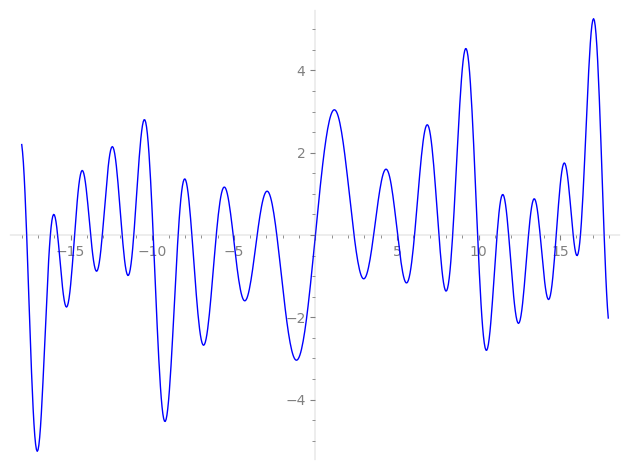
Imaginary part of the first few zeros on the critical line
−11.84437966496191401156316829978, −11.13165633020076596959326662164, −9.941312811394734616827437330305, −8.413377543717375617545702426836, −7.57124551990048567275701191475, −6.07628190405153258233047025570, −5.03963424363305903155129842208, −3.56905866703009578913117371452, −2.36734827443036508490741970084, 0,
2.36734827443036508490741970084, 3.56905866703009578913117371452, 5.03963424363305903155129842208, 6.07628190405153258233047025570, 7.57124551990048567275701191475, 8.413377543717375617545702426836, 9.941312811394734616827437330305, 11.13165633020076596959326662164, 11.84437966496191401156316829978