| L(s) = 1 | + (2.5 − 4.33i)5-s + (16.9 + 29.2i)7-s + (12.0 + 20.8i)11-s + (4.52 − 7.83i)13-s + 59.6·17-s + 114.·19-s + (11.4 − 19.8i)23-s + (−12.5 − 21.6i)25-s + (−26.5 − 45.9i)29-s + (−55.5 + 96.2i)31-s + 169.·35-s − 303.·37-s + (174. − 302. i)41-s + (257. + 445. i)43-s + (−57.2 − 99.1i)47-s + ⋯ |
| L(s) = 1 | + (0.223 − 0.387i)5-s + (0.912 + 1.58i)7-s + (0.330 + 0.572i)11-s + (0.0964 − 0.167i)13-s + 0.850·17-s + 1.38·19-s + (0.103 − 0.179i)23-s + (−0.100 − 0.173i)25-s + (−0.169 − 0.294i)29-s + (−0.322 + 0.557i)31-s + 0.816·35-s − 1.34·37-s + (0.665 − 1.15i)41-s + (0.912 + 1.58i)43-s + (−0.177 − 0.307i)47-s + ⋯ |
\[\begin{aligned}\Lambda(s)=\mathstrut & 1080 ^{s/2} \, \Gamma_{\C}(s) \, L(s)\cr =\mathstrut & (0.504 - 0.863i)\, \overline{\Lambda}(4-s) \end{aligned}\]
\[\begin{aligned}\Lambda(s)=\mathstrut & 1080 ^{s/2} \, \Gamma_{\C}(s+3/2) \, L(s)\cr =\mathstrut & (0.504 - 0.863i)\, \overline{\Lambda}(1-s) \end{aligned}\]
Particular Values
| \(L(2)\) |
\(\approx\) |
\(2.691204081\) |
| \(L(\frac12)\) |
\(\approx\) |
\(2.691204081\) |
| \(L(\frac{5}{2})\) |
|
not available |
| \(L(1)\) |
|
not available |
\(L(s) = \displaystyle \prod_{p} F_p(p^{-s})^{-1} \)
| $p$ | $F_p(T)$ |
|---|
| bad | 2 | \( 1 \) |
| 3 | \( 1 \) |
| 5 | \( 1 + (-2.5 + 4.33i)T \) |
| good | 7 | \( 1 + (-16.9 - 29.2i)T + (-171.5 + 297. i)T^{2} \) |
| 11 | \( 1 + (-12.0 - 20.8i)T + (-665.5 + 1.15e3i)T^{2} \) |
| 13 | \( 1 + (-4.52 + 7.83i)T + (-1.09e3 - 1.90e3i)T^{2} \) |
| 17 | \( 1 - 59.6T + 4.91e3T^{2} \) |
| 19 | \( 1 - 114.T + 6.85e3T^{2} \) |
| 23 | \( 1 + (-11.4 + 19.8i)T + (-6.08e3 - 1.05e4i)T^{2} \) |
| 29 | \( 1 + (26.5 + 45.9i)T + (-1.21e4 + 2.11e4i)T^{2} \) |
| 31 | \( 1 + (55.5 - 96.2i)T + (-1.48e4 - 2.57e4i)T^{2} \) |
| 37 | \( 1 + 303.T + 5.06e4T^{2} \) |
| 41 | \( 1 + (-174. + 302. i)T + (-3.44e4 - 5.96e4i)T^{2} \) |
| 43 | \( 1 + (-257. - 445. i)T + (-3.97e4 + 6.88e4i)T^{2} \) |
| 47 | \( 1 + (57.2 + 99.1i)T + (-5.19e4 + 8.99e4i)T^{2} \) |
| 53 | \( 1 - 296.T + 1.48e5T^{2} \) |
| 59 | \( 1 + (341. - 590. i)T + (-1.02e5 - 1.77e5i)T^{2} \) |
| 61 | \( 1 + (324. + 562. i)T + (-1.13e5 + 1.96e5i)T^{2} \) |
| 67 | \( 1 + (185. - 321. i)T + (-1.50e5 - 2.60e5i)T^{2} \) |
| 71 | \( 1 - 881.T + 3.57e5T^{2} \) |
| 73 | \( 1 + 545.T + 3.89e5T^{2} \) |
| 79 | \( 1 + (323. + 560. i)T + (-2.46e5 + 4.26e5i)T^{2} \) |
| 83 | \( 1 + (453. + 785. i)T + (-2.85e5 + 4.95e5i)T^{2} \) |
| 89 | \( 1 - 813.T + 7.04e5T^{2} \) |
| 97 | \( 1 + (-667. - 1.15e3i)T + (-4.56e5 + 7.90e5i)T^{2} \) |
| show more | |
| show less | |
\(L(s) = \displaystyle\prod_p \ \prod_{j=1}^{2} (1 - \alpha_{j,p}\, p^{-s})^{-1}\)
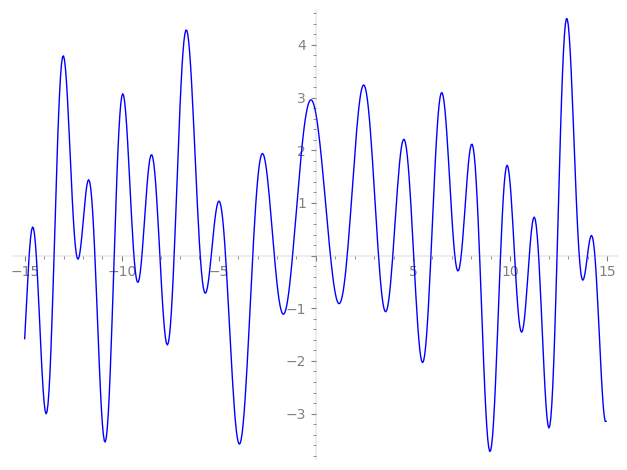
Imaginary part of the first few zeros on the critical line
−9.373283478611528653006079798989, −8.961836614324284038696278844384, −8.036476758130764852708617685127, −7.30248660761930451101590475234, −5.95821884274016334502024125897, −5.39115278172622972831017745690, −4.65428512228086595798176057031, −3.25347895741274569381214979945, −2.14092960071551631979770436035, −1.20211403675780708226863211099,
0.74839865723743780885002828413, 1.61211397728884793589311818428, 3.22466062411570383603266579415, 3.96053614074734946544490223996, 5.03710806755993910896219050461, 5.92447502290695342613121323408, 7.15608162725607389869283731776, 7.48358066980548457094203282305, 8.431584094030375707405022938655, 9.508837318611355038061568277390