| L(s) = 1 | + (−0.5 + 0.866i)3-s + 3·5-s + (−2 − 3.46i)7-s + (−0.499 − 0.866i)9-s + (2 − 3.46i)11-s + (−2.5 − 2.59i)13-s + (−1.5 + 2.59i)15-s + (−1.5 − 2.59i)17-s + (−2 − 3.46i)19-s + 3.99·21-s + (−4 + 6.92i)23-s + 4·25-s + 0.999·27-s + (2.5 − 4.33i)29-s + 8·31-s + ⋯ |
| L(s) = 1 | + (−0.288 + 0.499i)3-s + 1.34·5-s + (−0.755 − 1.30i)7-s + (−0.166 − 0.288i)9-s + (0.603 − 1.04i)11-s + (−0.693 − 0.720i)13-s + (−0.387 + 0.670i)15-s + (−0.363 − 0.630i)17-s + (−0.458 − 0.794i)19-s + 0.872·21-s + (−0.834 + 1.44i)23-s + 0.800·25-s + 0.192·27-s + (0.464 − 0.804i)29-s + 1.43·31-s + ⋯ |
\[\begin{aligned}\Lambda(s)=\mathstrut & 624 ^{s/2} \, \Gamma_{\C}(s) \, L(s)\cr =\mathstrut & (0.477 + 0.878i)\, \overline{\Lambda}(2-s) \end{aligned}\]
\[\begin{aligned}\Lambda(s)=\mathstrut & 624 ^{s/2} \, \Gamma_{\C}(s+1/2) \, L(s)\cr =\mathstrut & (0.477 + 0.878i)\, \overline{\Lambda}(1-s) \end{aligned}\]
Particular Values
| \(L(1)\) |
\(\approx\) |
\(1.19246 - 0.709015i\) |
| \(L(\frac12)\) |
\(\approx\) |
\(1.19246 - 0.709015i\) |
| \(L(\frac{3}{2})\) |
|
not available |
| \(L(1)\) |
|
not available |
\(L(s) = \displaystyle \prod_{p} F_p(p^{-s})^{-1} \)
| $p$ | $F_p(T)$ |
|---|
| bad | 2 | \( 1 \) |
| 3 | \( 1 + (0.5 - 0.866i)T \) |
| 13 | \( 1 + (2.5 + 2.59i)T \) |
| good | 5 | \( 1 - 3T + 5T^{2} \) |
| 7 | \( 1 + (2 + 3.46i)T + (-3.5 + 6.06i)T^{2} \) |
| 11 | \( 1 + (-2 + 3.46i)T + (-5.5 - 9.52i)T^{2} \) |
| 17 | \( 1 + (1.5 + 2.59i)T + (-8.5 + 14.7i)T^{2} \) |
| 19 | \( 1 + (2 + 3.46i)T + (-9.5 + 16.4i)T^{2} \) |
| 23 | \( 1 + (4 - 6.92i)T + (-11.5 - 19.9i)T^{2} \) |
| 29 | \( 1 + (-2.5 + 4.33i)T + (-14.5 - 25.1i)T^{2} \) |
| 31 | \( 1 - 8T + 31T^{2} \) |
| 37 | \( 1 + (3.5 - 6.06i)T + (-18.5 - 32.0i)T^{2} \) |
| 41 | \( 1 + (-4.5 + 7.79i)T + (-20.5 - 35.5i)T^{2} \) |
| 43 | \( 1 + (-4 - 6.92i)T + (-21.5 + 37.2i)T^{2} \) |
| 47 | \( 1 - 4T + 47T^{2} \) |
| 53 | \( 1 + 5T + 53T^{2} \) |
| 59 | \( 1 + (-2 - 3.46i)T + (-29.5 + 51.0i)T^{2} \) |
| 61 | \( 1 + (-2.5 - 4.33i)T + (-30.5 + 52.8i)T^{2} \) |
| 67 | \( 1 + (-4 + 6.92i)T + (-33.5 - 58.0i)T^{2} \) |
| 71 | \( 1 + (2 + 3.46i)T + (-35.5 + 61.4i)T^{2} \) |
| 73 | \( 1 - 11T + 73T^{2} \) |
| 79 | \( 1 - 4T + 79T^{2} \) |
| 83 | \( 1 + 83T^{2} \) |
| 89 | \( 1 + (-3 + 5.19i)T + (-44.5 - 77.0i)T^{2} \) |
| 97 | \( 1 + (-7 - 12.1i)T + (-48.5 + 84.0i)T^{2} \) |
| show more | |
| show less | |
\(L(s) = \displaystyle\prod_p \ \prod_{j=1}^{2} (1 - \alpha_{j,p}\, p^{-s})^{-1}\)
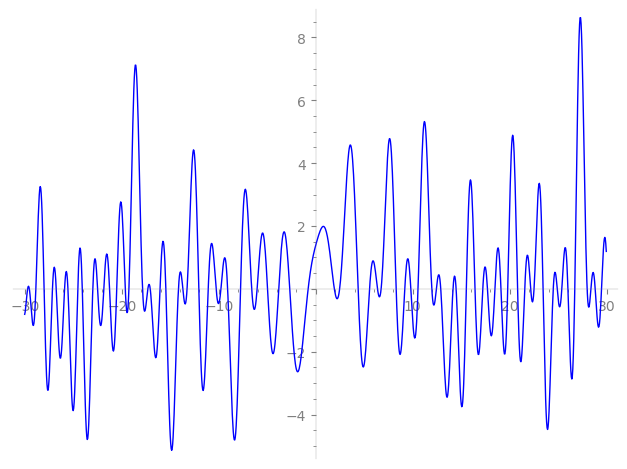
Imaginary part of the first few zeros on the critical line
−10.26605442352060627644228041243, −9.769152958039800980759367859989, −9.082085633499943486008612595852, −7.75076916107353423681006090398, −6.59849027619078970003877556877, −6.03977718352932619505639831947, −4.96653572333780385766057812380, −3.81778754927339176247922855276, −2.67811407560731761810951929586, −0.78092302757712654319429896482,
1.91947071777838480588208054130, 2.46388135250376994776166240557, 4.36887885855977114378883232238, 5.54659780721599603499567235342, 6.36810786646446921750579328786, 6.74126309742186585395125833203, 8.290926747982199134972998442251, 9.180587457514239873106109126044, 9.801942763502910906073008206898, 10.54331968385547638521964653801