| L(s) = 1 | + (0.809 − 0.587i)3-s + (−0.881 − 2.71i)5-s + (−1.5 − 1.08i)7-s + (0.309 − 0.951i)9-s + (−1.23 + 3.07i)11-s + (1 − 3.07i)13-s + (−2.30 − 1.67i)15-s + (−1.23 − 3.80i)17-s + (−0.618 + 0.449i)19-s − 1.85·21-s − 7.23·23-s + (−2.54 + 1.84i)25-s + (−0.309 − 0.951i)27-s + (−0.309 − 0.224i)29-s + (1.80 − 5.56i)31-s + ⋯ |
| L(s) = 1 | + (0.467 − 0.339i)3-s + (−0.394 − 1.21i)5-s + (−0.566 − 0.411i)7-s + (0.103 − 0.317i)9-s + (−0.372 + 0.927i)11-s + (0.277 − 0.853i)13-s + (−0.596 − 0.433i)15-s + (−0.299 − 0.922i)17-s + (−0.141 + 0.103i)19-s − 0.404·21-s − 1.50·23-s + (−0.509 + 0.369i)25-s + (−0.0594 − 0.183i)27-s + (−0.0573 − 0.0416i)29-s + (0.324 − 0.999i)31-s + ⋯ |
\[\begin{aligned}\Lambda(s)=\mathstrut & 528 ^{s/2} \, \Gamma_{\C}(s) \, L(s)\cr =\mathstrut & (-0.605 + 0.795i)\, \overline{\Lambda}(2-s) \end{aligned}\]
\[\begin{aligned}\Lambda(s)=\mathstrut & 528 ^{s/2} \, \Gamma_{\C}(s+1/2) \, L(s)\cr =\mathstrut & (-0.605 + 0.795i)\, \overline{\Lambda}(1-s) \end{aligned}\]
Particular Values
| \(L(1)\) |
\(\approx\) |
\(0.516558 - 1.04196i\) |
| \(L(\frac12)\) |
\(\approx\) |
\(0.516558 - 1.04196i\) |
| \(L(\frac{3}{2})\) |
|
not available |
| \(L(1)\) |
|
not available |
\(L(s) = \displaystyle \prod_{p} F_p(p^{-s})^{-1} \)
| $p$ | $F_p(T)$ |
|---|
| bad | 2 | \( 1 \) |
| 3 | \( 1 + (-0.809 + 0.587i)T \) |
| 11 | \( 1 + (1.23 - 3.07i)T \) |
| good | 5 | \( 1 + (0.881 + 2.71i)T + (-4.04 + 2.93i)T^{2} \) |
| 7 | \( 1 + (1.5 + 1.08i)T + (2.16 + 6.65i)T^{2} \) |
| 13 | \( 1 + (-1 + 3.07i)T + (-10.5 - 7.64i)T^{2} \) |
| 17 | \( 1 + (1.23 + 3.80i)T + (-13.7 + 9.99i)T^{2} \) |
| 19 | \( 1 + (0.618 - 0.449i)T + (5.87 - 18.0i)T^{2} \) |
| 23 | \( 1 + 7.23T + 23T^{2} \) |
| 29 | \( 1 + (0.309 + 0.224i)T + (8.96 + 27.5i)T^{2} \) |
| 31 | \( 1 + (-1.80 + 5.56i)T + (-25.0 - 18.2i)T^{2} \) |
| 37 | \( 1 + (-3.23 - 2.35i)T + (11.4 + 35.1i)T^{2} \) |
| 41 | \( 1 + (5.85 - 4.25i)T + (12.6 - 38.9i)T^{2} \) |
| 43 | \( 1 - 9.70T + 43T^{2} \) |
| 47 | \( 1 + (-7.23 + 5.25i)T + (14.5 - 44.6i)T^{2} \) |
| 53 | \( 1 + (-3.66 + 11.2i)T + (-42.8 - 31.1i)T^{2} \) |
| 59 | \( 1 + (-4.35 - 3.16i)T + (18.2 + 56.1i)T^{2} \) |
| 61 | \( 1 + (-4.38 - 13.4i)T + (-49.3 + 35.8i)T^{2} \) |
| 67 | \( 1 + 8T + 67T^{2} \) |
| 71 | \( 1 + (3.38 + 10.4i)T + (-57.4 + 41.7i)T^{2} \) |
| 73 | \( 1 + (-11.6 - 8.45i)T + (22.5 + 69.4i)T^{2} \) |
| 79 | \( 1 + (-0.118 + 0.363i)T + (-63.9 - 46.4i)T^{2} \) |
| 83 | \( 1 + (0.5 + 1.53i)T + (-67.1 + 48.7i)T^{2} \) |
| 89 | \( 1 - 6.76T + 89T^{2} \) |
| 97 | \( 1 + (-5.02 + 15.4i)T + (-78.4 - 57.0i)T^{2} \) |
| show more | |
| show less | |
\(L(s) = \displaystyle\prod_p \ \prod_{j=1}^{2} (1 - \alpha_{j,p}\, p^{-s})^{-1}\)
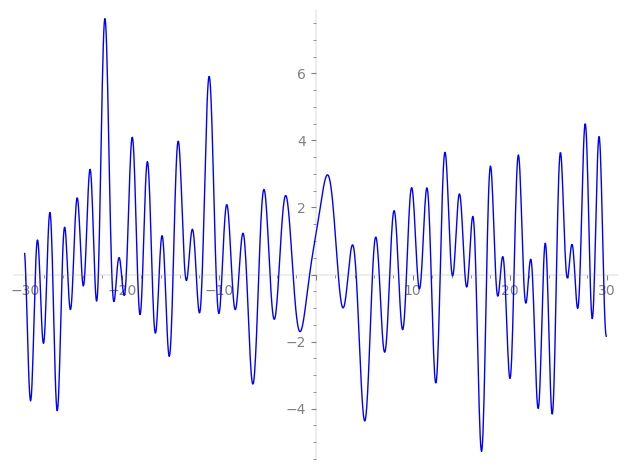
Imaginary part of the first few zeros on the critical line
−10.26321980439559474587895760908, −9.662708269411264836242159024620, −8.644781439650956102090081888514, −7.913978401424432070136755498777, −7.13133077569315487768427833327, −5.87122610858418282811492125251, −4.71312349861132037762232836432, −3.80630390177571824941863889406, −2.33348190624159076041923902671, −0.62943214958131817011722912016,
2.32391075580834437084908159024, 3.34381134920930658861509641382, 4.16636837062841361997671357392, 5.85090471039672274165001667871, 6.54334861378031217538741867013, 7.62653761301220814321369654394, 8.542188453796680750810924569139, 9.357423055101189185039952765643, 10.49360943725794649326578052736, 10.88742252357522200530394831499