| L(s) = 1 | + (1.51 − 0.831i)3-s − 2.52·5-s + (−1.07 − 2.41i)7-s + (1.61 − 2.52i)9-s − 5.71·11-s + (−2.45 − 4.24i)13-s + (−3.83 + 2.09i)15-s + (2.49 + 4.32i)17-s + (−0.00383 + 0.00664i)19-s + (−3.64 − 2.77i)21-s + 0.667·23-s + 1.36·25-s + (0.355 − 5.18i)27-s + (3.85 − 6.66i)29-s + (3.88 − 6.72i)31-s + ⋯ |
| L(s) = 1 | + (0.877 − 0.480i)3-s − 1.12·5-s + (−0.407 − 0.913i)7-s + (0.539 − 0.842i)9-s − 1.72·11-s + (−0.680 − 1.17i)13-s + (−0.989 + 0.541i)15-s + (0.605 + 1.04i)17-s + (−0.000880 + 0.00152i)19-s + (−0.795 − 0.605i)21-s + 0.139·23-s + 0.273·25-s + (0.0685 − 0.997i)27-s + (0.715 − 1.23i)29-s + (0.697 − 1.20i)31-s + ⋯ |
\[\begin{aligned}\Lambda(s)=\mathstrut & 504 ^{s/2} \, \Gamma_{\C}(s) \, L(s)\cr =\mathstrut & (-0.706 + 0.707i)\, \overline{\Lambda}(2-s) \end{aligned}\]
\[\begin{aligned}\Lambda(s)=\mathstrut & 504 ^{s/2} \, \Gamma_{\C}(s+1/2) \, L(s)\cr =\mathstrut & (-0.706 + 0.707i)\, \overline{\Lambda}(1-s) \end{aligned}\]
Particular Values
| \(L(1)\) |
\(\approx\) |
\(0.376469 - 0.908114i\) |
| \(L(\frac12)\) |
\(\approx\) |
\(0.376469 - 0.908114i\) |
| \(L(\frac{3}{2})\) |
|
not available |
| \(L(1)\) |
|
not available |
\(L(s) = \displaystyle \prod_{p} F_p(p^{-s})^{-1} \)
| $p$ | $F_p(T)$ |
|---|
| bad | 2 | \( 1 \) |
| 3 | \( 1 + (-1.51 + 0.831i)T \) |
| 7 | \( 1 + (1.07 + 2.41i)T \) |
| good | 5 | \( 1 + 2.52T + 5T^{2} \) |
| 11 | \( 1 + 5.71T + 11T^{2} \) |
| 13 | \( 1 + (2.45 + 4.24i)T + (-6.5 + 11.2i)T^{2} \) |
| 17 | \( 1 + (-2.49 - 4.32i)T + (-8.5 + 14.7i)T^{2} \) |
| 19 | \( 1 + (0.00383 - 0.00664i)T + (-9.5 - 16.4i)T^{2} \) |
| 23 | \( 1 - 0.667T + 23T^{2} \) |
| 29 | \( 1 + (-3.85 + 6.66i)T + (-14.5 - 25.1i)T^{2} \) |
| 31 | \( 1 + (-3.88 + 6.72i)T + (-15.5 - 26.8i)T^{2} \) |
| 37 | \( 1 + (3.19 - 5.53i)T + (-18.5 - 32.0i)T^{2} \) |
| 41 | \( 1 + (-5.21 - 9.02i)T + (-20.5 + 35.5i)T^{2} \) |
| 43 | \( 1 + (-4.42 + 7.67i)T + (-21.5 - 37.2i)T^{2} \) |
| 47 | \( 1 + (1.08 + 1.87i)T + (-23.5 + 40.7i)T^{2} \) |
| 53 | \( 1 + (3.69 + 6.40i)T + (-26.5 + 45.8i)T^{2} \) |
| 59 | \( 1 + (-0.261 + 0.453i)T + (-29.5 - 51.0i)T^{2} \) |
| 61 | \( 1 + (-4.49 - 7.78i)T + (-30.5 + 52.8i)T^{2} \) |
| 67 | \( 1 + (-2.54 + 4.41i)T + (-33.5 - 58.0i)T^{2} \) |
| 71 | \( 1 + 5.68T + 71T^{2} \) |
| 73 | \( 1 + (1.52 + 2.63i)T + (-36.5 + 63.2i)T^{2} \) |
| 79 | \( 1 + (3.08 + 5.33i)T + (-39.5 + 68.4i)T^{2} \) |
| 83 | \( 1 + (0.258 - 0.448i)T + (-41.5 - 71.8i)T^{2} \) |
| 89 | \( 1 + (-1.19 + 2.06i)T + (-44.5 - 77.0i)T^{2} \) |
| 97 | \( 1 + (-4.32 + 7.49i)T + (-48.5 - 84.0i)T^{2} \) |
| show more | |
| show less | |
\(L(s) = \displaystyle\prod_p \ \prod_{j=1}^{2} (1 - \alpha_{j,p}\, p^{-s})^{-1}\)
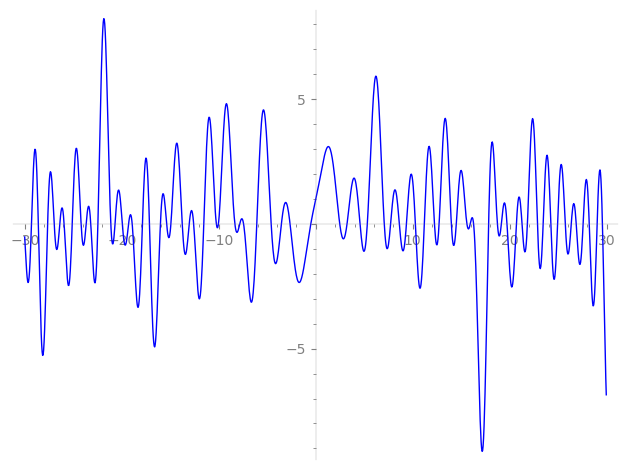
Imaginary part of the first few zeros on the critical line
−10.24141544710466090120096599358, −10.03016617036624025891744403219, −8.332639203993149719198397453971, −7.82847342965904186521499383625, −7.43938667354579069896153794018, −6.07615837179250271148194124973, −4.59347240417525450602733333923, −3.53695961648221580576662161034, −2.64697535706466480430642201967, −0.50645333751432538273277346377,
2.47486077255999744548821359519, 3.22824563059383396952407464258, 4.56834796465274393031261345875, 5.31739643800256729153996644628, 7.06487608293323162282600134652, 7.72014727229618140015319628260, 8.618482773713286339856482798150, 9.350892800470681465850175221360, 10.27273657702197526307698816577, 11.19398184281882442999626481597