| L(s) = 1 | + (−0.425 − 1.02i)2-s + (−0.165 + 0.165i)4-s + (−0.785 − 0.325i)8-s + 1.17i·16-s + (0.555 + 0.831i)17-s + (0.707 + 1.70i)19-s + (0.785 − 1.17i)23-s + (1.63 − 1.08i)31-s + (0.425 − 0.176i)32-s + (0.617 − 0.923i)34-s + (1.45 − 1.45i)38-s + (−1.54 − 0.306i)46-s + (0.275 + 0.275i)47-s + (0.923 − 0.382i)49-s + (−0.636 − 1.53i)53-s + ⋯ |
| L(s) = 1 | + (−0.425 − 1.02i)2-s + (−0.165 + 0.165i)4-s + (−0.785 − 0.325i)8-s + 1.17i·16-s + (0.555 + 0.831i)17-s + (0.707 + 1.70i)19-s + (0.785 − 1.17i)23-s + (1.63 − 1.08i)31-s + (0.425 − 0.176i)32-s + (0.617 − 0.923i)34-s + (1.45 − 1.45i)38-s + (−1.54 − 0.306i)46-s + (0.275 + 0.275i)47-s + (0.923 − 0.382i)49-s + (−0.636 − 1.53i)53-s + ⋯ |
\[\begin{aligned}\Lambda(s)=\mathstrut & 3825 ^{s/2} \, \Gamma_{\C}(s) \, L(s)\cr =\mathstrut & (0.0318 + 0.999i)\, \overline{\Lambda}(1-s) \end{aligned}\]
\[\begin{aligned}\Lambda(s)=\mathstrut & 3825 ^{s/2} \, \Gamma_{\C}(s) \, L(s)\cr =\mathstrut & (0.0318 + 0.999i)\, \overline{\Lambda}(1-s) \end{aligned}\]
Particular Values
| \(L(\frac{1}{2})\) |
\(\approx\) |
\(1.089396029\) |
| \(L(\frac12)\) |
\(\approx\) |
\(1.089396029\) |
| \(L(1)\) |
|
not available |
| \(L(1)\) |
|
not available |
\(L(s) = \displaystyle \prod_{p} F_p(p^{-s})^{-1} \)
| $p$ | $F_p(T)$ |
|---|
| bad | 3 | \( 1 \) |
| 5 | \( 1 \) |
| 17 | \( 1 + (-0.555 - 0.831i)T \) |
| good | 2 | \( 1 + (0.425 + 1.02i)T + (-0.707 + 0.707i)T^{2} \) |
| 7 | \( 1 + (-0.923 + 0.382i)T^{2} \) |
| 11 | \( 1 + (0.382 + 0.923i)T^{2} \) |
| 13 | \( 1 + iT^{2} \) |
| 19 | \( 1 + (-0.707 - 1.70i)T + (-0.707 + 0.707i)T^{2} \) |
| 23 | \( 1 + (-0.785 + 1.17i)T + (-0.382 - 0.923i)T^{2} \) |
| 29 | \( 1 + (0.923 + 0.382i)T^{2} \) |
| 31 | \( 1 + (-1.63 + 1.08i)T + (0.382 - 0.923i)T^{2} \) |
| 37 | \( 1 + (-0.382 + 0.923i)T^{2} \) |
| 41 | \( 1 + (-0.923 + 0.382i)T^{2} \) |
| 43 | \( 1 + (-0.707 - 0.707i)T^{2} \) |
| 47 | \( 1 + (-0.275 - 0.275i)T + iT^{2} \) |
| 53 | \( 1 + (0.636 + 1.53i)T + (-0.707 + 0.707i)T^{2} \) |
| 59 | \( 1 + (0.707 + 0.707i)T^{2} \) |
| 61 | \( 1 + (0.382 - 0.0761i)T + (0.923 - 0.382i)T^{2} \) |
| 67 | \( 1 - T^{2} \) |
| 71 | \( 1 + (-0.382 + 0.923i)T^{2} \) |
| 73 | \( 1 + (-0.923 - 0.382i)T^{2} \) |
| 79 | \( 1 + (0.324 + 0.216i)T + (0.382 + 0.923i)T^{2} \) |
| 83 | \( 1 + (1.53 - 0.636i)T + (0.707 - 0.707i)T^{2} \) |
| 89 | \( 1 - iT^{2} \) |
| 97 | \( 1 + (0.923 + 0.382i)T^{2} \) |
| show more | |
| show less | |
\(L(s) = \displaystyle\prod_p \ \prod_{j=1}^{2} (1 - \alpha_{j,p}\, p^{-s})^{-1}\)
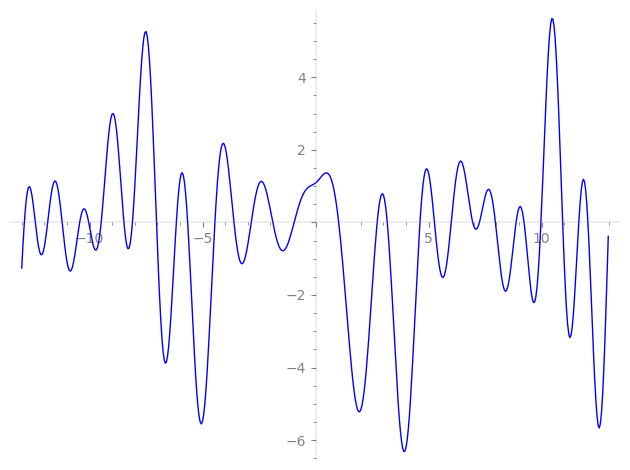
Imaginary part of the first few zeros on the critical line
−8.477517319496689309102203419113, −8.102079078893927417604269182865, −7.03736440919461273067886938214, −6.15944366162354537720635281756, −5.65846912144609158615994830750, −4.45405177053582429417852851364, −3.60927889617329236981928525063, −2.84638016751139526345248190658, −1.89093199215640502610974782315, −0.947975893754658292591851662512,
1.02302667283642032562735612792, 2.72528937641577185444748779065, 3.17238729748979198280328027834, 4.61921620660393622505997085712, 5.26009944918583113866711163717, 6.00298387810678915088518009147, 6.95336715527734389109230731722, 7.24911310193239641404024164834, 7.957026543350253838617198436634, 8.871035545220033157338367250101