| L(s) = 1 | + (0.891 − 0.453i)2-s + (0.707 − 0.707i)3-s + (0.587 − 0.809i)4-s + (0.309 − 0.951i)6-s + (0.156 − 0.987i)8-s − 1.00i·9-s + (−0.156 − 0.987i)12-s + (−0.309 − 0.951i)16-s + (1.14 + 1.14i)17-s + (−0.453 − 0.891i)18-s + 0.618i·19-s + (−0.831 − 0.831i)23-s + (−0.587 − 0.809i)24-s + (−0.707 − 0.707i)27-s + 1.17i·31-s + (−0.707 − 0.707i)32-s + ⋯ |
| L(s) = 1 | + (0.891 − 0.453i)2-s + (0.707 − 0.707i)3-s + (0.587 − 0.809i)4-s + (0.309 − 0.951i)6-s + (0.156 − 0.987i)8-s − 1.00i·9-s + (−0.156 − 0.987i)12-s + (−0.309 − 0.951i)16-s + (1.14 + 1.14i)17-s + (−0.453 − 0.891i)18-s + 0.618i·19-s + (−0.831 − 0.831i)23-s + (−0.587 − 0.809i)24-s + (−0.707 − 0.707i)27-s + 1.17i·31-s + (−0.707 − 0.707i)32-s + ⋯ |
\[\begin{aligned}\Lambda(s)=\mathstrut & 3000 ^{s/2} \, \Gamma_{\C}(s) \, L(s)\cr =\mathstrut & (-0.156 + 0.987i)\, \overline{\Lambda}(1-s) \end{aligned}\]
\[\begin{aligned}\Lambda(s)=\mathstrut & 3000 ^{s/2} \, \Gamma_{\C}(s) \, L(s)\cr =\mathstrut & (-0.156 + 0.987i)\, \overline{\Lambda}(1-s) \end{aligned}\]
Particular Values
| \(L(\frac{1}{2})\) |
\(\approx\) |
\(2.689254527\) |
| \(L(\frac12)\) |
\(\approx\) |
\(2.689254527\) |
| \(L(1)\) |
|
not available |
| \(L(1)\) |
|
not available |
\(L(s) = \displaystyle \prod_{p} F_p(p^{-s})^{-1} \)
| $p$ | $F_p(T)$ |
|---|
| bad | 2 | \( 1 + (-0.891 + 0.453i)T \) |
| 3 | \( 1 + (-0.707 + 0.707i)T \) |
| 5 | \( 1 \) |
| good | 7 | \( 1 + iT^{2} \) |
| 11 | \( 1 - T^{2} \) |
| 13 | \( 1 - iT^{2} \) |
| 17 | \( 1 + (-1.14 - 1.14i)T + iT^{2} \) |
| 19 | \( 1 - 0.618iT - T^{2} \) |
| 23 | \( 1 + (0.831 + 0.831i)T + iT^{2} \) |
| 29 | \( 1 - T^{2} \) |
| 31 | \( 1 - 1.17iT - T^{2} \) |
| 37 | \( 1 + iT^{2} \) |
| 41 | \( 1 - T^{2} \) |
| 43 | \( 1 + iT^{2} \) |
| 47 | \( 1 + (1.34 - 1.34i)T - iT^{2} \) |
| 53 | \( 1 + (1.34 + 1.34i)T + iT^{2} \) |
| 59 | \( 1 + T^{2} \) |
| 61 | \( 1 - 1.90iT - T^{2} \) |
| 67 | \( 1 - iT^{2} \) |
| 71 | \( 1 + T^{2} \) |
| 73 | \( 1 + iT^{2} \) |
| 79 | \( 1 - 1.90T + T^{2} \) |
| 83 | \( 1 + (0.437 - 0.437i)T - iT^{2} \) |
| 89 | \( 1 + T^{2} \) |
| 97 | \( 1 - iT^{2} \) |
| show more | |
| show less | |
\(L(s) = \displaystyle\prod_p \ \prod_{j=1}^{2} (1 - \alpha_{j,p}\, p^{-s})^{-1}\)
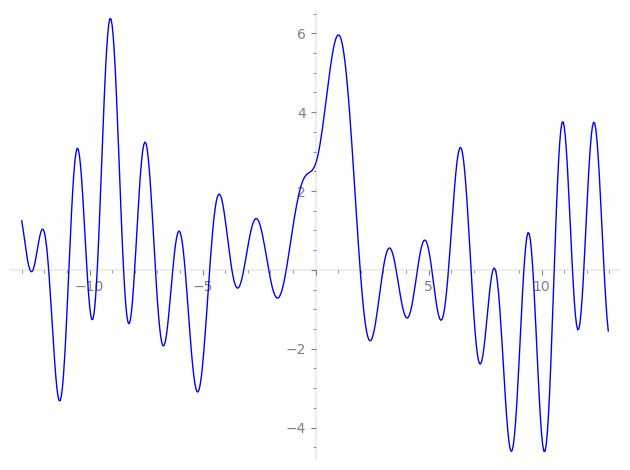
Imaginary part of the first few zeros on the critical line
−8.492983256354153908733258332203, −8.004341240519717366490482681954, −7.08261705564599673406310149259, −6.31755814167346768598822239341, −5.77064229894849840534818780720, −4.68690580150282688541543080152, −3.70136155072711950395071124822, −3.17729361717719435002883016934, −2.07243769762540150934655307291, −1.29761134819807874483044021678,
1.97469728859097428775544188062, 2.98440302451253017930385855239, 3.56470048803015450737519225094, 4.50561676831862212314645338508, 5.14412091144028823143339149971, 5.88047555317088486697345942853, 6.88023291996442280700794576264, 7.84895416691842685415526191096, 7.956198087976874263889304132764, 9.216555426165302211057872334952