| L(s) = 1 | + 1.04e6·2-s + 1.09e12·4-s + 1.82e14·5-s + 1.15e18·8-s + 1.21e19·9-s + 1.90e20·10-s − 1.58e21·13-s + 1.20e24·16-s − 7.56e24·17-s + 1.27e25·18-s + 2.00e26·20-s + 2.40e28·25-s − 1.66e27·26-s − 3.12e29·29-s + 1.26e30·32-s − 7.93e30·34-s + 1.33e31·36-s + 4.38e31·37-s + 2.09e32·40-s − 1.01e32·41-s + 2.21e33·45-s + 6.36e33·49-s + 2.51e34·50-s − 1.74e33·52-s + 8.31e33·53-s − 3.27e35·58-s − 9.00e35·61-s + ⋯ |
| L(s) = 1 | + 2-s + 4-s + 1.90·5-s + 8-s + 9-s + 1.90·10-s − 0.0836·13-s + 16-s − 1.86·17-s + 18-s + 1.90·20-s + 2.64·25-s − 0.0836·26-s − 1.76·29-s + 32-s − 1.86·34-s + 36-s + 1.89·37-s + 1.90·40-s − 0.564·41-s + 1.90·45-s + 49-s + 2.64·50-s − 0.0836·52-s + 0.271·53-s − 1.76·58-s − 1.76·61-s + ⋯ |
\[\begin{aligned}\Lambda(s)=\mathstrut & 4 ^{s/2} \, \Gamma_{\C}(s) \, L(s)\cr =\mathstrut & \, \Lambda(41-s) \end{aligned}\]
\[\begin{aligned}\Lambda(s)=\mathstrut & 4 ^{s/2} \, \Gamma_{\C}(s+20) \, L(s)\cr =\mathstrut & \, \Lambda(1-s) \end{aligned}\]
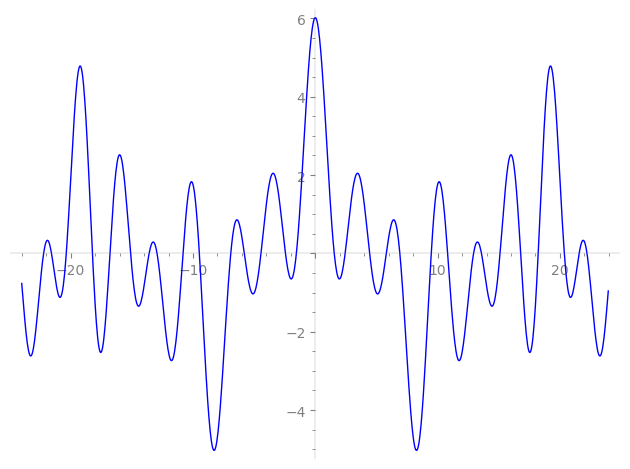
Particular Values
| \(L(\frac{41}{2})\) |
\(\approx\) |
\(6.019841844\) |
| \(L(\frac12)\) |
\(\approx\) |
\(6.019841844\) |
| \(L(21)\) |
|
not available |
| \(L(1)\) |
|
not available |
\(L(s) = \displaystyle \prod_{p} F_p(p^{-s})^{-1} \)
| $p$ | $F_p(T)$ |
|---|
| bad | 2 | \( 1 - p^{20} T \) |
| good | 3 | \( ( 1 - p^{20} T )( 1 + p^{20} T ) \) |
| 5 | \( 1 - 182008936336226 T + p^{40} T^{2} \) |
| 7 | \( ( 1 - p^{20} T )( 1 + p^{20} T ) \) |
| 11 | \( ( 1 - p^{20} T )( 1 + p^{20} T ) \) |
| 13 | \( 1 + \)\(15\!\cdots\!98\)\( T + p^{40} T^{2} \) |
| 17 | \( 1 + \)\(75\!\cdots\!98\)\( T + p^{40} T^{2} \) |
| 19 | \( ( 1 - p^{20} T )( 1 + p^{20} T ) \) |
| 23 | \( ( 1 - p^{20} T )( 1 + p^{20} T ) \) |
| 29 | \( 1 + \)\(31\!\cdots\!98\)\( T + p^{40} T^{2} \) |
| 31 | \( ( 1 - p^{20} T )( 1 + p^{20} T ) \) |
| 37 | \( 1 - \)\(43\!\cdots\!02\)\( T + p^{40} T^{2} \) |
| 41 | \( 1 + \)\(10\!\cdots\!98\)\( T + p^{40} T^{2} \) |
| 43 | \( ( 1 - p^{20} T )( 1 + p^{20} T ) \) |
| 47 | \( ( 1 - p^{20} T )( 1 + p^{20} T ) \) |
| 53 | \( 1 - \)\(83\!\cdots\!02\)\( T + p^{40} T^{2} \) |
| 59 | \( ( 1 - p^{20} T )( 1 + p^{20} T ) \) |
| 61 | \( 1 + \)\(90\!\cdots\!98\)\( T + p^{40} T^{2} \) |
| 67 | \( ( 1 - p^{20} T )( 1 + p^{20} T ) \) |
| 71 | \( ( 1 - p^{20} T )( 1 + p^{20} T ) \) |
| 73 | \( 1 + \)\(78\!\cdots\!98\)\( T + p^{40} T^{2} \) |
| 79 | \( ( 1 - p^{20} T )( 1 + p^{20} T ) \) |
| 83 | \( ( 1 - p^{20} T )( 1 + p^{20} T ) \) |
| 89 | \( 1 + \)\(18\!\cdots\!98\)\( T + p^{40} T^{2} \) |
| 97 | \( 1 + \)\(56\!\cdots\!98\)\( T + p^{40} T^{2} \) |
| show more | |
| show less | |
\(L(s) = \displaystyle\prod_p \ \prod_{j=1}^{2} (1 - \alpha_{j,p}\, p^{-s})^{-1}\)
Imaginary part of the first few zeros on the critical line
−15.10071645420164843860602943696, −13.58432762185632589947283611686, −12.93827376580409946022554224785, −10.81629669774266391295703147051, −9.479302953480549279925497030271, −6.91085190058351716466034964272, −5.80516922006487507015362405912, −4.44203127499654296164370170699, −2.43819820618462919560270824591, −1.54772323106021795024955210109,
1.54772323106021795024955210109, 2.43819820618462919560270824591, 4.44203127499654296164370170699, 5.80516922006487507015362405912, 6.91085190058351716466034964272, 9.479302953480549279925497030271, 10.81629669774266391295703147051, 12.93827376580409946022554224785, 13.58432762185632589947283611686, 15.10071645420164843860602943696