| L(s) = 1 | + (0.955 + 0.294i)3-s + (0.623 − 0.781i)4-s + (0.5 − 0.866i)7-s + (0.826 + 0.563i)9-s + (0.826 − 0.563i)12-s + (−0.0878 − 0.582i)13-s + (−0.222 − 0.974i)16-s + 1.99i·19-s + (0.733 − 0.680i)21-s + (−0.222 + 0.974i)25-s + (0.623 + 0.781i)27-s + (−0.365 − 0.930i)28-s + (−1.26 + 0.496i)31-s + (0.955 − 0.294i)36-s + (−0.988 − 1.71i)37-s + ⋯ |
| L(s) = 1 | + (0.955 + 0.294i)3-s + (0.623 − 0.781i)4-s + (0.5 − 0.866i)7-s + (0.826 + 0.563i)9-s + (0.826 − 0.563i)12-s + (−0.0878 − 0.582i)13-s + (−0.222 − 0.974i)16-s + 1.99i·19-s + (0.733 − 0.680i)21-s + (−0.222 + 0.974i)25-s + (0.623 + 0.781i)27-s + (−0.365 − 0.930i)28-s + (−1.26 + 0.496i)31-s + (0.955 − 0.294i)36-s + (−0.988 − 1.71i)37-s + ⋯ |
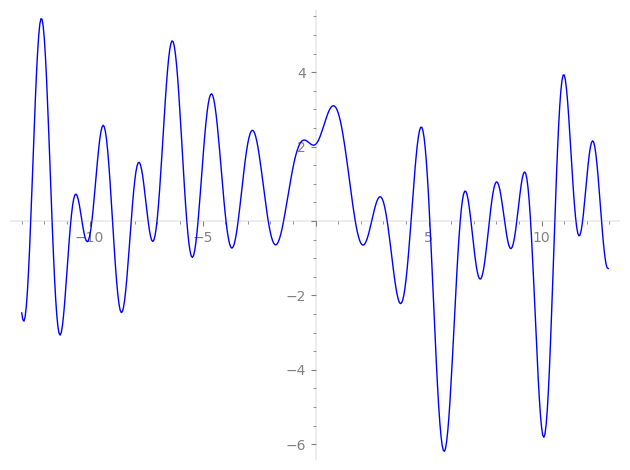
\[\begin{aligned}\Lambda(s)=\mathstrut & 2667 ^{s/2} \, \Gamma_{\C}(s) \, L(s)\cr =\mathstrut & (0.870 + 0.491i)\, \overline{\Lambda}(1-s) \end{aligned}\]
\[\begin{aligned}\Lambda(s)=\mathstrut & 2667 ^{s/2} \, \Gamma_{\C}(s) \, L(s)\cr =\mathstrut & (0.870 + 0.491i)\, \overline{\Lambda}(1-s) \end{aligned}\]
Particular Values
| \(L(\frac{1}{2})\) |
\(\approx\) |
\(2.059647182\) |
| \(L(\frac12)\) |
\(\approx\) |
\(2.059647182\) |
| \(L(1)\) |
|
not available |
| \(L(1)\) |
|
not available |
\(L(s) = \displaystyle \prod_{p} F_p(p^{-s})^{-1} \)
| $p$ | $F_p(T)$ |
|---|
| bad | 3 | \( 1 + (-0.955 - 0.294i)T \) |
| 7 | \( 1 + (-0.5 + 0.866i)T \) |
| 127 | \( 1 + T \) |
| good | 2 | \( 1 + (-0.623 + 0.781i)T^{2} \) |
| 5 | \( 1 + (0.222 - 0.974i)T^{2} \) |
| 11 | \( 1 + (0.988 - 0.149i)T^{2} \) |
| 13 | \( 1 + (0.0878 + 0.582i)T + (-0.955 + 0.294i)T^{2} \) |
| 17 | \( 1 + (-0.733 - 0.680i)T^{2} \) |
| 19 | \( 1 - 1.99iT - T^{2} \) |
| 23 | \( 1 + (-0.988 - 0.149i)T^{2} \) |
| 29 | \( 1 + (0.0747 - 0.997i)T^{2} \) |
| 31 | \( 1 + (1.26 - 0.496i)T + (0.733 - 0.680i)T^{2} \) |
| 37 | \( 1 + (0.988 + 1.71i)T + (-0.5 + 0.866i)T^{2} \) |
| 41 | \( 1 + (-0.733 - 0.680i)T^{2} \) |
| 43 | \( 1 + (0.590 + 0.636i)T + (-0.0747 + 0.997i)T^{2} \) |
| 47 | \( 1 + (-0.222 - 0.974i)T^{2} \) |
| 53 | \( 1 + (0.365 + 0.930i)T^{2} \) |
| 59 | \( 1 + (0.5 - 0.866i)T^{2} \) |
| 61 | \( 1 + (-1.81 + 0.414i)T + (0.900 - 0.433i)T^{2} \) |
| 67 | \( 1 + (0.510 - 1.65i)T + (-0.826 - 0.563i)T^{2} \) |
| 71 | \( 1 + (0.988 + 0.149i)T^{2} \) |
| 73 | \( 1 + (0.488 - 1.01i)T + (-0.623 - 0.781i)T^{2} \) |
| 79 | \( 1 + (-0.0747 + 0.997i)T + (-0.988 - 0.149i)T^{2} \) |
| 83 | \( 1 + (-0.365 - 0.930i)T^{2} \) |
| 89 | \( 1 + (-0.623 + 0.781i)T^{2} \) |
| 97 | \( 1 + (0.326 + 0.302i)T + (0.0747 + 0.997i)T^{2} \) |
| show more | |
| show less | |
\(L(s) = \displaystyle\prod_p \ \prod_{j=1}^{2} (1 - \alpha_{j,p}\, p^{-s})^{-1}\)
Imaginary part of the first few zeros on the critical line
−8.982611230243183867625880843380, −8.156890613850077144131525066144, −7.40820685564210082474645979564, −7.01488597732158010651436069905, −5.69727410682954170975242132664, −5.19806598471911555349919707404, −3.96242099597276756695158081145, −3.42476600940953787754787573145, −2.09383628789787844098234379281, −1.41430514379260358288165571681,
1.75623126789353345235107100646, 2.48345496599041085210459072564, 3.16856046226455469895316787952, 4.22507211035848562099348056333, 5.05552570692376186974154398186, 6.40033906874722124501560455306, 6.87451630518471382518172220879, 7.69024490870102797351443807699, 8.362558857964214397136789034395, 8.902949309770719563166837956431