| L(s) = 1 | + (0.309 − 0.951i)2-s + (−0.309 − 0.951i)3-s + (−0.809 − 0.587i)4-s − 0.999·6-s + (−0.809 + 0.587i)8-s + (−0.809 + 0.587i)9-s + (0.809 − 0.587i)11-s + (−0.309 + 0.951i)12-s + (0.309 + 0.951i)16-s + (0.5 + 1.53i)17-s + (0.309 + 0.951i)18-s + (−0.690 − 0.951i)19-s + (−0.309 − 0.951i)22-s + (0.809 + 0.587i)24-s + (0.809 − 0.587i)25-s + ⋯ |
| L(s) = 1 | + (0.309 − 0.951i)2-s + (−0.309 − 0.951i)3-s + (−0.809 − 0.587i)4-s − 0.999·6-s + (−0.809 + 0.587i)8-s + (−0.809 + 0.587i)9-s + (0.809 − 0.587i)11-s + (−0.309 + 0.951i)12-s + (0.309 + 0.951i)16-s + (0.5 + 1.53i)17-s + (0.309 + 0.951i)18-s + (−0.690 − 0.951i)19-s + (−0.309 − 0.951i)22-s + (0.809 + 0.587i)24-s + (0.809 − 0.587i)25-s + ⋯ |
\[\begin{aligned}\Lambda(s)=\mathstrut & 264 ^{s/2} \, \Gamma_{\C}(s) \, L(s)\cr =\mathstrut & (-0.605 + 0.795i)\, \overline{\Lambda}(1-s) \end{aligned}\]
\[\begin{aligned}\Lambda(s)=\mathstrut & 264 ^{s/2} \, \Gamma_{\C}(s) \, L(s)\cr =\mathstrut & (-0.605 + 0.795i)\, \overline{\Lambda}(1-s) \end{aligned}\]
Particular Values
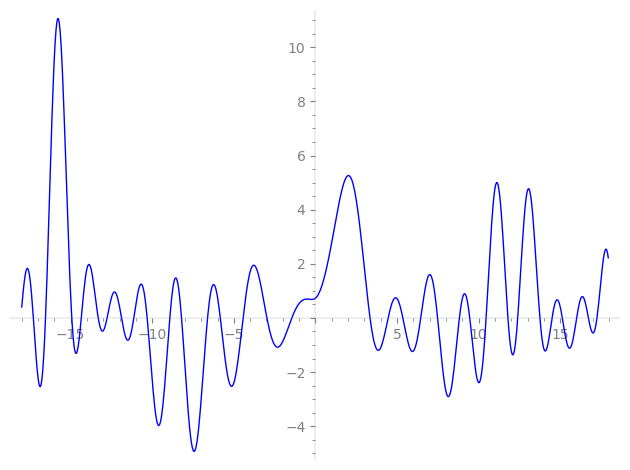
| \(L(\frac{1}{2})\) |
\(\approx\) |
\(0.7301745034\) |
| \(L(\frac12)\) |
\(\approx\) |
\(0.7301745034\) |
| \(L(1)\) |
|
not available |
| \(L(1)\) |
|
not available |
\(L(s) = \displaystyle \prod_{p} F_p(p^{-s})^{-1} \)
| $p$ | $F_p(T)$ |
|---|
| bad | 2 | \( 1 + (-0.309 + 0.951i)T \) |
| 3 | \( 1 + (0.309 + 0.951i)T \) |
| 11 | \( 1 + (-0.809 + 0.587i)T \) |
| good | 5 | \( 1 + (-0.809 + 0.587i)T^{2} \) |
| 7 | \( 1 + (0.309 + 0.951i)T^{2} \) |
| 13 | \( 1 + (-0.809 - 0.587i)T^{2} \) |
| 17 | \( 1 + (-0.5 - 1.53i)T + (-0.809 + 0.587i)T^{2} \) |
| 19 | \( 1 + (0.690 + 0.951i)T + (-0.309 + 0.951i)T^{2} \) |
| 23 | \( 1 + T^{2} \) |
| 29 | \( 1 + (-0.309 - 0.951i)T^{2} \) |
| 31 | \( 1 + (0.809 + 0.587i)T^{2} \) |
| 37 | \( 1 + (-0.309 - 0.951i)T^{2} \) |
| 41 | \( 1 + (0.5 - 0.363i)T + (0.309 - 0.951i)T^{2} \) |
| 43 | \( 1 - 1.90iT - T^{2} \) |
| 47 | \( 1 + (0.309 - 0.951i)T^{2} \) |
| 53 | \( 1 + (-0.809 - 0.587i)T^{2} \) |
| 59 | \( 1 + (0.690 - 0.951i)T + (-0.309 - 0.951i)T^{2} \) |
| 61 | \( 1 + (-0.809 + 0.587i)T^{2} \) |
| 67 | \( 1 + 1.61T + T^{2} \) |
| 71 | \( 1 + (-0.809 + 0.587i)T^{2} \) |
| 73 | \( 1 + (1.11 - 1.53i)T + (-0.309 - 0.951i)T^{2} \) |
| 79 | \( 1 + (-0.809 - 0.587i)T^{2} \) |
| 83 | \( 1 + (-0.190 - 0.587i)T + (-0.809 + 0.587i)T^{2} \) |
| 89 | \( 1 + 1.90iT - T^{2} \) |
| 97 | \( 1 + (0.190 - 0.587i)T + (-0.809 - 0.587i)T^{2} \) |
| show more | |
| show less | |
\(L(s) = \displaystyle\prod_p \ \prod_{j=1}^{2} (1 - \alpha_{j,p}\, p^{-s})^{-1}\)
Imaginary part of the first few zeros on the critical line
−11.88233636631081042980346052000, −11.13075773176848812876408049547, −10.31279379892031441806253012712, −8.923048755984395808721037115802, −8.205302176560563397974406158910, −6.61022323789624614754875095602, −5.82870264069521741180257457460, −4.43237380821548307174074806690, −2.97202891575827748818381179046, −1.44443085697744619131722888894,
3.34783083246382105995178614886, 4.45910169366013068365018126965, 5.36011549215479226791635819887, 6.45624228766588268368982511414, 7.48763754118740587582700584443, 8.824792026872531034906312972503, 9.459606869538502592406388070435, 10.46196037104065699756192326924, 11.79955328584549498905148341959, 12.39877852377842348717901158249