| L(s) = 1 | + (−1.21 − 0.922i)2-s + (−0.468 − 0.883i)3-s + (0.354 + 1.27i)4-s + (0.156 + 0.148i)5-s + (−0.246 + 1.50i)6-s + (0.182 − 0.458i)8-s + (−0.561 + 0.827i)9-s + (−0.0533 − 0.325i)10-s + (−0.719 − 0.432i)11-s + (0.960 − 0.910i)12-s + (0.561 + 0.827i)13-s + (0.0578 − 0.208i)15-s + (0.489 − 0.294i)16-s + (1.44 − 0.486i)18-s + (−0.134 + 0.252i)20-s + ⋯ |
| L(s) = 1 | + (−1.21 − 0.922i)2-s + (−0.468 − 0.883i)3-s + (0.354 + 1.27i)4-s + (0.156 + 0.148i)5-s + (−0.246 + 1.50i)6-s + (0.182 − 0.458i)8-s + (−0.561 + 0.827i)9-s + (−0.0533 − 0.325i)10-s + (−0.719 − 0.432i)11-s + (0.960 − 0.910i)12-s + (0.561 + 0.827i)13-s + (0.0578 − 0.208i)15-s + (0.489 − 0.294i)16-s + (1.44 − 0.486i)18-s + (−0.134 + 0.252i)20-s + ⋯ |
\[\begin{aligned}\Lambda(s)=\mathstrut & 2301 ^{s/2} \, \Gamma_{\C}(s) \, L(s)\cr =\mathstrut & (-0.837 + 0.545i)\, \overline{\Lambda}(1-s) \end{aligned}\]
\[\begin{aligned}\Lambda(s)=\mathstrut & 2301 ^{s/2} \, \Gamma_{\C}(s) \, L(s)\cr =\mathstrut & (-0.837 + 0.545i)\, \overline{\Lambda}(1-s) \end{aligned}\]
Particular Values
| \(L(\frac{1}{2})\) |
\(\approx\) |
\(0.4440606044\) |
| \(L(\frac12)\) |
\(\approx\) |
\(0.4440606044\) |
| \(L(1)\) |
|
not available |
| \(L(1)\) |
|
not available |
\(L(s) = \displaystyle \prod_{p} F_p(p^{-s})^{-1} \)
| $p$ | $F_p(T)$ |
|---|
| bad | 3 | \( 1 + (0.468 + 0.883i)T \) |
| 13 | \( 1 + (-0.561 - 0.827i)T \) |
| 59 | \( 1 + (0.419 + 0.907i)T \) |
| good | 2 | \( 1 + (1.21 + 0.922i)T + (0.267 + 0.963i)T^{2} \) |
| 5 | \( 1 + (-0.156 - 0.148i)T + (0.0541 + 0.998i)T^{2} \) |
| 7 | \( 1 + (0.161 + 0.986i)T^{2} \) |
| 11 | \( 1 + (0.719 + 0.432i)T + (0.468 + 0.883i)T^{2} \) |
| 17 | \( 1 + (0.161 - 0.986i)T^{2} \) |
| 19 | \( 1 + (-0.647 + 0.762i)T^{2} \) |
| 23 | \( 1 + (-0.796 - 0.605i)T^{2} \) |
| 29 | \( 1 + (-0.267 + 0.963i)T^{2} \) |
| 31 | \( 1 + (-0.647 - 0.762i)T^{2} \) |
| 37 | \( 1 + (0.725 - 0.687i)T^{2} \) |
| 41 | \( 1 + (1.14 - 0.386i)T + (0.796 - 0.605i)T^{2} \) |
| 43 | \( 1 + (-1.70 + 1.02i)T + (0.468 - 0.883i)T^{2} \) |
| 47 | \( 1 + (-1.43 + 1.35i)T + (0.0541 - 0.998i)T^{2} \) |
| 53 | \( 1 + (0.947 + 0.319i)T^{2} \) |
| 61 | \( 1 + (1.03 + 0.783i)T + (0.267 + 0.963i)T^{2} \) |
| 67 | \( 1 + (0.725 + 0.687i)T^{2} \) |
| 71 | \( 1 + (-1.28 + 1.21i)T + (0.0541 - 0.998i)T^{2} \) |
| 73 | \( 1 + (-0.907 + 0.419i)T^{2} \) |
| 79 | \( 1 + (0.745 - 1.40i)T + (-0.561 - 0.827i)T^{2} \) |
| 83 | \( 1 + (-1.98 + 0.215i)T + (0.976 - 0.214i)T^{2} \) |
| 89 | \( 1 + (-0.508 + 0.386i)T + (0.267 - 0.963i)T^{2} \) |
| 97 | \( 1 + (-0.907 - 0.419i)T^{2} \) |
| show more | |
| show less | |
\(L(s) = \displaystyle\prod_p \ \prod_{j=1}^{2} (1 - \alpha_{j,p}\, p^{-s})^{-1}\)
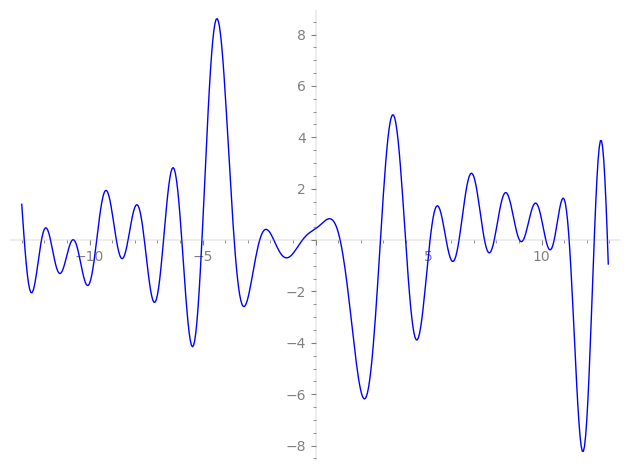
Imaginary part of the first few zeros on the critical line
−8.811997854468538558805148921701, −8.295557056000221252496143770339, −7.57482794553962984064031029669, −6.72648355896864017680683604376, −5.91750221724968976051219487117, −5.02702252569241150607501915860, −3.60106902751985892273572392382, −2.47259889730306654825348077453, −1.84548643053190056248417084446, −0.58261435008293396114345128595,
1.08734708251829554327520940338, 2.86929564420355004986803962674, 3.98279157183081026968394849628, 5.06552883852479066297886287263, 5.77860382333059945198308918847, 6.34749505661967322358194584058, 7.47523175839950637228008319466, 7.903813953103484696549260594014, 9.022789276063857778742024727075, 9.188436485401281519295646952510