| L(s) = 1 | + (−1.62 + 0.977i)2-s + (−0.370 − 0.928i)3-s + (1.21 − 2.29i)4-s + (1.80 − 0.196i)5-s + (1.50 + 1.14i)6-s + (0.163 + 3.01i)8-s + (−0.725 + 0.687i)9-s + (−2.73 + 2.08i)10-s + (−0.181 + 0.267i)11-s + (−2.57 − 0.280i)12-s + (−0.725 − 0.687i)13-s + (−0.850 − 1.60i)15-s + (−1.75 − 2.58i)16-s + (0.507 − 1.82i)18-s + (1.74 − 4.37i)20-s + ⋯ |
| L(s) = 1 | + (−1.62 + 0.977i)2-s + (−0.370 − 0.928i)3-s + (1.21 − 2.29i)4-s + (1.80 − 0.196i)5-s + (1.50 + 1.14i)6-s + (0.163 + 3.01i)8-s + (−0.725 + 0.687i)9-s + (−2.73 + 2.08i)10-s + (−0.181 + 0.267i)11-s + (−2.57 − 0.280i)12-s + (−0.725 − 0.687i)13-s + (−0.850 − 1.60i)15-s + (−1.75 − 2.58i)16-s + (0.507 − 1.82i)18-s + (1.74 − 4.37i)20-s + ⋯ |
\[\begin{aligned}\Lambda(s)=\mathstrut & 2301 ^{s/2} \, \Gamma_{\C}(s) \, L(s)\cr =\mathstrut & (0.826 + 0.562i)\, \overline{\Lambda}(1-s) \end{aligned}\]
\[\begin{aligned}\Lambda(s)=\mathstrut & 2301 ^{s/2} \, \Gamma_{\C}(s) \, L(s)\cr =\mathstrut & (0.826 + 0.562i)\, \overline{\Lambda}(1-s) \end{aligned}\]
Particular Values
| \(L(\frac{1}{2})\) |
\(\approx\) |
\(0.6153999038\) |
| \(L(\frac12)\) |
\(\approx\) |
\(0.6153999038\) |
| \(L(1)\) |
|
not available |
| \(L(1)\) |
|
not available |
\(L(s) = \displaystyle \prod_{p} F_p(p^{-s})^{-1} \)
| $p$ | $F_p(T)$ |
|---|
| bad | 3 | \( 1 + (0.370 + 0.928i)T \) |
| 13 | \( 1 + (0.725 + 0.687i)T \) |
| 59 | \( 1 + (-0.161 - 0.986i)T \) |
| good | 2 | \( 1 + (1.62 - 0.977i)T + (0.468 - 0.883i)T^{2} \) |
| 5 | \( 1 + (-1.80 + 0.196i)T + (0.976 - 0.214i)T^{2} \) |
| 7 | \( 1 + (-0.796 + 0.605i)T^{2} \) |
| 11 | \( 1 + (0.181 - 0.267i)T + (-0.370 - 0.928i)T^{2} \) |
| 17 | \( 1 + (-0.796 - 0.605i)T^{2} \) |
| 19 | \( 1 + (0.947 - 0.319i)T^{2} \) |
| 23 | \( 1 + (0.856 - 0.515i)T^{2} \) |
| 29 | \( 1 + (-0.468 - 0.883i)T^{2} \) |
| 31 | \( 1 + (0.947 + 0.319i)T^{2} \) |
| 37 | \( 1 + (0.994 + 0.108i)T^{2} \) |
| 41 | \( 1 + (-0.458 + 1.65i)T + (-0.856 - 0.515i)T^{2} \) |
| 43 | \( 1 + (1.01 + 1.50i)T + (-0.370 + 0.928i)T^{2} \) |
| 47 | \( 1 + (-1.58 - 0.172i)T + (0.976 + 0.214i)T^{2} \) |
| 53 | \( 1 + (-0.267 - 0.963i)T^{2} \) |
| 61 | \( 1 + (-1.62 + 0.977i)T + (0.468 - 0.883i)T^{2} \) |
| 67 | \( 1 + (0.994 - 0.108i)T^{2} \) |
| 71 | \( 1 + (0.735 + 0.0800i)T + (0.976 + 0.214i)T^{2} \) |
| 73 | \( 1 + (0.161 + 0.986i)T^{2} \) |
| 79 | \( 1 + (-0.634 + 1.59i)T + (-0.725 - 0.687i)T^{2} \) |
| 83 | \( 1 + (1.77 - 0.820i)T + (0.647 - 0.762i)T^{2} \) |
| 89 | \( 1 + (-0.458 - 0.275i)T + (0.468 + 0.883i)T^{2} \) |
| 97 | \( 1 + (0.161 - 0.986i)T^{2} \) |
| show more | |
| show less | |
\(L(s) = \displaystyle\prod_p \ \prod_{j=1}^{2} (1 - \alpha_{j,p}\, p^{-s})^{-1}\)
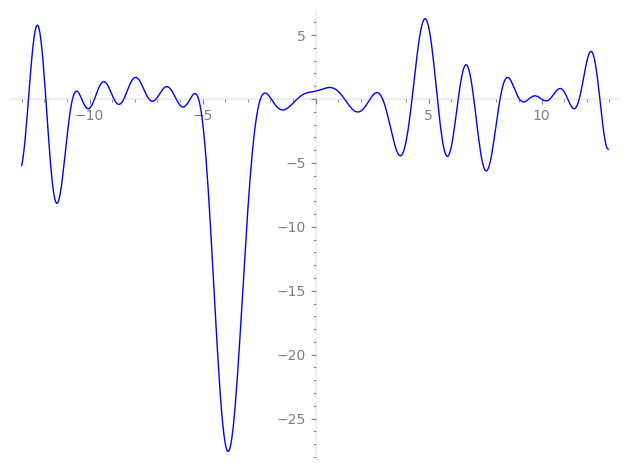
Imaginary part of the first few zeros on the critical line
−8.918991070941151777943206166954, −8.483982446181053206223480560757, −7.37281696210791711521122390846, −7.05596828669358032584027451289, −6.16749685747295588909367641996, −5.54907624119518852853414452101, −5.17633413583893671479491401953, −2.43878346979312741807881372122, −1.96053985997086476163484379457, −0.812753519671678995081308545802,
1.28203858751162548036765692147, 2.41422886693926077264926738794, 2.96485240819683765042621613502, 4.26792105794080554256888062662, 5.39223679054217314818851132787, 6.31199067338298073387406511321, 7.00068341504473923653593413486, 8.162873274232874595756642076034, 9.016448786280580226503334479329, 9.435805175933637675872791607558