| L(s) = 1 | + 2i·2-s + (3.71 + 3.63i)3-s − 4·4-s + 5·5-s + (−7.26 + 7.42i)6-s + (−0.448 − 18.5i)7-s − 8i·8-s + (0.598 + 26.9i)9-s + 10i·10-s + 37.8i·11-s + (−14.8 − 14.5i)12-s + 78.0i·13-s + (37.0 − 0.897i)14-s + (18.5 + 18.1i)15-s + 16·16-s − 28.9·17-s + ⋯ |
| L(s) = 1 | + 0.707i·2-s + (0.714 + 0.699i)3-s − 0.5·4-s + 0.447·5-s + (−0.494 + 0.505i)6-s + (−0.0242 − 0.999i)7-s − 0.353i·8-s + (0.0221 + 0.999i)9-s + 0.316i·10-s + 1.03i·11-s + (−0.357 − 0.349i)12-s + 1.66i·13-s + (0.706 − 0.0171i)14-s + (0.319 + 0.312i)15-s + 0.250·16-s − 0.413·17-s + ⋯ |
\[\begin{aligned}\Lambda(s)=\mathstrut & 210 ^{s/2} \, \Gamma_{\C}(s) \, L(s)\cr =\mathstrut & (-0.731 - 0.681i)\, \overline{\Lambda}(4-s) \end{aligned}\]
\[\begin{aligned}\Lambda(s)=\mathstrut & 210 ^{s/2} \, \Gamma_{\C}(s+3/2) \, L(s)\cr =\mathstrut & (-0.731 - 0.681i)\, \overline{\Lambda}(1-s) \end{aligned}\]
Particular Values
| \(L(2)\) |
\(\approx\) |
\(0.750516 + 1.90646i\) |
| \(L(\frac12)\) |
\(\approx\) |
\(0.750516 + 1.90646i\) |
| \(L(\frac{5}{2})\) |
|
not available |
| \(L(1)\) |
|
not available |
\(L(s) = \displaystyle \prod_{p} F_p(p^{-s})^{-1} \)
| $p$ | $F_p(T)$ |
|---|
| bad | 2 | \( 1 - 2iT \) |
| 3 | \( 1 + (-3.71 - 3.63i)T \) |
| 5 | \( 1 - 5T \) |
| 7 | \( 1 + (0.448 + 18.5i)T \) |
| good | 11 | \( 1 - 37.8iT - 1.33e3T^{2} \) |
| 13 | \( 1 - 78.0iT - 2.19e3T^{2} \) |
| 17 | \( 1 + 28.9T + 4.91e3T^{2} \) |
| 19 | \( 1 - 155. iT - 6.85e3T^{2} \) |
| 23 | \( 1 + 66.2iT - 1.21e4T^{2} \) |
| 29 | \( 1 + 166. iT - 2.43e4T^{2} \) |
| 31 | \( 1 + 62.4iT - 2.97e4T^{2} \) |
| 37 | \( 1 - 216.T + 5.06e4T^{2} \) |
| 41 | \( 1 - 247.T + 6.89e4T^{2} \) |
| 43 | \( 1 - 152.T + 7.95e4T^{2} \) |
| 47 | \( 1 + 133.T + 1.03e5T^{2} \) |
| 53 | \( 1 + 99.0iT - 1.48e5T^{2} \) |
| 59 | \( 1 + 460.T + 2.05e5T^{2} \) |
| 61 | \( 1 + 282. iT - 2.26e5T^{2} \) |
| 67 | \( 1 - 904.T + 3.00e5T^{2} \) |
| 71 | \( 1 + 611. iT - 3.57e5T^{2} \) |
| 73 | \( 1 - 1.02e3iT - 3.89e5T^{2} \) |
| 79 | \( 1 - 27.1T + 4.93e5T^{2} \) |
| 83 | \( 1 - 503.T + 5.71e5T^{2} \) |
| 89 | \( 1 - 129.T + 7.04e5T^{2} \) |
| 97 | \( 1 - 228. iT - 9.12e5T^{2} \) |
| show more | |
| show less | |
\(L(s) = \displaystyle\prod_p \ \prod_{j=1}^{2} (1 - \alpha_{j,p}\, p^{-s})^{-1}\)
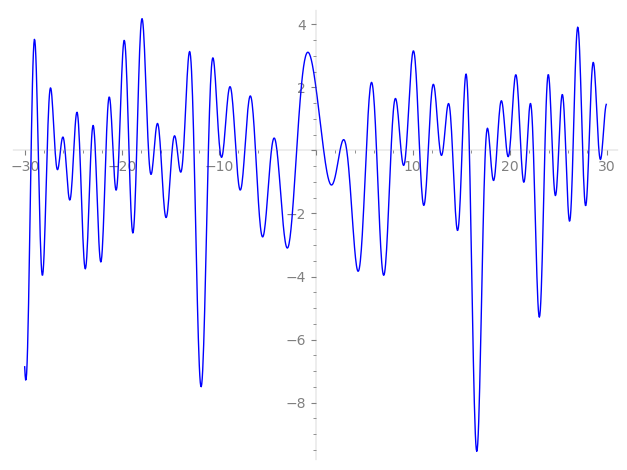
Imaginary part of the first few zeros on the critical line
−12.54705249852787605865188963850, −11.06389723223508677116441456112, −9.872201746198665805972753372101, −9.536528213417863669489701548699, −8.228605179620306398128453904590, −7.31363919794917406590744955706, −6.20782007220254907856398001235, −4.56845401266748500909776153521, −3.99548500863215902026303887595, −1.96750999818397805170643882209,
0.822334679519620070179789740886, 2.50329808598597511878767610528, 3.20048570393306160640303388402, 5.21492895635418817117557711943, 6.27112950215324097633802314248, 7.76356368833596003976350869991, 8.798048869037071213204654019162, 9.310274633852470864728128308360, 10.70902031591403903496785301499, 11.59492434818563152854355353132