| L(s) = 1 | + (0.5 − 0.866i)2-s + (0.5 + 0.866i)3-s + (−0.499 − 0.866i)4-s + (0.866 − 1.5i)5-s + 0.999·6-s + (−0.866 − 0.5i)7-s − 0.999·8-s + (−0.499 + 0.866i)9-s + (−0.866 − 1.5i)10-s + (−0.5 − 0.866i)11-s + (0.499 − 0.866i)12-s + (−0.866 + 0.499i)14-s + 1.73·15-s + (−0.5 + 0.866i)16-s + (0.5 + 0.866i)17-s + (0.499 + 0.866i)18-s + ⋯ |
| L(s) = 1 | + (0.5 − 0.866i)2-s + (0.5 + 0.866i)3-s + (−0.499 − 0.866i)4-s + (0.866 − 1.5i)5-s + 0.999·6-s + (−0.866 − 0.5i)7-s − 0.999·8-s + (−0.499 + 0.866i)9-s + (−0.866 − 1.5i)10-s + (−0.5 − 0.866i)11-s + (0.499 − 0.866i)12-s + (−0.866 + 0.499i)14-s + 1.73·15-s + (−0.5 + 0.866i)16-s + (0.5 + 0.866i)17-s + (0.499 + 0.866i)18-s + ⋯ |
\[\begin{aligned}\Lambda(s)=\mathstrut & 1848 ^{s/2} \, \Gamma_{\C}(s) \, L(s)\cr =\mathstrut & (-0.444 + 0.895i)\, \overline{\Lambda}(1-s) \end{aligned}\]
\[\begin{aligned}\Lambda(s)=\mathstrut & 1848 ^{s/2} \, \Gamma_{\C}(s) \, L(s)\cr =\mathstrut & (-0.444 + 0.895i)\, \overline{\Lambda}(1-s) \end{aligned}\]
Particular Values
| \(L(\frac{1}{2})\) |
\(\approx\) |
\(1.579015054\) |
| \(L(\frac12)\) |
\(\approx\) |
\(1.579015054\) |
| \(L(1)\) |
|
not available |
| \(L(1)\) |
|
not available |
\(L(s) = \displaystyle \prod_{p} F_p(p^{-s})^{-1} \)
| $p$ | $F_p(T)$ |
|---|
| bad | 2 | \( 1 + (-0.5 + 0.866i)T \) |
| 3 | \( 1 + (-0.5 - 0.866i)T \) |
| 7 | \( 1 + (0.866 + 0.5i)T \) |
| 11 | \( 1 + (0.5 + 0.866i)T \) |
| good | 5 | \( 1 + (-0.866 + 1.5i)T + (-0.5 - 0.866i)T^{2} \) |
| 13 | \( 1 + T^{2} \) |
| 17 | \( 1 + (-0.5 - 0.866i)T + (-0.5 + 0.866i)T^{2} \) |
| 19 | \( 1 + (0.5 + 0.866i)T^{2} \) |
| 23 | \( 1 + (-0.866 + 1.5i)T + (-0.5 - 0.866i)T^{2} \) |
| 29 | \( 1 - T^{2} \) |
| 31 | \( 1 + (0.5 - 0.866i)T^{2} \) |
| 37 | \( 1 + (0.5 + 0.866i)T^{2} \) |
| 41 | \( 1 - T + T^{2} \) |
| 43 | \( 1 - T^{2} \) |
| 47 | \( 1 + (0.866 - 1.5i)T + (-0.5 - 0.866i)T^{2} \) |
| 53 | \( 1 + (-0.5 + 0.866i)T^{2} \) |
| 59 | \( 1 + (0.5 - 0.866i)T^{2} \) |
| 61 | \( 1 + (-0.866 + 1.5i)T + (-0.5 - 0.866i)T^{2} \) |
| 67 | \( 1 + (-0.5 - 0.866i)T + (-0.5 + 0.866i)T^{2} \) |
| 71 | \( 1 + T^{2} \) |
| 73 | \( 1 + (0.5 - 0.866i)T^{2} \) |
| 79 | \( 1 + (0.866 - 1.5i)T + (-0.5 - 0.866i)T^{2} \) |
| 83 | \( 1 - T + T^{2} \) |
| 89 | \( 1 + (0.5 + 0.866i)T^{2} \) |
| 97 | \( 1 - T + T^{2} \) |
| show more | |
| show less | |
\(L(s) = \displaystyle\prod_p \ \prod_{j=1}^{2} (1 - \alpha_{j,p}\, p^{-s})^{-1}\)
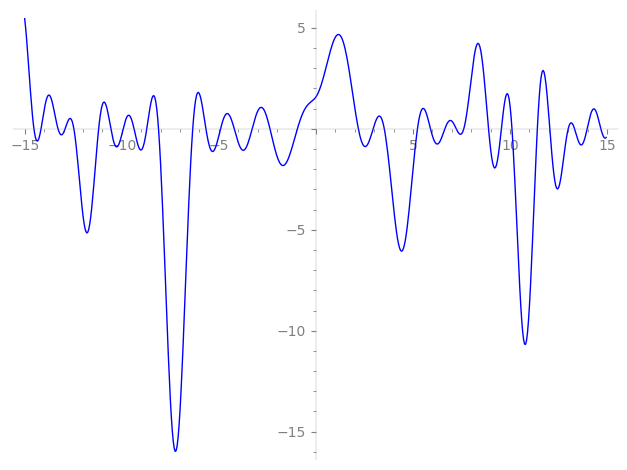
Imaginary part of the first few zeros on the critical line
−9.365726318201083035204532799281, −8.712309785981611836270164721355, −8.106396720002475362052942591738, −6.34415283720117332580091293177, −5.66468528632071186415042876314, −4.91021681320875771222261709778, −4.20473267193311608976039701796, −3.28427308043161759260229441924, −2.36531100860884395627375750114, −0.954544830919603701012845111387,
2.18769429067931693795284223674, 2.94819059192874965927485293625, 3.52306069211554486161030569934, 5.23007625809876241700841557354, 5.90294768203319991174972429883, 6.64277278390667425719398360094, 7.23054557657680227019309722683, 7.61640946023312166364026781759, 8.893349173836755884257979572334, 9.554167104809092943359299141678