| L(s) = 1 | + (−1.70 + 5.39i)2-s + (−26.1 − 18.3i)4-s + 25i·5-s + 101. i·7-s + (143. − 110. i)8-s + (−134. − 42.5i)10-s − 133.·11-s − 368.·13-s + (−546. − 172. i)14-s + (348. + 962. i)16-s − 415. i·17-s + 2.52e3i·19-s + (459. − 654. i)20-s + (227. − 721. i)22-s − 3.09e3·23-s + ⋯ |
| L(s) = 1 | + (−0.301 + 0.953i)2-s + (−0.818 − 0.574i)4-s + 0.447i·5-s + 0.781i·7-s + (0.794 − 0.607i)8-s + (−0.426 − 0.134i)10-s − 0.333·11-s − 0.604·13-s + (−0.745 − 0.235i)14-s + (0.340 + 0.940i)16-s − 0.348i·17-s + 1.60i·19-s + (0.256 − 0.366i)20-s + (0.100 − 0.317i)22-s − 1.22·23-s + ⋯ |
\[\begin{aligned}\Lambda(s)=\mathstrut & 180 ^{s/2} \, \Gamma_{\C}(s) \, L(s)\cr =\mathstrut & (0.336 + 0.941i)\, \overline{\Lambda}(6-s) \end{aligned}\]
\[\begin{aligned}\Lambda(s)=\mathstrut & 180 ^{s/2} \, \Gamma_{\C}(s+5/2) \, L(s)\cr =\mathstrut & (0.336 + 0.941i)\, \overline{\Lambda}(1-s) \end{aligned}\]
Particular Values
| \(L(3)\) |
\(\approx\) |
\(0.1904845587\) |
| \(L(\frac12)\) |
\(\approx\) |
\(0.1904845587\) |
| \(L(\frac{7}{2})\) |
|
not available |
| \(L(1)\) |
|
not available |
\(L(s) = \displaystyle \prod_{p} F_p(p^{-s})^{-1} \)
| $p$ | $F_p(T)$ |
|---|
| bad | 2 | \( 1 + (1.70 - 5.39i)T \) |
| 3 | \( 1 \) |
| 5 | \( 1 - 25iT \) |
| good | 7 | \( 1 - 101. iT - 1.68e4T^{2} \) |
| 11 | \( 1 + 133.T + 1.61e5T^{2} \) |
| 13 | \( 1 + 368.T + 3.71e5T^{2} \) |
| 17 | \( 1 + 415. iT - 1.41e6T^{2} \) |
| 19 | \( 1 - 2.52e3iT - 2.47e6T^{2} \) |
| 23 | \( 1 + 3.09e3T + 6.43e6T^{2} \) |
| 29 | \( 1 + 3.65e3iT - 2.05e7T^{2} \) |
| 31 | \( 1 + 9.13e3iT - 2.86e7T^{2} \) |
| 37 | \( 1 - 3.57e3T + 6.93e7T^{2} \) |
| 41 | \( 1 + 1.29e4iT - 1.15e8T^{2} \) |
| 43 | \( 1 - 3.92e3iT - 1.47e8T^{2} \) |
| 47 | \( 1 + 7.43e3T + 2.29e8T^{2} \) |
| 53 | \( 1 + 2.43e4iT - 4.18e8T^{2} \) |
| 59 | \( 1 + 3.80e3T + 7.14e8T^{2} \) |
| 61 | \( 1 - 2.46e4T + 8.44e8T^{2} \) |
| 67 | \( 1 + 3.91e4iT - 1.35e9T^{2} \) |
| 71 | \( 1 - 1.00e4T + 1.80e9T^{2} \) |
| 73 | \( 1 + 2.18e4T + 2.07e9T^{2} \) |
| 79 | \( 1 - 2.49e4iT - 3.07e9T^{2} \) |
| 83 | \( 1 + 4.70e4T + 3.93e9T^{2} \) |
| 89 | \( 1 + 9.52e4iT - 5.58e9T^{2} \) |
| 97 | \( 1 + 1.43e5T + 8.58e9T^{2} \) |
| show more | |
| show less | |
\(L(s) = \displaystyle\prod_p \ \prod_{j=1}^{2} (1 - \alpha_{j,p}\, p^{-s})^{-1}\)
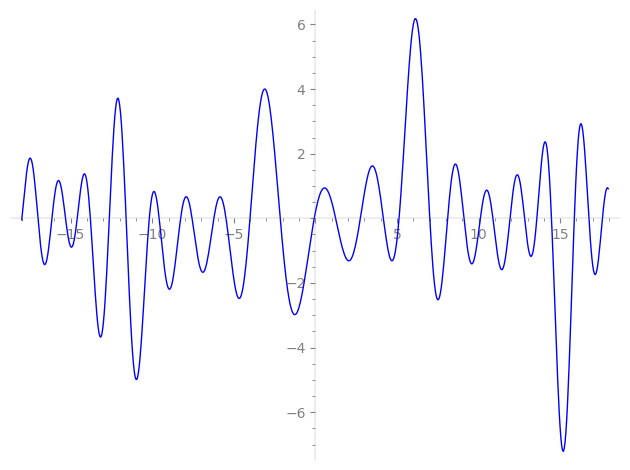
Imaginary part of the first few zeros on the critical line
−11.60281774202190222118488227013, −10.18045932350135619554523300928, −9.577573922531502205862194620534, −8.259743525358619578600734233899, −7.56144328443652978216286111971, −6.22299753568513373421243330256, −5.48005947811268146537229444887, −4.00817376474531328083210319326, −2.15605163745808579790720796901, −0.07149929498400167257969062102,
1.23947415053993523015277853053, 2.75432859232663676946965607364, 4.16435542913432767832986850244, 5.12701617606278602029897112825, 7.00988716039582972601229683492, 8.103883165146562728643451478758, 9.104158034213669046265296024573, 10.11077819604592922367756388461, 10.87897047185490958962252649990, 11.92733450813507225246857329346