| L(s) = 1 | + (1.70 + 5.39i)2-s + (−26.1 + 18.3i)4-s + 25i·5-s − 101. i·7-s + (−143. − 110. i)8-s + (−134. + 42.5i)10-s + 133.·11-s − 368.·13-s + (546. − 172. i)14-s + (348. − 962. i)16-s − 415. i·17-s − 2.52e3i·19-s + (−459. − 654. i)20-s + (227. + 721. i)22-s + 3.09e3·23-s + ⋯ |
| L(s) = 1 | + (0.301 + 0.953i)2-s + (−0.818 + 0.574i)4-s + 0.447i·5-s − 0.781i·7-s + (−0.794 − 0.607i)8-s + (−0.426 + 0.134i)10-s + 0.333·11-s − 0.604·13-s + (0.745 − 0.235i)14-s + (0.340 − 0.940i)16-s − 0.348i·17-s − 1.60i·19-s + (−0.256 − 0.366i)20-s + (0.100 + 0.317i)22-s + 1.22·23-s + ⋯ |
\[\begin{aligned}\Lambda(s)=\mathstrut & 180 ^{s/2} \, \Gamma_{\C}(s) \, L(s)\cr =\mathstrut & (0.999 + 0.00383i)\, \overline{\Lambda}(6-s) \end{aligned}\]
\[\begin{aligned}\Lambda(s)=\mathstrut & 180 ^{s/2} \, \Gamma_{\C}(s+5/2) \, L(s)\cr =\mathstrut & (0.999 + 0.00383i)\, \overline{\Lambda}(1-s) \end{aligned}\]
Particular Values
| \(L(3)\) |
\(\approx\) |
\(1.613033746\) |
| \(L(\frac12)\) |
\(\approx\) |
\(1.613033746\) |
| \(L(\frac{7}{2})\) |
|
not available |
| \(L(1)\) |
|
not available |
\(L(s) = \displaystyle \prod_{p} F_p(p^{-s})^{-1} \)
| $p$ | $F_p(T)$ |
|---|
| bad | 2 | \( 1 + (-1.70 - 5.39i)T \) |
| 3 | \( 1 \) |
| 5 | \( 1 - 25iT \) |
| good | 7 | \( 1 + 101. iT - 1.68e4T^{2} \) |
| 11 | \( 1 - 133.T + 1.61e5T^{2} \) |
| 13 | \( 1 + 368.T + 3.71e5T^{2} \) |
| 17 | \( 1 + 415. iT - 1.41e6T^{2} \) |
| 19 | \( 1 + 2.52e3iT - 2.47e6T^{2} \) |
| 23 | \( 1 - 3.09e3T + 6.43e6T^{2} \) |
| 29 | \( 1 + 3.65e3iT - 2.05e7T^{2} \) |
| 31 | \( 1 - 9.13e3iT - 2.86e7T^{2} \) |
| 37 | \( 1 - 3.57e3T + 6.93e7T^{2} \) |
| 41 | \( 1 + 1.29e4iT - 1.15e8T^{2} \) |
| 43 | \( 1 + 3.92e3iT - 1.47e8T^{2} \) |
| 47 | \( 1 - 7.43e3T + 2.29e8T^{2} \) |
| 53 | \( 1 + 2.43e4iT - 4.18e8T^{2} \) |
| 59 | \( 1 - 3.80e3T + 7.14e8T^{2} \) |
| 61 | \( 1 - 2.46e4T + 8.44e8T^{2} \) |
| 67 | \( 1 - 3.91e4iT - 1.35e9T^{2} \) |
| 71 | \( 1 + 1.00e4T + 1.80e9T^{2} \) |
| 73 | \( 1 + 2.18e4T + 2.07e9T^{2} \) |
| 79 | \( 1 + 2.49e4iT - 3.07e9T^{2} \) |
| 83 | \( 1 - 4.70e4T + 3.93e9T^{2} \) |
| 89 | \( 1 + 9.52e4iT - 5.58e9T^{2} \) |
| 97 | \( 1 + 1.43e5T + 8.58e9T^{2} \) |
| show more | |
| show less | |
\(L(s) = \displaystyle\prod_p \ \prod_{j=1}^{2} (1 - \alpha_{j,p}\, p^{-s})^{-1}\)
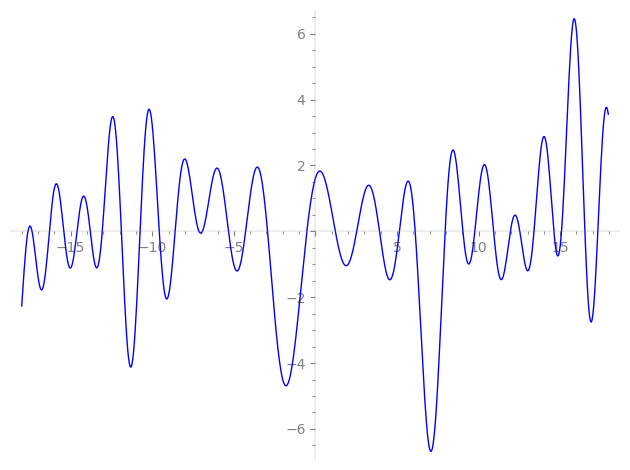
Imaginary part of the first few zeros on the critical line
−11.89165676075874171128045505086, −10.74766447903579836791141928744, −9.569926464156346523500837188161, −8.597091684808096207802038321431, −7.13451278966216203219717451247, −6.92695958995552757625864495271, −5.32753123293670372421499302803, −4.27684334459016804440564790240, −2.93387960064782471396348741959, −0.52382020520989840059955071940,
1.22105753765535627654387812869, 2.53182862474754875790311144881, 3.92949217518624122631435952537, 5.14518658565008590342146652043, 6.11517435641220067372688787723, 7.949068359596085862969393271733, 9.039898217712477375901828693866, 9.770600849183261595775687214897, 10.92131987831345278038063398533, 11.95045663461585925631358224547