| L(s) = 1 | + (5.61 + 0.646i)2-s + (31.1 + 7.26i)4-s + 25i·5-s + 234. i·7-s + (170. + 60.9i)8-s + (−16.1 + 140. i)10-s − 267.·11-s − 1.06e3·13-s + (−151. + 1.31e3i)14-s + (918. + 452. i)16-s − 664. i·17-s − 1.28e3i·19-s + (−181. + 779. i)20-s + (−1.50e3 − 172. i)22-s − 1.25e3·23-s + ⋯ |
| L(s) = 1 | + (0.993 + 0.114i)2-s + (0.973 + 0.226i)4-s + 0.447i·5-s + 1.80i·7-s + (0.941 + 0.336i)8-s + (−0.0510 + 0.444i)10-s − 0.665·11-s − 1.74·13-s + (−0.206 + 1.79i)14-s + (0.897 + 0.441i)16-s − 0.557i·17-s − 0.818i·19-s + (−0.101 + 0.435i)20-s + (−0.661 − 0.0760i)22-s − 0.492·23-s + ⋯ |
\[\begin{aligned}\Lambda(s)=\mathstrut & 180 ^{s/2} \, \Gamma_{\C}(s) \, L(s)\cr =\mathstrut & (-0.664 - 0.747i)\, \overline{\Lambda}(6-s) \end{aligned}\]
\[\begin{aligned}\Lambda(s)=\mathstrut & 180 ^{s/2} \, \Gamma_{\C}(s+5/2) \, L(s)\cr =\mathstrut & (-0.664 - 0.747i)\, \overline{\Lambda}(1-s) \end{aligned}\]
Particular Values
| \(L(3)\) |
\(\approx\) |
\(2.749098448\) |
| \(L(\frac12)\) |
\(\approx\) |
\(2.749098448\) |
| \(L(\frac{7}{2})\) |
|
not available |
| \(L(1)\) |
|
not available |
\(L(s) = \displaystyle \prod_{p} F_p(p^{-s})^{-1} \)
| $p$ | $F_p(T)$ |
|---|
| bad | 2 | \( 1 + (-5.61 - 0.646i)T \) |
| 3 | \( 1 \) |
| 5 | \( 1 - 25iT \) |
| good | 7 | \( 1 - 234. iT - 1.68e4T^{2} \) |
| 11 | \( 1 + 267.T + 1.61e5T^{2} \) |
| 13 | \( 1 + 1.06e3T + 3.71e5T^{2} \) |
| 17 | \( 1 + 664. iT - 1.41e6T^{2} \) |
| 19 | \( 1 + 1.28e3iT - 2.47e6T^{2} \) |
| 23 | \( 1 + 1.25e3T + 6.43e6T^{2} \) |
| 29 | \( 1 - 3.16e3iT - 2.05e7T^{2} \) |
| 31 | \( 1 - 7.31e3iT - 2.86e7T^{2} \) |
| 37 | \( 1 - 7.45e3T + 6.93e7T^{2} \) |
| 41 | \( 1 - 1.68e4iT - 1.15e8T^{2} \) |
| 43 | \( 1 + 9.06e3iT - 1.47e8T^{2} \) |
| 47 | \( 1 - 2.47e4T + 2.29e8T^{2} \) |
| 53 | \( 1 - 9.85e3iT - 4.18e8T^{2} \) |
| 59 | \( 1 - 3.69e4T + 7.14e8T^{2} \) |
| 61 | \( 1 + 9.08e3T + 8.44e8T^{2} \) |
| 67 | \( 1 + 1.05e4iT - 1.35e9T^{2} \) |
| 71 | \( 1 - 4.12e4T + 1.80e9T^{2} \) |
| 73 | \( 1 + 8.41e4T + 2.07e9T^{2} \) |
| 79 | \( 1 - 1.84e4iT - 3.07e9T^{2} \) |
| 83 | \( 1 - 4.86e4T + 3.93e9T^{2} \) |
| 89 | \( 1 - 1.07e5iT - 5.58e9T^{2} \) |
| 97 | \( 1 - 1.62e5T + 8.58e9T^{2} \) |
| show more | |
| show less | |
\(L(s) = \displaystyle\prod_p \ \prod_{j=1}^{2} (1 - \alpha_{j,p}\, p^{-s})^{-1}\)
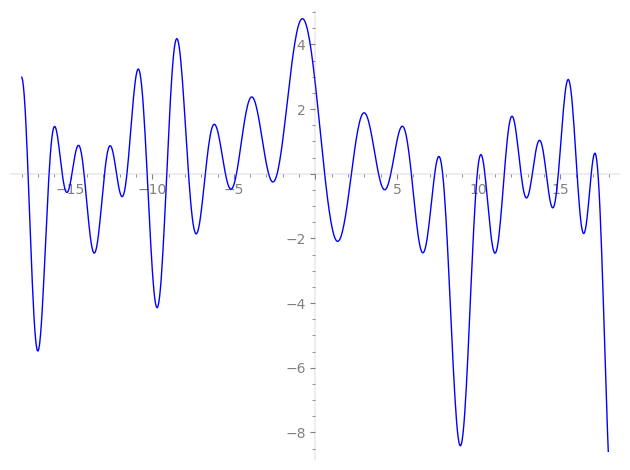
Imaginary part of the first few zeros on the critical line
−12.18786462089879091732494623637, −11.55162004971045464890036765564, −10.31311017392561142708666537084, −9.110936643904827850061265407046, −7.77796822677736009428563205554, −6.74615518509125028021875728411, −5.51506606804201264710056693803, −4.83878878061731209455261660648, −2.86675525592129454281361201849, −2.34596424193647920006262683948,
0.56622259929484830563270529443, 2.20633878333229780789099433671, 3.86871355653809587777317769919, 4.62089281040208406522893222502, 5.88024990571960586606665258763, 7.31271384584122654003773332828, 7.79881244108149253114503174727, 9.921104103719466002771737519727, 10.38554417584028942277093061684, 11.57623723693854235275511482686