| L(s) = 1 | + (−0.713 − 2.73i)2-s − 3i·3-s + (−6.98 + 3.90i)4-s − 14.5·5-s + (−8.21 + 2.13i)6-s + (11.7 + 14.3i)7-s + (15.6 + 16.3i)8-s − 9·9-s + (10.3 + 39.8i)10-s − 28.6·11-s + (11.7 + 20.9i)12-s + 83.2·13-s + (30.8 − 42.3i)14-s + 43.6i·15-s + (33.5 − 54.5i)16-s + 27.2i·17-s + ⋯ |
| L(s) = 1 | + (−0.252 − 0.967i)2-s − 0.577i·3-s + (−0.872 + 0.487i)4-s − 1.30·5-s + (−0.558 + 0.145i)6-s + (0.633 + 0.773i)7-s + (0.692 + 0.721i)8-s − 0.333·9-s + (0.328 + 1.26i)10-s − 0.784·11-s + (0.281 + 0.503i)12-s + 1.77·13-s + (0.589 − 0.807i)14-s + 0.752i·15-s + (0.523 − 0.851i)16-s + 0.388i·17-s + ⋯ |
\[\begin{aligned}\Lambda(s)=\mathstrut & 168 ^{s/2} \, \Gamma_{\C}(s) \, L(s)\cr =\mathstrut & (0.992 + 0.120i)\, \overline{\Lambda}(4-s) \end{aligned}\]
\[\begin{aligned}\Lambda(s)=\mathstrut & 168 ^{s/2} \, \Gamma_{\C}(s+3/2) \, L(s)\cr =\mathstrut & (0.992 + 0.120i)\, \overline{\Lambda}(1-s) \end{aligned}\]
Particular Values
| \(L(2)\) |
\(\approx\) |
\(0.920164 - 0.0555442i\) |
| \(L(\frac12)\) |
\(\approx\) |
\(0.920164 - 0.0555442i\) |
| \(L(\frac{5}{2})\) |
|
not available |
| \(L(1)\) |
|
not available |
\(L(s) = \displaystyle \prod_{p} F_p(p^{-s})^{-1} \)
| $p$ | $F_p(T)$ |
|---|
| bad | 2 | \( 1 + (0.713 + 2.73i)T \) |
| 3 | \( 1 + 3iT \) |
| 7 | \( 1 + (-11.7 - 14.3i)T \) |
| good | 5 | \( 1 + 14.5T + 125T^{2} \) |
| 11 | \( 1 + 28.6T + 1.33e3T^{2} \) |
| 13 | \( 1 - 83.2T + 2.19e3T^{2} \) |
| 17 | \( 1 - 27.2iT - 4.91e3T^{2} \) |
| 19 | \( 1 + 62.8iT - 6.85e3T^{2} \) |
| 23 | \( 1 - 200. iT - 1.21e4T^{2} \) |
| 29 | \( 1 + 32.4iT - 2.43e4T^{2} \) |
| 31 | \( 1 - 51.2T + 2.97e4T^{2} \) |
| 37 | \( 1 - 353. iT - 5.06e4T^{2} \) |
| 41 | \( 1 - 83.7iT - 6.89e4T^{2} \) |
| 43 | \( 1 - 535.T + 7.95e4T^{2} \) |
| 47 | \( 1 - 411.T + 1.03e5T^{2} \) |
| 53 | \( 1 - 210. iT - 1.48e5T^{2} \) |
| 59 | \( 1 - 103. iT - 2.05e5T^{2} \) |
| 61 | \( 1 + 425.T + 2.26e5T^{2} \) |
| 67 | \( 1 + 796.T + 3.00e5T^{2} \) |
| 71 | \( 1 - 175. iT - 3.57e5T^{2} \) |
| 73 | \( 1 - 1.03e3iT - 3.89e5T^{2} \) |
| 79 | \( 1 - 273. iT - 4.93e5T^{2} \) |
| 83 | \( 1 + 486. iT - 5.71e5T^{2} \) |
| 89 | \( 1 + 267. iT - 7.04e5T^{2} \) |
| 97 | \( 1 - 603. iT - 9.12e5T^{2} \) |
| show more | |
| show less | |
\(L(s) = \displaystyle\prod_p \ \prod_{j=1}^{2} (1 - \alpha_{j,p}\, p^{-s})^{-1}\)
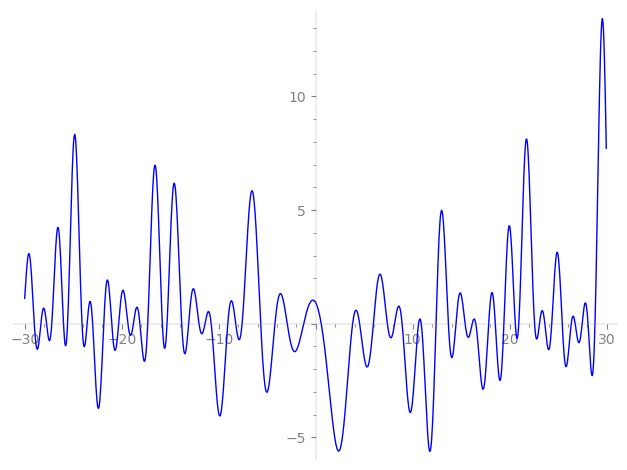
Imaginary part of the first few zeros on the critical line
−12.02951522489350622799900752618, −11.41344133801992869015453444450, −10.77432885799286818035086544631, −9.063569334792307810126492895042, −8.245990625666270696696618095607, −7.59012605208698101257981295862, −5.67349008028262511423003141369, −4.20485807962325644974606527664, −2.93701128803171164962742106483, −1.24477235052606891534492672562,
0.56546938713491209772727603313, 3.80457301355176768299420575172, 4.52594278322870194913023956846, 5.94188402519180887333109082556, 7.38415756974457601430411785993, 8.132291855909239229252454238132, 8.905528310148029483248876209598, 10.60233435197859908404748089159, 10.87237117044954111981173408662, 12.40037710819422341574064047341