| L(s) = 1 | + (−0.895 + 1.09i)2-s + (−0.395 − 1.96i)4-s + (2.49 + 1.32i)8-s + (1.5 + 2.59i)9-s + (4.58 + 2.64i)11-s + (−3.68 + 1.55i)16-s + (−4.18 − 0.685i)18-s + (−6.99 + 2.64i)22-s + (4.58 − 2.64i)23-s + (−2.5 + 4.33i)25-s − 2·29-s + (1.60 − 5.42i)32-s + (4.49 − 3.96i)36-s + (−3 − 5.19i)37-s − 5.29i·43-s + (3.37 − 10.0i)44-s + ⋯ |
| L(s) = 1 | + (−0.633 + 0.773i)2-s + (−0.197 − 0.980i)4-s + (0.883 + 0.467i)8-s + (0.5 + 0.866i)9-s + (1.38 + 0.797i)11-s + (−0.921 + 0.387i)16-s + (−0.986 − 0.161i)18-s + (−1.49 + 0.564i)22-s + (0.955 − 0.551i)23-s + (−0.5 + 0.866i)25-s − 0.371·29-s + (0.283 − 0.958i)32-s + (0.749 − 0.661i)36-s + (−0.493 − 0.854i)37-s − 0.806i·43-s + (0.508 − 1.51i)44-s + ⋯ |
\[\begin{aligned}\Lambda(s)=\mathstrut & 196 ^{s/2} \, \Gamma_{\C}(s) \, L(s)\cr =\mathstrut & (0.378 - 0.925i)\, \overline{\Lambda}(2-s) \end{aligned}\]
\[\begin{aligned}\Lambda(s)=\mathstrut & 196 ^{s/2} \, \Gamma_{\C}(s+1/2) \, L(s)\cr =\mathstrut & (0.378 - 0.925i)\, \overline{\Lambda}(1-s) \end{aligned}\]
Particular Values
| \(L(1)\) |
\(\approx\) |
\(0.767031 + 0.515214i\) |
| \(L(\frac12)\) |
\(\approx\) |
\(0.767031 + 0.515214i\) |
| \(L(\frac{3}{2})\) |
|
not available |
| \(L(1)\) |
|
not available |
\(L(s) = \displaystyle \prod_{p} F_p(p^{-s})^{-1} \)
| $p$ | $F_p(T)$ |
|---|
| bad | 2 | \( 1 + (0.895 - 1.09i)T \) |
| 7 | \( 1 \) |
| good | 3 | \( 1 + (-1.5 - 2.59i)T^{2} \) |
| 5 | \( 1 + (2.5 - 4.33i)T^{2} \) |
| 11 | \( 1 + (-4.58 - 2.64i)T + (5.5 + 9.52i)T^{2} \) |
| 13 | \( 1 - 13T^{2} \) |
| 17 | \( 1 + (8.5 + 14.7i)T^{2} \) |
| 19 | \( 1 + (-9.5 + 16.4i)T^{2} \) |
| 23 | \( 1 + (-4.58 + 2.64i)T + (11.5 - 19.9i)T^{2} \) |
| 29 | \( 1 + 2T + 29T^{2} \) |
| 31 | \( 1 + (-15.5 - 26.8i)T^{2} \) |
| 37 | \( 1 + (3 + 5.19i)T + (-18.5 + 32.0i)T^{2} \) |
| 41 | \( 1 - 41T^{2} \) |
| 43 | \( 1 + 5.29iT - 43T^{2} \) |
| 47 | \( 1 + (-23.5 + 40.7i)T^{2} \) |
| 53 | \( 1 + (-5 + 8.66i)T + (-26.5 - 45.8i)T^{2} \) |
| 59 | \( 1 + (-29.5 - 51.0i)T^{2} \) |
| 61 | \( 1 + (30.5 - 52.8i)T^{2} \) |
| 67 | \( 1 + (13.7 + 7.93i)T + (33.5 + 58.0i)T^{2} \) |
| 71 | \( 1 - 5.29iT - 71T^{2} \) |
| 73 | \( 1 + (36.5 + 63.2i)T^{2} \) |
| 79 | \( 1 + (13.7 - 7.93i)T + (39.5 - 68.4i)T^{2} \) |
| 83 | \( 1 + 83T^{2} \) |
| 89 | \( 1 + (44.5 - 77.0i)T^{2} \) |
| 97 | \( 1 - 97T^{2} \) |
| show more | |
| show less | |
\(L(s) = \displaystyle\prod_p \ \prod_{j=1}^{2} (1 - \alpha_{j,p}\, p^{-s})^{-1}\)
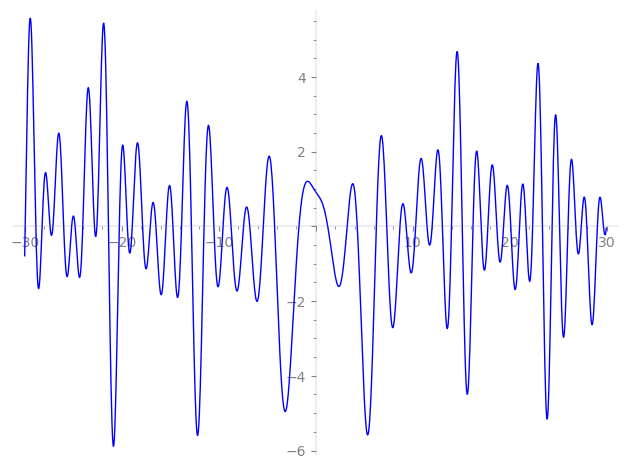
Imaginary part of the first few zeros on the critical line
−12.81471602609523602339860749154, −11.50877349618274784214652833200, −10.50327735275171279047341053341, −9.551978801375808694968419197358, −8.719858549194704313227725266593, −7.44159961406715001642149827690, −6.79721347299415402208623122425, −5.40592446642738935757152614136, −4.23739907177150787592050740914, −1.72936483391171059479635891350,
1.23845354689855811952550514282, 3.23756362214674834415442174929, 4.27950580911791396004361692953, 6.24717727928567446695323503089, 7.32128405161204637453610980480, 8.681365177359837863344972974138, 9.317930915324724375829408442346, 10.29868440891307741296997628749, 11.47526629447669567014353971579, 12.00264385996560793849805593791