| L(s) = 1 | + (1.13 − 1.96i)3-s + (−0.581 − 1.00i)5-s + (2.58 + 0.547i)7-s + (−1.08 − 1.87i)9-s + (−2.45 + 4.24i)11-s + 13-s − 2.64·15-s + (2.21 − 3.84i)17-s + (−3.17 − 5.49i)19-s + (4.01 − 4.47i)21-s + (−3.30 − 5.71i)23-s + (1.82 − 3.15i)25-s + 1.89·27-s + 5.27·29-s + (2.13 − 3.70i)31-s + ⋯ |
| L(s) = 1 | + (0.655 − 1.13i)3-s + (−0.260 − 0.450i)5-s + (0.978 + 0.206i)7-s + (−0.360 − 0.624i)9-s + (−0.739 + 1.28i)11-s + 0.277·13-s − 0.682·15-s + (0.537 − 0.931i)17-s + (−0.727 − 1.25i)19-s + (0.876 − 0.975i)21-s + (−0.688 − 1.19i)23-s + (0.364 − 0.631i)25-s + 0.365·27-s + 0.979·29-s + (0.383 − 0.664i)31-s + ⋯ |
\[\begin{aligned}\Lambda(s)=\mathstrut & 1456 ^{s/2} \, \Gamma_{\C}(s) \, L(s)\cr =\mathstrut & (-0.268 + 0.963i)\, \overline{\Lambda}(2-s) \end{aligned}\]
\[\begin{aligned}\Lambda(s)=\mathstrut & 1456 ^{s/2} \, \Gamma_{\C}(s+1/2) \, L(s)\cr =\mathstrut & (-0.268 + 0.963i)\, \overline{\Lambda}(1-s) \end{aligned}\]
Particular Values
| \(L(1)\) |
\(\approx\) |
\(2.089599717\) |
| \(L(\frac12)\) |
\(\approx\) |
\(2.089599717\) |
| \(L(\frac{3}{2})\) |
|
not available |
| \(L(1)\) |
|
not available |
\(L(s) = \displaystyle \prod_{p} F_p(p^{-s})^{-1} \)
| $p$ | $F_p(T)$ |
|---|
| bad | 2 | \( 1 \) |
| 7 | \( 1 + (-2.58 - 0.547i)T \) |
| 13 | \( 1 - T \) |
| good | 3 | \( 1 + (-1.13 + 1.96i)T + (-1.5 - 2.59i)T^{2} \) |
| 5 | \( 1 + (0.581 + 1.00i)T + (-2.5 + 4.33i)T^{2} \) |
| 11 | \( 1 + (2.45 - 4.24i)T + (-5.5 - 9.52i)T^{2} \) |
| 17 | \( 1 + (-2.21 + 3.84i)T + (-8.5 - 14.7i)T^{2} \) |
| 19 | \( 1 + (3.17 + 5.49i)T + (-9.5 + 16.4i)T^{2} \) |
| 23 | \( 1 + (3.30 + 5.71i)T + (-11.5 + 19.9i)T^{2} \) |
| 29 | \( 1 - 5.27T + 29T^{2} \) |
| 31 | \( 1 + (-2.13 + 3.70i)T + (-15.5 - 26.8i)T^{2} \) |
| 37 | \( 1 + (4.04 + 6.99i)T + (-18.5 + 32.0i)T^{2} \) |
| 41 | \( 1 - 2.37T + 41T^{2} \) |
| 43 | \( 1 - 0.891T + 43T^{2} \) |
| 47 | \( 1 + (1.45 + 2.51i)T + (-23.5 + 40.7i)T^{2} \) |
| 53 | \( 1 + (0.132 - 0.228i)T + (-26.5 - 45.8i)T^{2} \) |
| 59 | \( 1 + (4.78 - 8.27i)T + (-29.5 - 51.0i)T^{2} \) |
| 61 | \( 1 + (-3.39 - 5.88i)T + (-30.5 + 52.8i)T^{2} \) |
| 67 | \( 1 + (7.53 - 13.0i)T + (-33.5 - 58.0i)T^{2} \) |
| 71 | \( 1 + 11.8T + 71T^{2} \) |
| 73 | \( 1 + (-4.59 + 7.95i)T + (-36.5 - 63.2i)T^{2} \) |
| 79 | \( 1 + (3.58 + 6.20i)T + (-39.5 + 68.4i)T^{2} \) |
| 83 | \( 1 - 5.79T + 83T^{2} \) |
| 89 | \( 1 + (-2.87 - 4.98i)T + (-44.5 + 77.0i)T^{2} \) |
| 97 | \( 1 - 13.5T + 97T^{2} \) |
| show more | |
| show less | |
\(L(s) = \displaystyle\prod_p \ \prod_{j=1}^{2} (1 - \alpha_{j,p}\, p^{-s})^{-1}\)
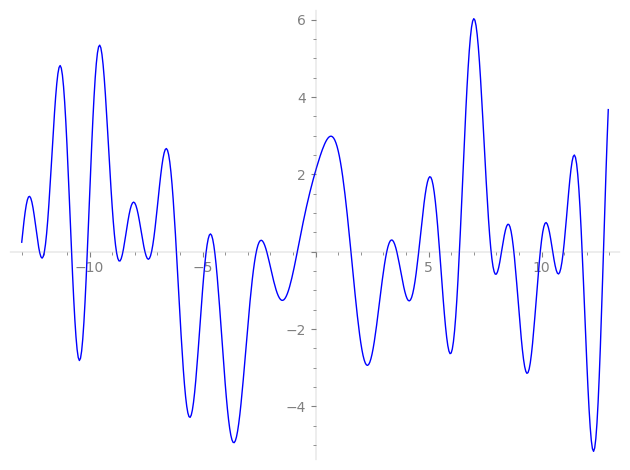
Imaginary part of the first few zeros on the critical line
−8.810455371834515723680525040632, −8.522037940446262481269283647461, −7.54864004371611746411320689671, −7.25516424993418369294051798511, −6.15560933841345014876092990709, −4.84046375019317200111914854393, −4.46320720534400357212396496153, −2.62162227976436159296275203207, −2.16056544939535776130220484710, −0.807172355473882261693297176276,
1.56522869393538940469566378093, 3.14943553230145697410700670824, 3.59377558346087095353773546962, 4.56299240829525400316364049796, 5.49035629439307843631985737971, 6.36410299719600686604244600144, 7.76645361216016046395756539410, 8.228085770942407173087560868540, 8.772675384353414479651596447049, 9.941936390553422231455548215427