| L(s) = 1 | − 0.712·3-s + 7.86i·7-s − 8.49·9-s + (2.47 − 10.7i)11-s + 1.76i·13-s + 15.1i·17-s − 3.61i·19-s − 5.60i·21-s − 10.7·23-s + 12.4·27-s − 26.5i·29-s − 21.3·31-s + (−1.76 + 7.64i)33-s − 1.48·37-s − 1.25i·39-s + ⋯ |
| L(s) = 1 | − 0.237·3-s + 1.12i·7-s − 0.943·9-s + (0.225 − 0.974i)11-s + 0.135i·13-s + 0.888i·17-s − 0.190i·19-s − 0.267i·21-s − 0.465·23-s + 0.461·27-s − 0.916i·29-s − 0.690·31-s + (−0.0535 + 0.231i)33-s − 0.0400·37-s − 0.0322i·39-s + ⋯ |
\[\begin{aligned}\Lambda(s)=\mathstrut & 1100 ^{s/2} \, \Gamma_{\C}(s) \, L(s)\cr =\mathstrut & (-0.225 + 0.974i)\, \overline{\Lambda}(3-s) \end{aligned}\]
\[\begin{aligned}\Lambda(s)=\mathstrut & 1100 ^{s/2} \, \Gamma_{\C}(s+1) \, L(s)\cr =\mathstrut & (-0.225 + 0.974i)\, \overline{\Lambda}(1-s) \end{aligned}\]
Particular Values
| \(L(\frac{3}{2})\) |
\(\approx\) |
\(0.7161647130\) |
| \(L(\frac12)\) |
\(\approx\) |
\(0.7161647130\) |
| \(L(2)\) |
|
not available |
| \(L(1)\) |
|
not available |
\(L(s) = \displaystyle \prod_{p} F_p(p^{-s})^{-1} \)
| $p$ | $F_p(T)$ |
|---|
| bad | 2 | \( 1 \) |
| 5 | \( 1 \) |
| 11 | \( 1 + (-2.47 + 10.7i)T \) |
| good | 3 | \( 1 + 0.712T + 9T^{2} \) |
| 7 | \( 1 - 7.86iT - 49T^{2} \) |
| 13 | \( 1 - 1.76iT - 169T^{2} \) |
| 17 | \( 1 - 15.1iT - 289T^{2} \) |
| 19 | \( 1 + 3.61iT - 361T^{2} \) |
| 23 | \( 1 + 10.7T + 529T^{2} \) |
| 29 | \( 1 + 26.5iT - 841T^{2} \) |
| 31 | \( 1 + 21.3T + 961T^{2} \) |
| 37 | \( 1 + 1.48T + 1.36e3T^{2} \) |
| 41 | \( 1 + 23.4iT - 1.68e3T^{2} \) |
| 43 | \( 1 + 60.3iT - 1.84e3T^{2} \) |
| 47 | \( 1 - 1.97T + 2.20e3T^{2} \) |
| 53 | \( 1 - 16.5T + 2.80e3T^{2} \) |
| 59 | \( 1 - 78.3T + 3.48e3T^{2} \) |
| 61 | \( 1 + 27.2iT - 3.72e3T^{2} \) |
| 67 | \( 1 + 56.0T + 4.48e3T^{2} \) |
| 71 | \( 1 + 41.7T + 5.04e3T^{2} \) |
| 73 | \( 1 + 106. iT - 5.32e3T^{2} \) |
| 79 | \( 1 - 89.4iT - 6.24e3T^{2} \) |
| 83 | \( 1 + 132. iT - 6.88e3T^{2} \) |
| 89 | \( 1 + 59.5T + 7.92e3T^{2} \) |
| 97 | \( 1 + 46.9T + 9.40e3T^{2} \) |
| show more | |
| show less | |
\(L(s) = \displaystyle\prod_p \ \prod_{j=1}^{2} (1 - \alpha_{j,p}\, p^{-s})^{-1}\)
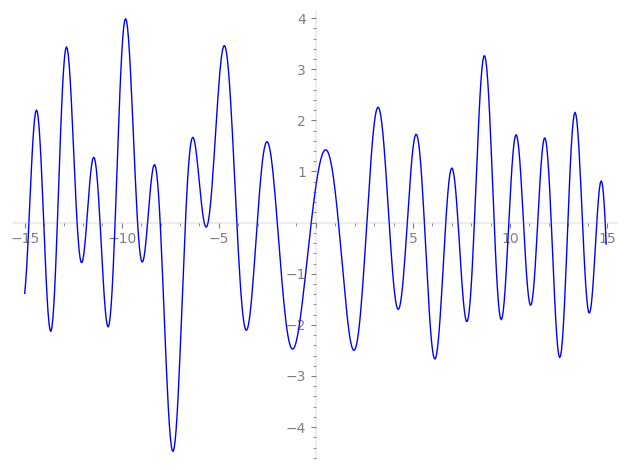
Imaginary part of the first few zeros on the critical line
−9.184504366453430233893646984934, −8.668518023857641608033156631926, −8.021621011037448446258846188739, −6.72133449423971607899482884832, −5.75408973128781997510742985150, −5.55407761932898865269949720546, −4.07243616213132952728533763706, −3.02163214914010747775416127523, −1.98811110003249855022817966545, −0.24084848063455514285839829092,
1.16185356376559665454435946158, 2.62428309111375672287975666144, 3.77439557335367413989705717244, 4.70703049539196078602819002296, 5.58662564763801690186594834609, 6.68885468441161160950452272195, 7.32237965030068615240824455351, 8.162539845601788680981196791253, 9.183163763729057747177913729884, 9.937059664630170506141502034207