| L(s) = 1 | + (−0.707 − 1.22i)2-s + (−0.999 + 1.73i)4-s + (−3.27 + 1.89i)5-s + (0.548 − 2.58i)7-s + 2.82·8-s + (1.5 + 2.59i)9-s + (4.63 + 2.67i)10-s + (−3.55 + 1.15i)14-s + (−2.00 − 3.46i)16-s + (3.57 + 2.06i)17-s + (2.12 − 3.67i)18-s + (−5.69 + 3.28i)19-s − 7.56i·20-s + (−3.92 − 6.79i)23-s + (4.65 − 8.06i)25-s + ⋯ |
| L(s) = 1 | + (−0.499 − 0.866i)2-s + (−0.499 + 0.866i)4-s + (−1.46 + 0.845i)5-s + (0.207 − 0.978i)7-s + 0.999·8-s + (0.5 + 0.866i)9-s + (1.46 + 0.845i)10-s + (−0.950 + 0.309i)14-s + (−0.500 − 0.866i)16-s + (0.866 + 0.499i)17-s + (0.499 − 0.866i)18-s + (−1.30 + 0.753i)19-s − 1.69i·20-s + (−0.817 − 1.41i)23-s + (0.931 − 1.61i)25-s + ⋯ |
\[\begin{aligned}\Lambda(s)=\mathstrut & 952 ^{s/2} \, \Gamma_{\C}(s) \, L(s)\cr =\mathstrut & (-0.996 - 0.0818i)\, \overline{\Lambda}(2-s) \end{aligned}\]
\[\begin{aligned}\Lambda(s)=\mathstrut & 952 ^{s/2} \, \Gamma_{\C}(s+1/2) \, L(s)\cr =\mathstrut & (-0.996 - 0.0818i)\, \overline{\Lambda}(1-s) \end{aligned}\]
Particular Values
| \(L(1)\) |
\(\approx\) |
\(0.00677387 + 0.165267i\) |
| \(L(\frac12)\) |
\(\approx\) |
\(0.00677387 + 0.165267i\) |
| \(L(\frac{3}{2})\) |
|
not available |
| \(L(1)\) |
|
not available |
\(L(s) = \displaystyle \prod_{p} F_p(p^{-s})^{-1} \)
| $p$ | $F_p(T)$ |
|---|
| bad | 2 | \( 1 + (0.707 + 1.22i)T \) |
| 7 | \( 1 + (-0.548 + 2.58i)T \) |
| 17 | \( 1 + (-3.57 - 2.06i)T \) |
| good | 3 | \( 1 + (-1.5 - 2.59i)T^{2} \) |
| 5 | \( 1 + (3.27 - 1.89i)T + (2.5 - 4.33i)T^{2} \) |
| 11 | \( 1 + (5.5 + 9.52i)T^{2} \) |
| 13 | \( 1 + 13T^{2} \) |
| 19 | \( 1 + (5.69 - 3.28i)T + (9.5 - 16.4i)T^{2} \) |
| 23 | \( 1 + (3.92 + 6.79i)T + (-11.5 + 19.9i)T^{2} \) |
| 29 | \( 1 - 7.97T + 29T^{2} \) |
| 31 | \( 1 + (5.43 + 3.13i)T + (15.5 + 26.8i)T^{2} \) |
| 37 | \( 1 + (2.74 + 4.75i)T + (-18.5 + 32.0i)T^{2} \) |
| 41 | \( 1 + 41T^{2} \) |
| 43 | \( 1 + 13.0T + 43T^{2} \) |
| 47 | \( 1 + (-23.5 + 40.7i)T^{2} \) |
| 53 | \( 1 + (26.5 + 45.8i)T^{2} \) |
| 59 | \( 1 + (2.45 + 1.41i)T + (29.5 + 51.0i)T^{2} \) |
| 61 | \( 1 + (13.1 - 7.57i)T + (30.5 - 52.8i)T^{2} \) |
| 67 | \( 1 + (-7.10 + 12.3i)T + (-33.5 - 58.0i)T^{2} \) |
| 71 | \( 1 + 16.5T + 71T^{2} \) |
| 73 | \( 1 + (-36.5 - 63.2i)T^{2} \) |
| 79 | \( 1 + (-1.65 - 2.86i)T + (-39.5 + 68.4i)T^{2} \) |
| 83 | \( 1 + 11.6iT - 83T^{2} \) |
| 89 | \( 1 + (-9.15 + 5.28i)T + (44.5 - 77.0i)T^{2} \) |
| 97 | \( 1 + 97T^{2} \) |
| show more | |
| show less | |
\(L(s) = \displaystyle\prod_p \ \prod_{j=1}^{2} (1 - \alpha_{j,p}\, p^{-s})^{-1}\)
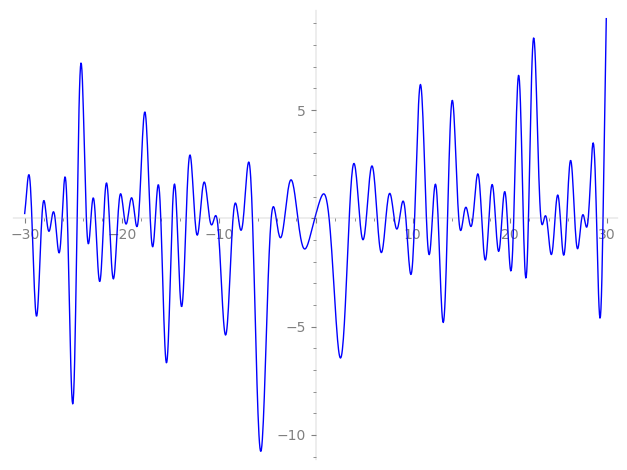
Imaginary part of the first few zeros on the critical line
−10.18670605761037222633051993580, −8.524731988710803160986596357152, −7.969684316349015353637077201496, −7.46137872653981381926267796679, −6.52200772299085642434155316609, −4.58863875502393952225106558580, −4.07637244453260583189739543659, −3.21409614452469009710127159072, −1.84147027597056521457203924839, −0.099337124313018937889377298346,
1.37908954730682503814435216010, 3.45162331566273569651096883737, 4.53798096351921195220062228705, 5.21213874523736940249976057772, 6.34553299972264070184166536043, 7.23094251243539856910268407141, 8.087507819808620198708173138502, 8.644660169149088764522311942177, 9.291454575394029461843351373985, 10.19345904041858290312304312478