| L(s) = 1 | + (1.40 − 0.809i)2-s + (1.11 + 1.93i)3-s + (0.309 − 0.535i)4-s + i·5-s + (3.13 + 1.80i)6-s + (−0.204 − 0.118i)7-s + 2.23i·8-s + (−1 + 1.73i)9-s + (0.809 + 1.40i)10-s + (−3.66 + 2.11i)11-s + 1.38·12-s − 0.381·14-s + (−1.93 + 1.11i)15-s + (2.42 + 4.20i)16-s + (2.73 − 4.73i)17-s + 3.23i·18-s + ⋯ |
| L(s) = 1 | + (0.990 − 0.572i)2-s + (0.645 + 1.11i)3-s + (0.154 − 0.267i)4-s + 0.447i·5-s + (1.27 + 0.738i)6-s + (−0.0772 − 0.0446i)7-s + 0.790i·8-s + (−0.333 + 0.577i)9-s + (0.255 + 0.443i)10-s + (−1.10 + 0.638i)11-s + 0.398·12-s − 0.102·14-s + (−0.500 + 0.288i)15-s + (0.606 + 1.05i)16-s + (0.663 − 1.14i)17-s + 0.762i·18-s + ⋯ |
\[\begin{aligned}\Lambda(s)=\mathstrut & 845 ^{s/2} \, \Gamma_{\C}(s) \, L(s)\cr =\mathstrut & (0.252 - 0.967i)\, \overline{\Lambda}(2-s) \end{aligned}\]
\[\begin{aligned}\Lambda(s)=\mathstrut & 845 ^{s/2} \, \Gamma_{\C}(s+1/2) \, L(s)\cr =\mathstrut & (0.252 - 0.967i)\, \overline{\Lambda}(1-s) \end{aligned}\]
Particular Values
| \(L(1)\) |
\(\approx\) |
\(2.27993 + 1.76109i\) |
| \(L(\frac12)\) |
\(\approx\) |
\(2.27993 + 1.76109i\) |
| \(L(\frac{3}{2})\) |
|
not available |
| \(L(1)\) |
|
not available |
\(L(s) = \displaystyle \prod_{p} F_p(p^{-s})^{-1} \)
| $p$ | $F_p(T)$ |
|---|
| bad | 5 | \( 1 - iT \) |
| 13 | \( 1 \) |
| good | 2 | \( 1 + (-1.40 + 0.809i)T + (1 - 1.73i)T^{2} \) |
| 3 | \( 1 + (-1.11 - 1.93i)T + (-1.5 + 2.59i)T^{2} \) |
| 7 | \( 1 + (0.204 + 0.118i)T + (3.5 + 6.06i)T^{2} \) |
| 11 | \( 1 + (3.66 - 2.11i)T + (5.5 - 9.52i)T^{2} \) |
| 17 | \( 1 + (-2.73 + 4.73i)T + (-8.5 - 14.7i)T^{2} \) |
| 19 | \( 1 + (-0.204 - 0.118i)T + (9.5 + 16.4i)T^{2} \) |
| 23 | \( 1 + (-4.11 - 7.13i)T + (-11.5 + 19.9i)T^{2} \) |
| 29 | \( 1 + (0.736 + 1.27i)T + (-14.5 + 25.1i)T^{2} \) |
| 31 | \( 1 - 31T^{2} \) |
| 37 | \( 1 + (2.59 - 1.5i)T + (18.5 - 32.0i)T^{2} \) |
| 41 | \( 1 + (5.14 - 2.97i)T + (20.5 - 35.5i)T^{2} \) |
| 43 | \( 1 + (0.881 - 1.52i)T + (-21.5 - 37.2i)T^{2} \) |
| 47 | \( 1 + 12.9iT - 47T^{2} \) |
| 53 | \( 1 - 6T + 53T^{2} \) |
| 59 | \( 1 + (-11.0 - 6.35i)T + (29.5 + 51.0i)T^{2} \) |
| 61 | \( 1 + (-6.20 + 10.7i)T + (-30.5 - 52.8i)T^{2} \) |
| 67 | \( 1 + (-9.27 + 5.35i)T + (33.5 - 58.0i)T^{2} \) |
| 71 | \( 1 + (-1.52 - 0.881i)T + (35.5 + 61.4i)T^{2} \) |
| 73 | \( 1 - 6iT - 73T^{2} \) |
| 79 | \( 1 + 79T^{2} \) |
| 83 | \( 1 + 8.94iT - 83T^{2} \) |
| 89 | \( 1 + (-7.79 + 4.5i)T + (44.5 - 77.0i)T^{2} \) |
| 97 | \( 1 + (4.73 + 2.73i)T + (48.5 + 84.0i)T^{2} \) |
| show more | |
| show less | |
\(L(s) = \displaystyle\prod_p \ \prod_{j=1}^{2} (1 - \alpha_{j,p}\, p^{-s})^{-1}\)
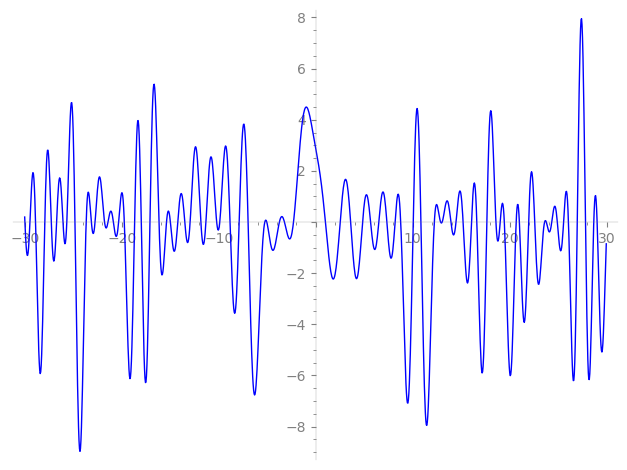
Imaginary part of the first few zeros on the critical line
−10.20911551740092878529554599580, −9.890465046010624468204828382587, −8.835209895244128679422092506707, −7.892112143001541075968431266521, −6.96966954112005768666111952796, −5.24735483970006639514864939916, −5.04654446003982046253997974471, −3.74406532181029156150727558120, −3.22493365576754116670064688257, −2.28983723395628549839684868102,
0.998290877453678516090630527421, 2.52189268742950821639140934058, 3.59797526781700916858178816829, 4.83044246205459270685806532923, 5.65477586102029003742329990490, 6.50268685263644860346355559292, 7.33350122874357144054893605298, 8.180681397719358395470230194217, 8.758808777605134656882114814777, 10.04655515986453410464705666351