| L(s) = 1 | + (−0.837 + 1.45i)2-s + (−0.403 − 0.698i)4-s + 5-s + (−1.81 − 3.15i)7-s − 2·8-s + (−0.837 + 1.45i)10-s + (0.806 − 1.39i)11-s + (3.22 − 1.61i)13-s + 6.09·14-s + (2.48 − 4.29i)16-s + (−1.64 − 2.84i)17-s + (3.55 + 6.16i)19-s + (−0.403 − 0.698i)20-s + (1.35 + 2.33i)22-s + (2.86 − 4.96i)23-s + ⋯ |
| L(s) = 1 | + (−0.592 + 1.02i)2-s + (−0.201 − 0.349i)4-s + 0.447·5-s + (−0.687 − 1.19i)7-s − 0.707·8-s + (−0.264 + 0.458i)10-s + (0.243 − 0.420i)11-s + (0.893 − 0.448i)13-s + 1.62·14-s + (0.620 − 1.07i)16-s + (−0.398 − 0.690i)17-s + (0.816 + 1.41i)19-s + (−0.0901 − 0.156i)20-s + (0.287 + 0.498i)22-s + (0.598 − 1.03i)23-s + ⋯ |
\[\begin{aligned}\Lambda(s)=\mathstrut & 585 ^{s/2} \, \Gamma_{\C}(s) \, L(s)\cr =\mathstrut & (0.980 - 0.196i)\, \overline{\Lambda}(2-s) \end{aligned}\]
\[\begin{aligned}\Lambda(s)=\mathstrut & 585 ^{s/2} \, \Gamma_{\C}(s+1/2) \, L(s)\cr =\mathstrut & (0.980 - 0.196i)\, \overline{\Lambda}(1-s) \end{aligned}\]
Particular Values
| \(L(1)\) |
\(\approx\) |
\(1.02484 + 0.101462i\) |
| \(L(\frac12)\) |
\(\approx\) |
\(1.02484 + 0.101462i\) |
| \(L(\frac{3}{2})\) |
|
not available |
| \(L(1)\) |
|
not available |
\(L(s) = \displaystyle \prod_{p} F_p(p^{-s})^{-1} \)
| $p$ | $F_p(T)$ |
|---|
| bad | 3 | \( 1 \) |
| 5 | \( 1 - T \) |
| 13 | \( 1 + (-3.22 + 1.61i)T \) |
| good | 2 | \( 1 + (0.837 - 1.45i)T + (-1 - 1.73i)T^{2} \) |
| 7 | \( 1 + (1.81 + 3.15i)T + (-3.5 + 6.06i)T^{2} \) |
| 11 | \( 1 + (-0.806 + 1.39i)T + (-5.5 - 9.52i)T^{2} \) |
| 17 | \( 1 + (1.64 + 2.84i)T + (-8.5 + 14.7i)T^{2} \) |
| 19 | \( 1 + (-3.55 - 6.16i)T + (-9.5 + 16.4i)T^{2} \) |
| 23 | \( 1 + (-2.86 + 4.96i)T + (-11.5 - 19.9i)T^{2} \) |
| 29 | \( 1 + (-3.72 + 6.44i)T + (-14.5 - 25.1i)T^{2} \) |
| 31 | \( 1 + 6.76T + 31T^{2} \) |
| 37 | \( 1 + (-5.96 + 10.3i)T + (-18.5 - 32.0i)T^{2} \) |
| 41 | \( 1 + (2.56 - 4.44i)T + (-20.5 - 35.5i)T^{2} \) |
| 43 | \( 1 + (-3.54 - 6.14i)T + (-21.5 + 37.2i)T^{2} \) |
| 47 | \( 1 - 1.67T + 47T^{2} \) |
| 53 | \( 1 - 1.42T + 53T^{2} \) |
| 59 | \( 1 + (-5.78 - 10.0i)T + (-29.5 + 51.0i)T^{2} \) |
| 61 | \( 1 + (3.38 + 5.86i)T + (-30.5 + 52.8i)T^{2} \) |
| 67 | \( 1 + (2.70 - 4.68i)T + (-33.5 - 58.0i)T^{2} \) |
| 71 | \( 1 + (1.91 + 3.31i)T + (-35.5 + 61.4i)T^{2} \) |
| 73 | \( 1 + 6.67T + 73T^{2} \) |
| 79 | \( 1 - 2.45T + 79T^{2} \) |
| 83 | \( 1 - 2.96T + 83T^{2} \) |
| 89 | \( 1 + (-0.590 + 1.02i)T + (-44.5 - 77.0i)T^{2} \) |
| 97 | \( 1 + (4.50 + 7.80i)T + (-48.5 + 84.0i)T^{2} \) |
| show more | |
| show less | |
\(L(s) = \displaystyle\prod_p \ \prod_{j=1}^{2} (1 - \alpha_{j,p}\, p^{-s})^{-1}\)
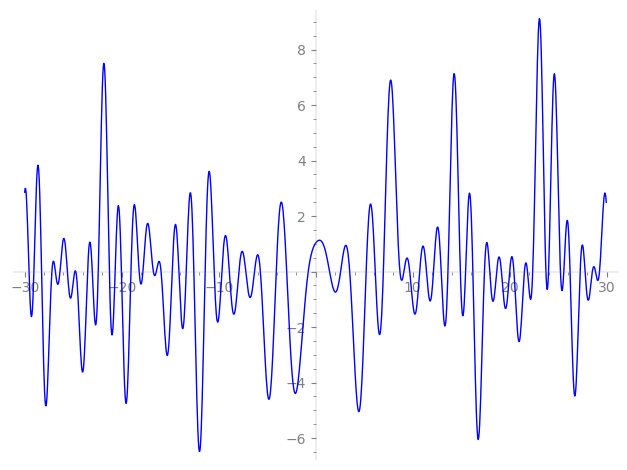
Imaginary part of the first few zeros on the critical line
−10.47130930183632093542257756623, −9.673650013296591280081771326530, −8.903844479520912686525945159612, −7.920224900905711722660327476133, −7.20856873949418918021303635734, −6.30876296993635163381821979104, −5.70663071490076141156907856978, −4.07312478598554639064216369260, −2.99320014475872109041001728101, −0.77187670609570541346524471998,
1.42873053028325911166119081858, 2.56499271330492702621251030318, 3.50212815679732663165076297759, 5.19752857962159650270072640070, 6.13651798795885321277349892628, 6.97208709730623164580507266269, 8.680918239370591064741353658383, 9.091604230067039845150286966006, 9.691294128150895608675654909857, 10.71599216446648755329077256092