| L(s) = 1 | + (1.09 − 1.09i)2-s + (−1.05 + 0.436i)3-s − 0.403i·4-s + (−0.676 + 1.63i)6-s + (−1.43 + 3.45i)7-s + (1.74 + 1.74i)8-s + (−1.20 + 1.20i)9-s + (0.558 − 1.34i)11-s + (0.176 + 0.425i)12-s − 6.71·13-s + (2.21 + 5.35i)14-s + 4.64·16-s + (−0.148 + 4.12i)17-s + 2.63i·18-s + (1.32 + 1.32i)19-s + ⋯ |
| L(s) = 1 | + (0.775 − 0.775i)2-s + (−0.608 + 0.251i)3-s − 0.201i·4-s + (−0.276 + 0.666i)6-s + (−0.541 + 1.30i)7-s + (0.618 + 0.618i)8-s + (−0.400 + 0.400i)9-s + (0.168 − 0.406i)11-s + (0.0508 + 0.122i)12-s − 1.86·13-s + (0.593 + 1.43i)14-s + 1.16·16-s + (−0.0360 + 0.999i)17-s + 0.621i·18-s + (0.304 + 0.304i)19-s + ⋯ |
\[\begin{aligned}\Lambda(s)=\mathstrut & 425 ^{s/2} \, \Gamma_{\C}(s) \, L(s)\cr =\mathstrut & (0.420 - 0.907i)\, \overline{\Lambda}(2-s) \end{aligned}\]
\[\begin{aligned}\Lambda(s)=\mathstrut & 425 ^{s/2} \, \Gamma_{\C}(s+1/2) \, L(s)\cr =\mathstrut & (0.420 - 0.907i)\, \overline{\Lambda}(1-s) \end{aligned}\]
Particular Values
| \(L(1)\) |
\(\approx\) |
\(1.09771 + 0.701278i\) |
| \(L(\frac12)\) |
\(\approx\) |
\(1.09771 + 0.701278i\) |
| \(L(\frac{3}{2})\) |
|
not available |
| \(L(1)\) |
|
not available |
\(L(s) = \displaystyle \prod_{p} F_p(p^{-s})^{-1} \)
| $p$ | $F_p(T)$ |
|---|
| bad | 5 | \( 1 \) |
| 17 | \( 1 + (0.148 - 4.12i)T \) |
| good | 2 | \( 1 + (-1.09 + 1.09i)T - 2iT^{2} \) |
| 3 | \( 1 + (1.05 - 0.436i)T + (2.12 - 2.12i)T^{2} \) |
| 7 | \( 1 + (1.43 - 3.45i)T + (-4.94 - 4.94i)T^{2} \) |
| 11 | \( 1 + (-0.558 + 1.34i)T + (-7.77 - 7.77i)T^{2} \) |
| 13 | \( 1 + 6.71T + 13T^{2} \) |
| 19 | \( 1 + (-1.32 - 1.32i)T + 19iT^{2} \) |
| 23 | \( 1 + (-3.90 - 1.61i)T + (16.2 + 16.2i)T^{2} \) |
| 29 | \( 1 + (-7.01 + 2.90i)T + (20.5 - 20.5i)T^{2} \) |
| 31 | \( 1 + (-0.495 - 1.19i)T + (-21.9 + 21.9i)T^{2} \) |
| 37 | \( 1 + (-4.17 + 1.72i)T + (26.1 - 26.1i)T^{2} \) |
| 41 | \( 1 + (-1.45 - 0.601i)T + (28.9 + 28.9i)T^{2} \) |
| 43 | \( 1 + (4.56 + 4.56i)T + 43iT^{2} \) |
| 47 | \( 1 + 2.36T + 47T^{2} \) |
| 53 | \( 1 + (4.25 - 4.25i)T - 53iT^{2} \) |
| 59 | \( 1 + (7.29 - 7.29i)T - 59iT^{2} \) |
| 61 | \( 1 + (-2.90 - 1.20i)T + (43.1 + 43.1i)T^{2} \) |
| 67 | \( 1 + 6.08iT - 67T^{2} \) |
| 71 | \( 1 + (1.46 + 3.53i)T + (-50.2 + 50.2i)T^{2} \) |
| 73 | \( 1 + (-5.35 - 12.9i)T + (-51.6 + 51.6i)T^{2} \) |
| 79 | \( 1 + (-0.916 + 2.21i)T + (-55.8 - 55.8i)T^{2} \) |
| 83 | \( 1 + (-11.9 + 11.9i)T - 83iT^{2} \) |
| 89 | \( 1 + 1.59iT - 89T^{2} \) |
| 97 | \( 1 + (-5.20 - 12.5i)T + (-68.5 + 68.5i)T^{2} \) |
| show more | |
| show less | |
\(L(s) = \displaystyle\prod_p \ \prod_{j=1}^{2} (1 - \alpha_{j,p}\, p^{-s})^{-1}\)
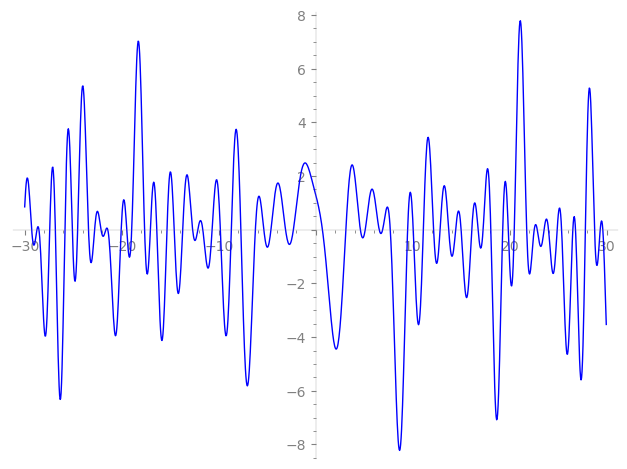
Imaginary part of the first few zeros on the critical line
−11.63792719184480188537951511056, −10.67915090052835559302469331669, −9.830250068878196499136142289524, −8.705289378073424077396278183744, −7.71548048684796282378914201725, −6.22183543803685610119265401948, −5.34850691945502050886704422436, −4.61548412762227724485115165279, −3.11046694398793517178559649531, −2.30314828961700500757052395597,
0.69088359477152935159811162609, 3.10557392937362200796658422908, 4.60282732596244169768132787193, 5.10158011776882969377330026525, 6.54725988184005947560317503462, 6.89470416842494769991885599409, 7.68392698285143165661642073863, 9.472036597995687818428963918180, 10.04947029507982603449780492858, 11.09213357973336654974431359436