| L(s) = 1 | + (0.111 + 0.993i)3-s + (−0.433 + 0.900i)4-s + (0.846 − 0.532i)7-s + (−0.974 + 0.222i)9-s + (−0.943 − 0.330i)12-s + (0.663 + 1.05i)13-s + (−0.623 − 0.781i)16-s + 1.94·19-s + (0.623 + 0.781i)21-s + (−0.330 − 0.943i)27-s + (0.111 + 0.993i)28-s + 0.867i·31-s + (0.222 − 0.974i)36-s + (−0.286 + 0.819i)37-s + (−0.974 + 0.777i)39-s + ⋯ |
| L(s) = 1 | + (0.111 + 0.993i)3-s + (−0.433 + 0.900i)4-s + (0.846 − 0.532i)7-s + (−0.974 + 0.222i)9-s + (−0.943 − 0.330i)12-s + (0.663 + 1.05i)13-s + (−0.623 − 0.781i)16-s + 1.94·19-s + (0.623 + 0.781i)21-s + (−0.330 − 0.943i)27-s + (0.111 + 0.993i)28-s + 0.867i·31-s + (0.222 − 0.974i)36-s + (−0.286 + 0.819i)37-s + (−0.974 + 0.777i)39-s + ⋯ |
\[\begin{aligned}\Lambda(s)=\mathstrut & 3675 ^{s/2} \, \Gamma_{\C}(s) \, L(s)\cr =\mathstrut & (-0.455 - 0.890i)\, \overline{\Lambda}(1-s) \end{aligned}\]
\[\begin{aligned}\Lambda(s)=\mathstrut & 3675 ^{s/2} \, \Gamma_{\C}(s) \, L(s)\cr =\mathstrut & (-0.455 - 0.890i)\, \overline{\Lambda}(1-s) \end{aligned}\]
Particular Values
| \(L(\frac{1}{2})\) |
\(\approx\) |
\(1.310026336\) |
| \(L(\frac12)\) |
\(\approx\) |
\(1.310026336\) |
| \(L(1)\) |
|
not available |
| \(L(1)\) |
|
not available |
\(L(s) = \displaystyle \prod_{p} F_p(p^{-s})^{-1} \)
| $p$ | $F_p(T)$ |
|---|
| bad | 3 | \( 1 + (-0.111 - 0.993i)T \) |
| 5 | \( 1 \) |
| 7 | \( 1 + (-0.846 + 0.532i)T \) |
| good | 2 | \( 1 + (0.433 - 0.900i)T^{2} \) |
| 11 | \( 1 + (0.900 + 0.433i)T^{2} \) |
| 13 | \( 1 + (-0.663 - 1.05i)T + (-0.433 + 0.900i)T^{2} \) |
| 17 | \( 1 + (-0.781 - 0.623i)T^{2} \) |
| 19 | \( 1 - 1.94T + T^{2} \) |
| 23 | \( 1 + (0.781 - 0.623i)T^{2} \) |
| 29 | \( 1 + (0.623 - 0.781i)T^{2} \) |
| 31 | \( 1 - 0.867iT - T^{2} \) |
| 37 | \( 1 + (0.286 - 0.819i)T + (-0.781 - 0.623i)T^{2} \) |
| 41 | \( 1 + (-0.222 - 0.974i)T^{2} \) |
| 43 | \( 1 + (0.218 - 1.93i)T + (-0.974 - 0.222i)T^{2} \) |
| 47 | \( 1 + (-0.433 + 0.900i)T^{2} \) |
| 53 | \( 1 + (0.781 - 0.623i)T^{2} \) |
| 59 | \( 1 + (0.222 - 0.974i)T^{2} \) |
| 61 | \( 1 + (0.376 + 0.781i)T + (-0.623 + 0.781i)T^{2} \) |
| 67 | \( 1 + (1.10 - 1.10i)T - iT^{2} \) |
| 71 | \( 1 + (-0.623 - 0.781i)T^{2} \) |
| 73 | \( 1 + (1.52 + 0.958i)T + (0.433 + 0.900i)T^{2} \) |
| 79 | \( 1 + 1.80iT - T^{2} \) |
| 83 | \( 1 + (-0.433 - 0.900i)T^{2} \) |
| 89 | \( 1 + (0.900 - 0.433i)T^{2} \) |
| 97 | \( 1 + (0.314 + 0.314i)T + iT^{2} \) |
| show more | |
| show less | |
\(L(s) = \displaystyle\prod_p \ \prod_{j=1}^{2} (1 - \alpha_{j,p}\, p^{-s})^{-1}\)
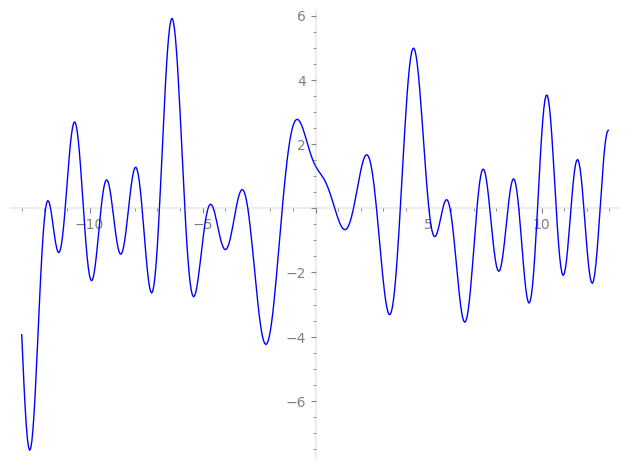
Imaginary part of the first few zeros on the critical line
−8.981229035242977853204157507873, −8.273024354237362149192146740052, −7.67583580315377525071717688728, −6.90687856041272411683001839207, −5.78467460306229547914993189525, −4.75622697232592827345573986646, −4.52348473121013938430938950840, −3.51684688174591067931877714283, −2.99849220262137318701250478352, −1.47198144397277742492265205206,
0.848599217895718404195427182134, 1.67819823758922722625567172270, 2.69555000179772553685648001686, 3.74961268705593050527721889861, 5.01304992133286903005860516343, 5.62986728769194344343204800938, 5.94736828833218227040358585137, 7.14137244744887024510659574629, 7.70639326785727269122046728100, 8.513997738188452187569942807339