| L(s) = 1 | + (−0.5 − 0.866i)3-s + 3·5-s + (−0.499 + 0.866i)9-s + (3.5 − 0.866i)13-s + (−1.5 − 2.59i)15-s + (0.5 − 0.866i)17-s + (−2 − 3.46i)23-s + 4·25-s + 0.999·27-s + (−1.5 − 2.59i)29-s + 8·31-s + (2.5 + 4.33i)37-s + (−2.5 − 2.59i)39-s + (−1.5 − 2.59i)41-s + (−2 + 3.46i)43-s + ⋯ |
| L(s) = 1 | + (−0.288 − 0.499i)3-s + 1.34·5-s + (−0.166 + 0.288i)9-s + (0.970 − 0.240i)13-s + (−0.387 − 0.670i)15-s + (0.121 − 0.210i)17-s + (−0.417 − 0.722i)23-s + 0.800·25-s + 0.192·27-s + (−0.278 − 0.482i)29-s + 1.43·31-s + (0.410 + 0.711i)37-s + (−0.400 − 0.416i)39-s + (−0.234 − 0.405i)41-s + (−0.304 + 0.528i)43-s + ⋯ |
\[\begin{aligned}\Lambda(s)=\mathstrut & 312 ^{s/2} \, \Gamma_{\C}(s) \, L(s)\cr =\mathstrut & (0.859 + 0.511i)\, \overline{\Lambda}(2-s) \end{aligned}\]
\[\begin{aligned}\Lambda(s)=\mathstrut & 312 ^{s/2} \, \Gamma_{\C}(s+1/2) \, L(s)\cr =\mathstrut & (0.859 + 0.511i)\, \overline{\Lambda}(1-s) \end{aligned}\]
Particular Values
| \(L(1)\) |
\(\approx\) |
\(1.43427 - 0.394187i\) |
| \(L(\frac12)\) |
\(\approx\) |
\(1.43427 - 0.394187i\) |
| \(L(\frac{3}{2})\) |
|
not available |
| \(L(1)\) |
|
not available |
\(L(s) = \displaystyle \prod_{p} F_p(p^{-s})^{-1} \)
| $p$ | $F_p(T)$ |
|---|
| bad | 2 | \( 1 \) |
| 3 | \( 1 + (0.5 + 0.866i)T \) |
| 13 | \( 1 + (-3.5 + 0.866i)T \) |
| good | 5 | \( 1 - 3T + 5T^{2} \) |
| 7 | \( 1 + (-3.5 - 6.06i)T^{2} \) |
| 11 | \( 1 + (-5.5 + 9.52i)T^{2} \) |
| 17 | \( 1 + (-0.5 + 0.866i)T + (-8.5 - 14.7i)T^{2} \) |
| 19 | \( 1 + (-9.5 - 16.4i)T^{2} \) |
| 23 | \( 1 + (2 + 3.46i)T + (-11.5 + 19.9i)T^{2} \) |
| 29 | \( 1 + (1.5 + 2.59i)T + (-14.5 + 25.1i)T^{2} \) |
| 31 | \( 1 - 8T + 31T^{2} \) |
| 37 | \( 1 + (-2.5 - 4.33i)T + (-18.5 + 32.0i)T^{2} \) |
| 41 | \( 1 + (1.5 + 2.59i)T + (-20.5 + 35.5i)T^{2} \) |
| 43 | \( 1 + (2 - 3.46i)T + (-21.5 - 37.2i)T^{2} \) |
| 47 | \( 1 + 8T + 47T^{2} \) |
| 53 | \( 1 + 13T + 53T^{2} \) |
| 59 | \( 1 + (6 - 10.3i)T + (-29.5 - 51.0i)T^{2} \) |
| 61 | \( 1 + (7.5 - 12.9i)T + (-30.5 - 52.8i)T^{2} \) |
| 67 | \( 1 + (6 + 10.3i)T + (-33.5 + 58.0i)T^{2} \) |
| 71 | \( 1 + (4 - 6.92i)T + (-35.5 - 61.4i)T^{2} \) |
| 73 | \( 1 - 3T + 73T^{2} \) |
| 79 | \( 1 + 4T + 79T^{2} \) |
| 83 | \( 1 - 12T + 83T^{2} \) |
| 89 | \( 1 + (5 + 8.66i)T + (-44.5 + 77.0i)T^{2} \) |
| 97 | \( 1 + (1 - 1.73i)T + (-48.5 - 84.0i)T^{2} \) |
| show more | |
| show less | |
\(L(s) = \displaystyle\prod_p \ \prod_{j=1}^{2} (1 - \alpha_{j,p}\, p^{-s})^{-1}\)
Imaginary part of the first few zeros on the critical line
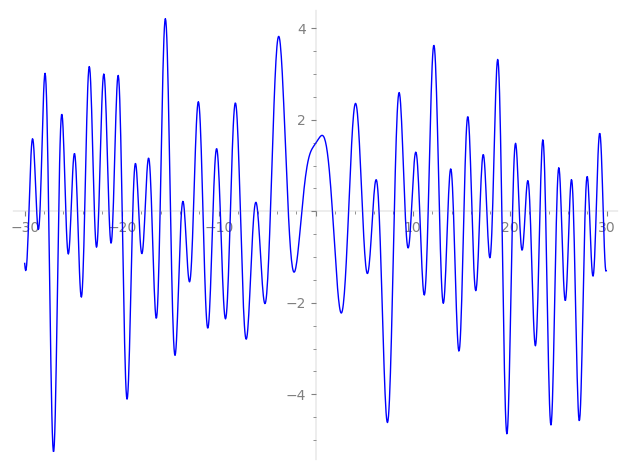
−11.62292162436593495312194158447, −10.58832133759301379743022411382, −9.837914609998657231857675340173, −8.794550399354803440088808874578, −7.76901976195737233647079640152, −6.34538186879401067698037396990, −5.99007749996929647816003772971, −4.66776475550602276807200700380, −2.82895586817474621720524245291, −1.43499133906165139030918547822,
1.72159990829401135929287508890, 3.38751374332310410175321206840, 4.82361483187115110582129798381, 5.88394477089614038455528081751, 6.52662889645244401370877893506, 8.100508021663300914241474255790, 9.214684869125839839883750657889, 9.861212634020860723693032357808, 10.71888246329299168417625582925, 11.59068624652272287960495516095