| L(s) = 1 | + (0.939 + 0.342i)2-s + (0.0783 + 0.745i)3-s + (0.766 + 0.642i)4-s + (−0.181 + 0.726i)6-s + (0.500 + 0.866i)8-s + (0.429 − 0.0912i)9-s + (−0.418 + 0.621i)12-s + (0.812 − 1.82i)13-s + (0.173 + 0.984i)16-s + (0.434 + 0.0610i)18-s + (−0.309 + 0.951i)23-s + (−0.606 + 0.440i)24-s + (−0.5 + 0.866i)25-s + (1.38 − 1.43i)26-s + (0.333 + 1.02i)27-s + ⋯ |
| L(s) = 1 | + (0.939 + 0.342i)2-s + (0.0783 + 0.745i)3-s + (0.766 + 0.642i)4-s + (−0.181 + 0.726i)6-s + (0.500 + 0.866i)8-s + (0.429 − 0.0912i)9-s + (−0.418 + 0.621i)12-s + (0.812 − 1.82i)13-s + (0.173 + 0.984i)16-s + (0.434 + 0.0610i)18-s + (−0.309 + 0.951i)23-s + (−0.606 + 0.440i)24-s + (−0.5 + 0.866i)25-s + (1.38 − 1.43i)26-s + (0.333 + 1.02i)27-s + ⋯ |
\[\begin{aligned}\Lambda(s)=\mathstrut & 2852 ^{s/2} \, \Gamma_{\C}(s) \, L(s)\cr =\mathstrut & (0.306 - 0.951i)\, \overline{\Lambda}(1-s) \end{aligned}\]
\[\begin{aligned}\Lambda(s)=\mathstrut & 2852 ^{s/2} \, \Gamma_{\C}(s) \, L(s)\cr =\mathstrut & (0.306 - 0.951i)\, \overline{\Lambda}(1-s) \end{aligned}\]
Particular Values
| \(L(\frac{1}{2})\) |
\(\approx\) |
\(2.455692734\) |
| \(L(\frac12)\) |
\(\approx\) |
\(2.455692734\) |
| \(L(1)\) |
|
not available |
| \(L(1)\) |
|
not available |
\(L(s) = \displaystyle \prod_{p} F_p(p^{-s})^{-1} \)
| $p$ | $F_p(T)$ |
|---|
| bad | 2 | \( 1 + (-0.939 - 0.342i)T \) |
| 23 | \( 1 + (0.309 - 0.951i)T \) |
| 31 | \( 1 + (0.559 + 0.829i)T \) |
| good | 3 | \( 1 + (-0.0783 - 0.745i)T + (-0.978 + 0.207i)T^{2} \) |
| 5 | \( 1 + (0.5 - 0.866i)T^{2} \) |
| 7 | \( 1 + (0.913 + 0.406i)T^{2} \) |
| 11 | \( 1 + (0.104 + 0.994i)T^{2} \) |
| 13 | \( 1 + (-0.812 + 1.82i)T + (-0.669 - 0.743i)T^{2} \) |
| 17 | \( 1 + (-0.104 + 0.994i)T^{2} \) |
| 19 | \( 1 + (0.669 - 0.743i)T^{2} \) |
| 29 | \( 1 + (-0.551 + 0.759i)T + (-0.309 - 0.951i)T^{2} \) |
| 37 | \( 1 + (-0.5 - 0.866i)T^{2} \) |
| 41 | \( 1 + (0.128 - 1.22i)T + (-0.978 - 0.207i)T^{2} \) |
| 43 | \( 1 + (-0.669 + 0.743i)T^{2} \) |
| 47 | \( 1 + (0.974 + 1.34i)T + (-0.309 + 0.951i)T^{2} \) |
| 53 | \( 1 + (0.913 - 0.406i)T^{2} \) |
| 59 | \( 1 + (1.89 - 0.198i)T + (0.978 - 0.207i)T^{2} \) |
| 61 | \( 1 + T^{2} \) |
| 67 | \( 1 + (-0.5 + 0.866i)T^{2} \) |
| 71 | \( 1 + (0.0578 + 0.272i)T + (-0.913 + 0.406i)T^{2} \) |
| 73 | \( 1 + (0.787 + 0.709i)T + (0.104 + 0.994i)T^{2} \) |
| 79 | \( 1 + (0.104 - 0.994i)T^{2} \) |
| 83 | \( 1 + (0.978 + 0.207i)T^{2} \) |
| 89 | \( 1 + (-0.809 + 0.587i)T^{2} \) |
| 97 | \( 1 + (0.809 - 0.587i)T^{2} \) |
| show more | |
| show less | |
\(L(s) = \displaystyle\prod_p \ \prod_{j=1}^{2} (1 - \alpha_{j,p}\, p^{-s})^{-1}\)
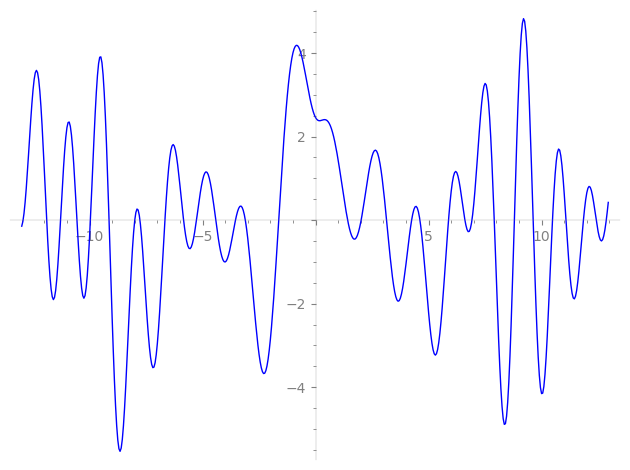
Imaginary part of the first few zeros on the critical line
−9.136884956743153724671070877296, −7.999434037946206208832432332235, −7.76987316065470574304142575656, −6.66436112723758883842646489749, −5.83855971374807905852859751555, −5.27011648177042249916440893828, −4.41434214193053383591346186102, −3.54325945939605576034098234260, −3.10805269262124975316865054742, −1.63150877864876275348783100542,
1.41969404461771078948983339505, 2.01626644296740777682886762505, 3.14136339390956421852752849675, 4.24981782634810690637775284197, 4.61696887653936566219435843599, 5.88260279571330873919093322735, 6.60818678077909573922478591698, 6.91828888344072161793326815224, 7.904349648343948220245256002287, 8.795213011201175267939327542992