| L(s) = 1 | + (−0.173 − 0.984i)2-s + (−1.88 − 0.399i)3-s + (−0.939 + 0.342i)4-s + (−0.0670 + 1.92i)6-s + (0.5 + 0.866i)8-s + (2.46 + 1.09i)9-s + (1.90 − 0.267i)12-s + (−1.33 − 1.20i)13-s + (0.766 − 0.642i)16-s + (0.652 − 2.61i)18-s + (0.809 − 0.587i)23-s + (−0.594 − 1.82i)24-s + (−0.5 + 0.866i)25-s + (−0.952 + 1.52i)26-s + (−2.63 − 1.91i)27-s + ⋯ |
| L(s) = 1 | + (−0.173 − 0.984i)2-s + (−1.88 − 0.399i)3-s + (−0.939 + 0.342i)4-s + (−0.0670 + 1.92i)6-s + (0.5 + 0.866i)8-s + (2.46 + 1.09i)9-s + (1.90 − 0.267i)12-s + (−1.33 − 1.20i)13-s + (0.766 − 0.642i)16-s + (0.652 − 2.61i)18-s + (0.809 − 0.587i)23-s + (−0.594 − 1.82i)24-s + (−0.5 + 0.866i)25-s + (−0.952 + 1.52i)26-s + (−2.63 − 1.91i)27-s + ⋯ |
\[\begin{aligned}\Lambda(s)=\mathstrut & 2852 ^{s/2} \, \Gamma_{\C}(s) \, L(s)\cr =\mathstrut & (0.542 - 0.840i)\, \overline{\Lambda}(1-s) \end{aligned}\]
\[\begin{aligned}\Lambda(s)=\mathstrut & 2852 ^{s/2} \, \Gamma_{\C}(s) \, L(s)\cr =\mathstrut & (0.542 - 0.840i)\, \overline{\Lambda}(1-s) \end{aligned}\]
Particular Values
| \(L(\frac{1}{2})\) |
\(\approx\) |
\(0.09850796891\) |
| \(L(\frac12)\) |
\(\approx\) |
\(0.09850796891\) |
| \(L(1)\) |
|
not available |
| \(L(1)\) |
|
not available |
\(L(s) = \displaystyle \prod_{p} F_p(p^{-s})^{-1} \)
| $p$ | $F_p(T)$ |
|---|
| bad | 2 | \( 1 + (0.173 + 0.984i)T \) |
| 23 | \( 1 + (-0.809 + 0.587i)T \) |
| 31 | \( 1 + (0.990 + 0.139i)T \) |
| good | 3 | \( 1 + (1.88 + 0.399i)T + (0.913 + 0.406i)T^{2} \) |
| 5 | \( 1 + (0.5 - 0.866i)T^{2} \) |
| 7 | \( 1 + (0.669 - 0.743i)T^{2} \) |
| 11 | \( 1 + (0.978 + 0.207i)T^{2} \) |
| 13 | \( 1 + (1.33 + 1.20i)T + (0.104 + 0.994i)T^{2} \) |
| 17 | \( 1 + (-0.978 + 0.207i)T^{2} \) |
| 19 | \( 1 + (-0.104 + 0.994i)T^{2} \) |
| 29 | \( 1 + (-0.132 - 0.0431i)T + (0.809 + 0.587i)T^{2} \) |
| 37 | \( 1 + (-0.5 - 0.866i)T^{2} \) |
| 41 | \( 1 + (1.40 - 0.299i)T + (0.913 - 0.406i)T^{2} \) |
| 43 | \( 1 + (0.104 - 0.994i)T^{2} \) |
| 47 | \( 1 + (0.264 - 0.0860i)T + (0.809 - 0.587i)T^{2} \) |
| 53 | \( 1 + (0.669 + 0.743i)T^{2} \) |
| 59 | \( 1 + (-0.244 + 1.14i)T + (-0.913 - 0.406i)T^{2} \) |
| 61 | \( 1 + T^{2} \) |
| 67 | \( 1 + (-0.5 + 0.866i)T^{2} \) |
| 71 | \( 1 + (0.789 - 1.77i)T + (-0.669 - 0.743i)T^{2} \) |
| 73 | \( 1 + (-1.64 - 0.173i)T + (0.978 + 0.207i)T^{2} \) |
| 79 | \( 1 + (0.978 - 0.207i)T^{2} \) |
| 83 | \( 1 + (-0.913 + 0.406i)T^{2} \) |
| 89 | \( 1 + (0.309 + 0.951i)T^{2} \) |
| 97 | \( 1 + (-0.309 - 0.951i)T^{2} \) |
| show more | |
| show less | |
\(L(s) = \displaystyle\prod_p \ \prod_{j=1}^{2} (1 - \alpha_{j,p}\, p^{-s})^{-1}\)
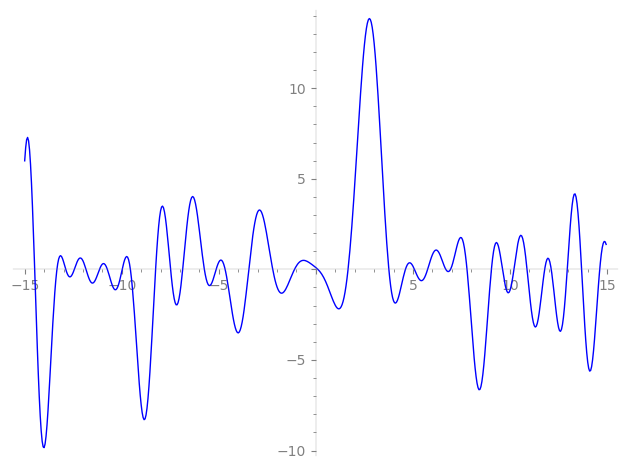
Imaginary part of the first few zeros on the critical line
−9.555732022099706429319531798883, −8.256459449034096542801018375859, −7.48439392513024877426199370106, −6.86191428381017498545671660880, −5.74550306139998292092207586142, −5.13819987791560601751107521811, −4.67558851572843667271856341827, −3.45579753149004663711400517766, −2.22331638249231050848818757886, −1.10297769743596968922672764661,
0.10145357027634961714458102537, 1.65572054567380649916804384402, 3.75799791923324545588337332786, 4.61107241947383280514591073242, 5.07593961824538042093946417635, 5.75433212221252698504484790193, 6.69157320527854570810877023541, 6.93297721463068808735380868597, 7.78345261950497836546025312492, 9.040171270957121160184591873369