| L(s) = 1 | + (−1 + i)2-s − 2i·4-s + (1.77 − 4.67i)5-s + (−5.89 + 5.89i)7-s + (2 + 2i)8-s + (2.89 + 6.44i)10-s + 14.8·11-s + (−11.4 − 11.4i)13-s − 11.7i·14-s − 4·16-s + (14.2 − 14.2i)17-s − 10.5i·19-s + (−9.34 − 3.55i)20-s + (−14.8 + 14.8i)22-s + (−21.7 − 21.7i)23-s + ⋯ |
| L(s) = 1 | + (−0.5 + 0.5i)2-s − 0.5i·4-s + (0.355 − 0.934i)5-s + (−0.842 + 0.842i)7-s + (0.250 + 0.250i)8-s + (0.289 + 0.644i)10-s + 1.35·11-s + (−0.880 − 0.880i)13-s − 0.842i·14-s − 0.250·16-s + (0.836 − 0.836i)17-s − 0.555i·19-s + (−0.467 − 0.177i)20-s + (−0.677 + 0.677i)22-s + (−0.944 − 0.944i)23-s + ⋯ |
\[\begin{aligned}\Lambda(s)=\mathstrut & 270 ^{s/2} \, \Gamma_{\C}(s) \, L(s)\cr =\mathstrut & (0.608 + 0.793i)\, \overline{\Lambda}(3-s) \end{aligned}\]
\[\begin{aligned}\Lambda(s)=\mathstrut & 270 ^{s/2} \, \Gamma_{\C}(s+1) \, L(s)\cr =\mathstrut & (0.608 + 0.793i)\, \overline{\Lambda}(1-s) \end{aligned}\]
Particular Values
| \(L(\frac{3}{2})\) |
\(\approx\) |
\(0.966146 - 0.476598i\) |
| \(L(\frac12)\) |
\(\approx\) |
\(0.966146 - 0.476598i\) |
| \(L(2)\) |
|
not available |
| \(L(1)\) |
|
not available |
\(L(s) = \displaystyle \prod_{p} F_p(p^{-s})^{-1} \)
| $p$ | $F_p(T)$ |
|---|
| bad | 2 | \( 1 + (1 - i)T \) |
| 3 | \( 1 \) |
| 5 | \( 1 + (-1.77 + 4.67i)T \) |
| good | 7 | \( 1 + (5.89 - 5.89i)T - 49iT^{2} \) |
| 11 | \( 1 - 14.8T + 121T^{2} \) |
| 13 | \( 1 + (11.4 + 11.4i)T + 169iT^{2} \) |
| 17 | \( 1 + (-14.2 + 14.2i)T - 289iT^{2} \) |
| 19 | \( 1 + 10.5iT - 361T^{2} \) |
| 23 | \( 1 + (21.7 + 21.7i)T + 529iT^{2} \) |
| 29 | \( 1 + 30.9iT - 841T^{2} \) |
| 31 | \( 1 - 57.9T + 961T^{2} \) |
| 37 | \( 1 + (-12.3 + 12.3i)T - 1.36e3iT^{2} \) |
| 41 | \( 1 - 10.4T + 1.68e3T^{2} \) |
| 43 | \( 1 + (2.94 + 2.94i)T + 1.84e3iT^{2} \) |
| 47 | \( 1 + (-26.6 + 26.6i)T - 2.20e3iT^{2} \) |
| 53 | \( 1 + (10.6 + 10.6i)T + 2.80e3iT^{2} \) |
| 59 | \( 1 - 60.0iT - 3.48e3T^{2} \) |
| 61 | \( 1 + 102.T + 3.72e3T^{2} \) |
| 67 | \( 1 + (46.4 - 46.4i)T - 4.48e3iT^{2} \) |
| 71 | \( 1 - 38.9T + 5.04e3T^{2} \) |
| 73 | \( 1 + (-71.7 - 71.7i)T + 5.32e3iT^{2} \) |
| 79 | \( 1 + 118. iT - 6.24e3T^{2} \) |
| 83 | \( 1 + (18.7 + 18.7i)T + 6.88e3iT^{2} \) |
| 89 | \( 1 + 44.6iT - 7.92e3T^{2} \) |
| 97 | \( 1 + (125. - 125. i)T - 9.40e3iT^{2} \) |
| show more | |
| show less | |
\(L(s) = \displaystyle\prod_p \ \prod_{j=1}^{2} (1 - \alpha_{j,p}\, p^{-s})^{-1}\)
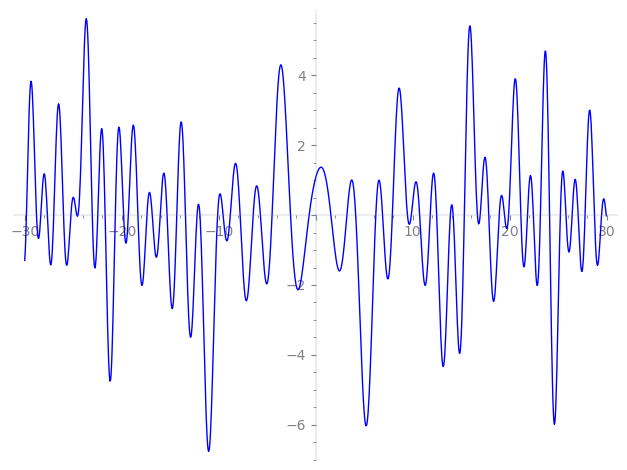
Imaginary part of the first few zeros on the critical line
−11.93593012385418128497699124139, −10.11342998705579410194135217788, −9.547785572222265675414770984967, −8.805817035911977729060851162457, −7.79280799727386889035520298386, −6.45018758105359997646088288977, −5.70185172667274138644636516150, −4.50133819529369572121659894453, −2.59627692801206798751038038475, −0.68039803764449209045751497143,
1.56723133109216685241954664015, 3.21368157856631765956364092682, 4.12078519184904608903829087674, 6.19137266775359397731608473071, 6.89371515378821989911168096215, 7.898941120789014393591245784266, 9.455478282454832904043519852825, 9.855939860845948894583335431491, 10.71537147119038759470994638824, 11.79717343485395037315648723342