| L(s) = 1 | + 2-s + 4-s + (0.306 + 0.531i)5-s + 8-s + (0.306 + 0.531i)10-s + (−2.31 + 4.00i)11-s + (−3.25 + 5.64i)13-s + 16-s + (−1.01 − 1.75i)17-s + (−1.32 + 2.29i)19-s + (0.306 + 0.531i)20-s + (−2.31 + 4.00i)22-s + (−1.81 − 3.13i)23-s + (2.31 − 4.00i)25-s + (−3.25 + 5.64i)26-s + ⋯ |
| L(s) = 1 | + 0.707·2-s + 0.5·4-s + (0.137 + 0.237i)5-s + 0.353·8-s + (0.0970 + 0.168i)10-s + (−0.697 + 1.20i)11-s + (−0.903 + 1.56i)13-s + 0.250·16-s + (−0.246 − 0.426i)17-s + (−0.303 + 0.525i)19-s + (0.0686 + 0.118i)20-s + (−0.492 + 0.853i)22-s + (−0.377 − 0.654i)23-s + (0.462 − 0.800i)25-s + (−0.639 + 1.10i)26-s + ⋯ |
\[\begin{aligned}\Lambda(s)=\mathstrut & 2646 ^{s/2} \, \Gamma_{\C}(s) \, L(s)\cr =\mathstrut & (-0.793 - 0.608i)\, \overline{\Lambda}(2-s) \end{aligned}\]
\[\begin{aligned}\Lambda(s)=\mathstrut & 2646 ^{s/2} \, \Gamma_{\C}(s+1/2) \, L(s)\cr =\mathstrut & (-0.793 - 0.608i)\, \overline{\Lambda}(1-s) \end{aligned}\]
Particular Values
| \(L(1)\) |
\(\approx\) |
\(1.388185521\) |
| \(L(\frac12)\) |
\(\approx\) |
\(1.388185521\) |
| \(L(\frac{3}{2})\) |
|
not available |
| \(L(1)\) |
|
not available |
\(L(s) = \displaystyle \prod_{p} F_p(p^{-s})^{-1} \)
| $p$ | $F_p(T)$ |
|---|
| bad | 2 | \( 1 - T \) |
| 3 | \( 1 \) |
| 7 | \( 1 \) |
| good | 5 | \( 1 + (-0.306 - 0.531i)T + (-2.5 + 4.33i)T^{2} \) |
| 11 | \( 1 + (2.31 - 4.00i)T + (-5.5 - 9.52i)T^{2} \) |
| 13 | \( 1 + (3.25 - 5.64i)T + (-6.5 - 11.2i)T^{2} \) |
| 17 | \( 1 + (1.01 + 1.75i)T + (-8.5 + 14.7i)T^{2} \) |
| 19 | \( 1 + (1.32 - 2.29i)T + (-9.5 - 16.4i)T^{2} \) |
| 23 | \( 1 + (1.81 + 3.13i)T + (-11.5 + 19.9i)T^{2} \) |
| 29 | \( 1 + (2 + 3.46i)T + (-14.5 + 25.1i)T^{2} \) |
| 31 | \( 1 + 6.51T + 31T^{2} \) |
| 37 | \( 1 + (3 - 5.19i)T + (-18.5 - 32.0i)T^{2} \) |
| 41 | \( 1 + (1.01 - 1.75i)T + (-20.5 - 35.5i)T^{2} \) |
| 43 | \( 1 + (-1.31 - 2.27i)T + (-21.5 + 37.2i)T^{2} \) |
| 47 | \( 1 + 10.5T + 47T^{2} \) |
| 53 | \( 1 + (2 + 3.46i)T + (-26.5 + 45.8i)T^{2} \) |
| 59 | \( 1 + 12.2T + 59T^{2} \) |
| 61 | \( 1 - 7.13T + 61T^{2} \) |
| 67 | \( 1 - 4.62T + 67T^{2} \) |
| 71 | \( 1 - 0.376T + 71T^{2} \) |
| 73 | \( 1 + (3.66 + 6.34i)T + (-36.5 + 63.2i)T^{2} \) |
| 79 | \( 1 - 13.6T + 79T^{2} \) |
| 83 | \( 1 + (-3.87 - 6.70i)T + (-41.5 + 71.8i)T^{2} \) |
| 89 | \( 1 + (7.13 - 12.3i)T + (-44.5 - 77.0i)T^{2} \) |
| 97 | \( 1 + (-8.14 - 14.1i)T + (-48.5 + 84.0i)T^{2} \) |
| show more | |
| show less | |
\(L(s) = \displaystyle\prod_p \ \prod_{j=1}^{2} (1 - \alpha_{j,p}\, p^{-s})^{-1}\)
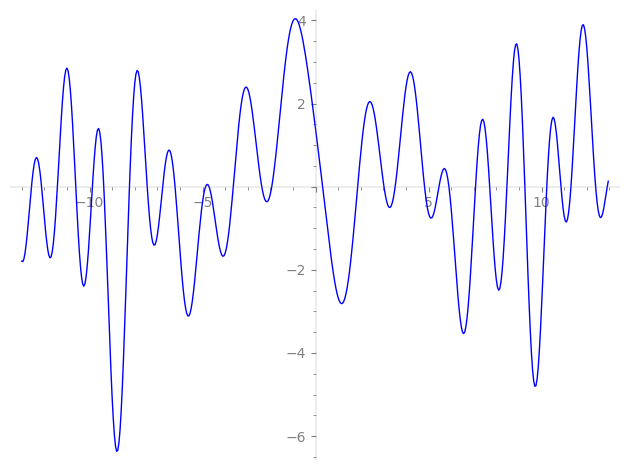
Imaginary part of the first few zeros on the critical line
−9.370184994651950484737306313674, −8.234191097217946690897433655039, −7.44810221395870492956536618665, −6.76447727294540781479736059697, −6.21674086548657820818255990726, −4.86628542547154343127682769745, −4.71278519201122128921932402739, −3.64112327564665229692755125612, −2.38013815334500829208400186422, −1.93799610770330114685681096431,
0.31060851134195277735190867179, 1.86159842015467437876529419712, 3.02682682506392099031290983504, 3.52148318169290868200521664141, 4.82162829772410133852673439429, 5.45956746788792162591602241916, 5.89979302586240080705159318502, 7.07715369158255595824619283803, 7.70470653997036947224491227947, 8.466200213667403266146053083731