| L(s) = 1 | + (0.307 + 0.532i)3-s + (2.46 − 1.42i)5-s + (1.31 − 2.27i)9-s + (1.56 − 0.901i)11-s + (−3.01 − 1.97i)13-s + (1.51 + 0.876i)15-s + 1.61·17-s + (4.64 + 2.68i)19-s + 1.15·23-s + (1.56 − 2.70i)25-s + 3.45·27-s + (−1.88 + 3.26i)29-s + (0.325 + 0.187i)31-s + (0.959 + 0.553i)33-s − 2.27i·37-s + ⋯ |
| L(s) = 1 | + (0.177 + 0.307i)3-s + (1.10 − 0.637i)5-s + (0.436 − 0.756i)9-s + (0.470 − 0.271i)11-s + (−0.835 − 0.548i)13-s + (0.391 + 0.226i)15-s + 0.391·17-s + (1.06 + 0.615i)19-s + 0.240·23-s + (0.312 − 0.540i)25-s + 0.665·27-s + (−0.350 + 0.606i)29-s + (0.0584 + 0.0337i)31-s + (0.167 + 0.0964i)33-s − 0.373i·37-s + ⋯ |
\[\begin{aligned}\Lambda(s)=\mathstrut & 2548 ^{s/2} \, \Gamma_{\C}(s) \, L(s)\cr =\mathstrut & (0.719 + 0.694i)\, \overline{\Lambda}(2-s) \end{aligned}\]
\[\begin{aligned}\Lambda(s)=\mathstrut & 2548 ^{s/2} \, \Gamma_{\C}(s+1/2) \, L(s)\cr =\mathstrut & (0.719 + 0.694i)\, \overline{\Lambda}(1-s) \end{aligned}\]
Particular Values
| \(L(1)\) |
\(\approx\) |
\(2.546948497\) |
| \(L(\frac12)\) |
\(\approx\) |
\(2.546948497\) |
| \(L(\frac{3}{2})\) |
|
not available |
| \(L(1)\) |
|
not available |
\(L(s) = \displaystyle \prod_{p} F_p(p^{-s})^{-1} \)
| $p$ | $F_p(T)$ |
|---|
| bad | 2 | \( 1 \) |
| 7 | \( 1 \) |
| 13 | \( 1 + (3.01 + 1.97i)T \) |
| good | 3 | \( 1 + (-0.307 - 0.532i)T + (-1.5 + 2.59i)T^{2} \) |
| 5 | \( 1 + (-2.46 + 1.42i)T + (2.5 - 4.33i)T^{2} \) |
| 11 | \( 1 + (-1.56 + 0.901i)T + (5.5 - 9.52i)T^{2} \) |
| 17 | \( 1 - 1.61T + 17T^{2} \) |
| 19 | \( 1 + (-4.64 - 2.68i)T + (9.5 + 16.4i)T^{2} \) |
| 23 | \( 1 - 1.15T + 23T^{2} \) |
| 29 | \( 1 + (1.88 - 3.26i)T + (-14.5 - 25.1i)T^{2} \) |
| 31 | \( 1 + (-0.325 - 0.187i)T + (15.5 + 26.8i)T^{2} \) |
| 37 | \( 1 + 2.27iT - 37T^{2} \) |
| 41 | \( 1 + (5.59 + 3.23i)T + (20.5 + 35.5i)T^{2} \) |
| 43 | \( 1 + (0.235 + 0.407i)T + (-21.5 + 37.2i)T^{2} \) |
| 47 | \( 1 + (-1.24 + 0.719i)T + (23.5 - 40.7i)T^{2} \) |
| 53 | \( 1 + (-6.06 + 10.5i)T + (-26.5 - 45.8i)T^{2} \) |
| 59 | \( 1 + 7.12iT - 59T^{2} \) |
| 61 | \( 1 + (2.80 - 4.86i)T + (-30.5 - 52.8i)T^{2} \) |
| 67 | \( 1 + (-1.40 + 0.811i)T + (33.5 - 58.0i)T^{2} \) |
| 71 | \( 1 + (-8.79 + 5.07i)T + (35.5 - 61.4i)T^{2} \) |
| 73 | \( 1 + (-4.86 - 2.81i)T + (36.5 + 63.2i)T^{2} \) |
| 79 | \( 1 + (7.18 + 12.4i)T + (-39.5 + 68.4i)T^{2} \) |
| 83 | \( 1 - 2.93iT - 83T^{2} \) |
| 89 | \( 1 - 12.9iT - 89T^{2} \) |
| 97 | \( 1 + (10.4 - 6.05i)T + (48.5 - 84.0i)T^{2} \) |
| show more | |
| show less | |
\(L(s) = \displaystyle\prod_p \ \prod_{j=1}^{2} (1 - \alpha_{j,p}\, p^{-s})^{-1}\)
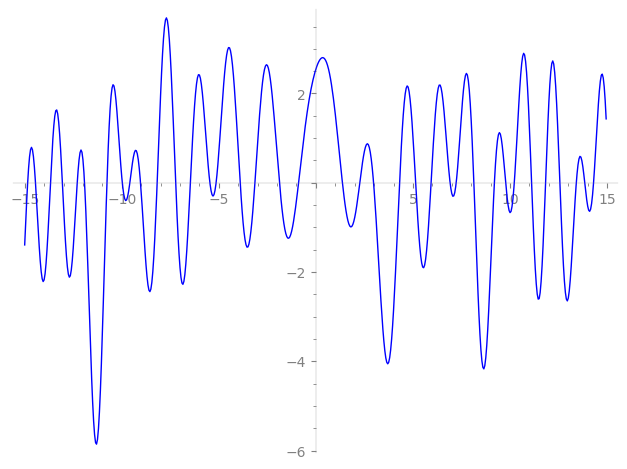
Imaginary part of the first few zeros on the critical line
−9.034856867370351094774124764915, −8.176555261613127494929694976029, −7.22297531162080542910934747592, −6.46612124919636417034491243969, −5.46017503557747704288521963901, −5.14070967448955697937149489512, −3.89922439425289707249327276818, −3.14143276190054167473235817658, −1.87648993963708400000066654022, −0.892428120974357509393664848376,
1.36591392643068314981597592279, 2.26146433957821405486614095161, 2.96976187059198606644422712407, 4.30861522751734589723509589529, 5.13742376767319687516733288640, 5.93332648502320316605025044876, 6.91219248407361181937166969778, 7.22545254777264531919286929904, 8.136367226815644278690794697181, 9.193687680015572186208583361255