| L(s) = 1 | + (−4.03 − 6.98i)5-s + (−3.90 − 2.25i)7-s + (3.25 + 1.88i)11-s + (3.52 + 6.10i)13-s − 0.517·17-s + 16.4i·19-s + (−27.7 + 15.9i)23-s + (−19.9 + 34.6i)25-s + (9.48 − 16.4i)29-s + (−13.1 + 7.58i)31-s + 36.3i·35-s − 0.592·37-s + (−12.3 − 21.4i)41-s + (−27.8 − 16.0i)43-s + (52.4 + 30.2i)47-s + ⋯ |
| L(s) = 1 | + (−0.806 − 1.39i)5-s + (−0.557 − 0.321i)7-s + (0.296 + 0.171i)11-s + (0.271 + 0.469i)13-s − 0.0304·17-s + 0.864i·19-s + (−1.20 + 0.695i)23-s + (−0.799 + 1.38i)25-s + (0.327 − 0.566i)29-s + (−0.423 + 0.244i)31-s + 1.03i·35-s − 0.0160·37-s + (−0.301 − 0.522i)41-s + (−0.648 − 0.374i)43-s + (1.11 + 0.644i)47-s + ⋯ |
\[\begin{aligned}\Lambda(s)=\mathstrut & 1728 ^{s/2} \, \Gamma_{\C}(s) \, L(s)\cr =\mathstrut & (0.889 - 0.457i)\, \overline{\Lambda}(3-s) \end{aligned}\]
\[\begin{aligned}\Lambda(s)=\mathstrut & 1728 ^{s/2} \, \Gamma_{\C}(s+1) \, L(s)\cr =\mathstrut & (0.889 - 0.457i)\, \overline{\Lambda}(1-s) \end{aligned}\]
Particular Values
| \(L(\frac{3}{2})\) |
\(\approx\) |
\(1.024631662\) |
| \(L(\frac12)\) |
\(\approx\) |
\(1.024631662\) |
| \(L(2)\) |
|
not available |
| \(L(1)\) |
|
not available |
\(L(s) = \displaystyle \prod_{p} F_p(p^{-s})^{-1} \)
| $p$ | $F_p(T)$ |
|---|
| bad | 2 | \( 1 \) |
| 3 | \( 1 \) |
| good | 5 | \( 1 + (4.03 + 6.98i)T + (-12.5 + 21.6i)T^{2} \) |
| 7 | \( 1 + (3.90 + 2.25i)T + (24.5 + 42.4i)T^{2} \) |
| 11 | \( 1 + (-3.25 - 1.88i)T + (60.5 + 104. i)T^{2} \) |
| 13 | \( 1 + (-3.52 - 6.10i)T + (-84.5 + 146. i)T^{2} \) |
| 17 | \( 1 + 0.517T + 289T^{2} \) |
| 19 | \( 1 - 16.4iT - 361T^{2} \) |
| 23 | \( 1 + (27.7 - 15.9i)T + (264.5 - 458. i)T^{2} \) |
| 29 | \( 1 + (-9.48 + 16.4i)T + (-420.5 - 728. i)T^{2} \) |
| 31 | \( 1 + (13.1 - 7.58i)T + (480.5 - 832. i)T^{2} \) |
| 37 | \( 1 + 0.592T + 1.36e3T^{2} \) |
| 41 | \( 1 + (12.3 + 21.4i)T + (-840.5 + 1.45e3i)T^{2} \) |
| 43 | \( 1 + (27.8 + 16.0i)T + (924.5 + 1.60e3i)T^{2} \) |
| 47 | \( 1 + (-52.4 - 30.2i)T + (1.10e3 + 1.91e3i)T^{2} \) |
| 53 | \( 1 + 0.664T + 2.80e3T^{2} \) |
| 59 | \( 1 + (30.5 - 17.6i)T + (1.74e3 - 3.01e3i)T^{2} \) |
| 61 | \( 1 + (33.7 - 58.4i)T + (-1.86e3 - 3.22e3i)T^{2} \) |
| 67 | \( 1 + (-74.4 + 42.9i)T + (2.24e3 - 3.88e3i)T^{2} \) |
| 71 | \( 1 - 56.4iT - 5.04e3T^{2} \) |
| 73 | \( 1 - 131.T + 5.32e3T^{2} \) |
| 79 | \( 1 + (-126. - 73.2i)T + (3.12e3 + 5.40e3i)T^{2} \) |
| 83 | \( 1 + (-87.1 - 50.2i)T + (3.44e3 + 5.96e3i)T^{2} \) |
| 89 | \( 1 - 25.8T + 7.92e3T^{2} \) |
| 97 | \( 1 + (48.2 - 83.5i)T + (-4.70e3 - 8.14e3i)T^{2} \) |
| show more | |
| show less | |
\(L(s) = \displaystyle\prod_p \ \prod_{j=1}^{2} (1 - \alpha_{j,p}\, p^{-s})^{-1}\)
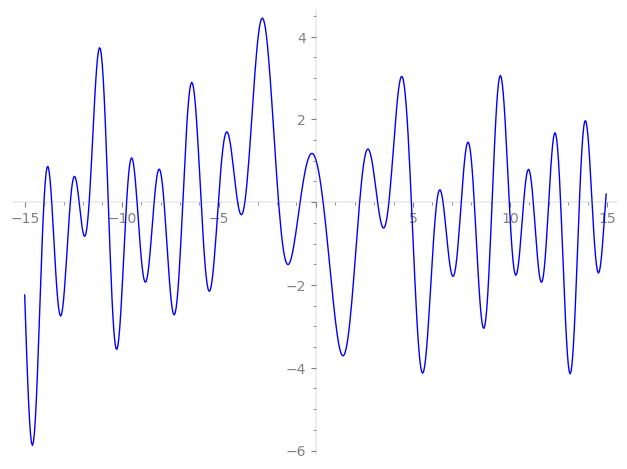
Imaginary part of the first few zeros on the critical line
−9.211204441670875274236193056209, −8.331391140754931059811356032635, −7.82387972524210188526847631298, −6.85487614386148611147223135990, −5.90978459638589281216818707245, −5.02294791646476912910717922391, −4.03088564218269745080483238727, −3.65929833664332523058617980724, −1.92184264970924322566090167002, −0.812561919857023008717115823358,
0.37201140736744352305994127879, 2.25244322591372208870160746166, 3.17946773001280951010946734768, 3.75993135930902746900081703146, 4.91833185628425649808469853153, 6.22568687960086011075695962348, 6.54809992037123900527039915775, 7.48631348919235989836160657130, 8.157535912577391182429568846963, 9.074436665091318160057857914785