| L(s) = 1 | + (0.707 + 0.707i)3-s + (1.28 + 1.82i)5-s + (1.75 + 1.97i)7-s + 1.00i·9-s + 2.67·11-s + (−1.22 − 1.22i)13-s + (−0.379 + 2.20i)15-s + (4.74 − 4.74i)17-s + 6.01·19-s + (−0.152 + 2.64i)21-s + (0.175 − 0.175i)23-s + (−1.67 + 4.71i)25-s + (−0.707 + 0.707i)27-s − 0.304i·29-s − 7.25i·31-s + ⋯ |
| L(s) = 1 | + (0.408 + 0.408i)3-s + (0.576 + 0.816i)5-s + (0.665 + 0.746i)7-s + 0.333i·9-s + 0.805·11-s + (−0.340 − 0.340i)13-s + (−0.0979 + 0.568i)15-s + (1.15 − 1.15i)17-s + 1.38·19-s + (−0.0332 + 0.576i)21-s + (0.0366 − 0.0366i)23-s + (−0.334 + 0.942i)25-s + (−0.136 + 0.136i)27-s − 0.0566i·29-s − 1.30i·31-s + ⋯ |
\[\begin{aligned}\Lambda(s)=\mathstrut & 1680 ^{s/2} \, \Gamma_{\C}(s) \, L(s)\cr =\mathstrut & (0.443 - 0.896i)\, \overline{\Lambda}(2-s) \end{aligned}\]
\[\begin{aligned}\Lambda(s)=\mathstrut & 1680 ^{s/2} \, \Gamma_{\C}(s+1/2) \, L(s)\cr =\mathstrut & (0.443 - 0.896i)\, \overline{\Lambda}(1-s) \end{aligned}\]
Particular Values
| \(L(1)\) |
\(\approx\) |
\(2.628468176\) |
| \(L(\frac12)\) |
\(\approx\) |
\(2.628468176\) |
| \(L(\frac{3}{2})\) |
|
not available |
| \(L(1)\) |
|
not available |
\(L(s) = \displaystyle \prod_{p} F_p(p^{-s})^{-1} \)
| $p$ | $F_p(T)$ |
|---|
| bad | 2 | \( 1 \) |
| 3 | \( 1 + (-0.707 - 0.707i)T \) |
| 5 | \( 1 + (-1.28 - 1.82i)T \) |
| 7 | \( 1 + (-1.75 - 1.97i)T \) |
| good | 11 | \( 1 - 2.67T + 11T^{2} \) |
| 13 | \( 1 + (1.22 + 1.22i)T + 13iT^{2} \) |
| 17 | \( 1 + (-4.74 + 4.74i)T - 17iT^{2} \) |
| 19 | \( 1 - 6.01T + 19T^{2} \) |
| 23 | \( 1 + (-0.175 + 0.175i)T - 23iT^{2} \) |
| 29 | \( 1 + 0.304iT - 29T^{2} \) |
| 31 | \( 1 + 7.25iT - 31T^{2} \) |
| 37 | \( 1 + (0.735 + 0.735i)T + 37iT^{2} \) |
| 41 | \( 1 - 7.05iT - 41T^{2} \) |
| 43 | \( 1 + (0.304 - 0.304i)T - 43iT^{2} \) |
| 47 | \( 1 + (-0.556 + 0.556i)T - 47iT^{2} \) |
| 53 | \( 1 + (4.99 - 4.99i)T - 53iT^{2} \) |
| 59 | \( 1 + 7.98T + 59T^{2} \) |
| 61 | \( 1 + 5.53iT - 61T^{2} \) |
| 67 | \( 1 + (-3.43 - 3.43i)T + 67iT^{2} \) |
| 71 | \( 1 + 15.3T + 71T^{2} \) |
| 73 | \( 1 + (10.0 + 10.0i)T + 73iT^{2} \) |
| 79 | \( 1 - 11.2iT - 79T^{2} \) |
| 83 | \( 1 + (4.88 + 4.88i)T + 83iT^{2} \) |
| 89 | \( 1 + 6.91T + 89T^{2} \) |
| 97 | \( 1 + (-8.84 + 8.84i)T - 97iT^{2} \) |
| show more | |
| show less | |
\(L(s) = \displaystyle\prod_p \ \prod_{j=1}^{2} (1 - \alpha_{j,p}\, p^{-s})^{-1}\)
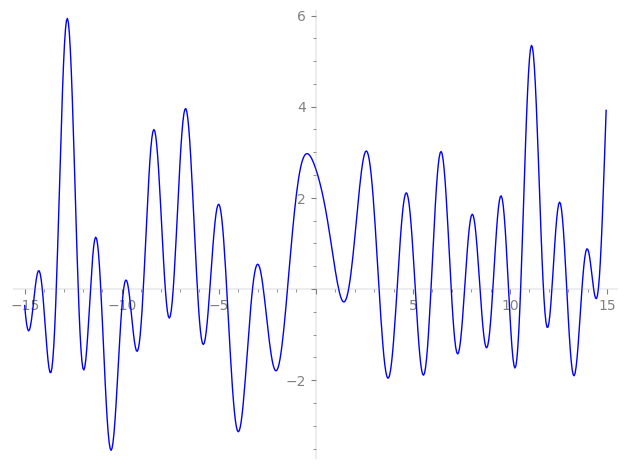
Imaginary part of the first few zeros on the critical line
−9.649664456675196608220089494129, −8.891515113565930553847051921680, −7.75580883748965618998945175195, −7.34900779560541395836954138467, −6.10381676034149076382538479630, −5.46312973656750310720058812404, −4.59281120671920182281720451328, −3.26633614749008050068935470052, −2.70734530473096481851232177469, −1.46351429508349018506931017905,
1.17258642491509972691804441691, 1.68426389345896051208933749877, 3.25302881929121552535557613418, 4.18154183618513578307252095891, 5.11942504661229295076668311226, 5.92814476267023460375895759934, 6.96968852762326821981473091779, 7.65921548989232211042052090270, 8.454437991625453790103455102425, 9.113652889425262566616338964686