| L(s) = 1 | + 4·2-s − 4.18·3-s + 16·4-s − 19.2·5-s − 16.7·6-s − 11.5·7-s + 64·8-s − 225.·9-s − 76.8·10-s + 613.·11-s − 66.9·12-s − 338.·13-s − 46.2·14-s + 80.4·15-s + 256·16-s − 2.10e3·17-s − 901.·18-s − 1.16e3·19-s − 307.·20-s + 48.3·21-s + 2.45e3·22-s − 550.·23-s − 267.·24-s − 2.75e3·25-s − 1.35e3·26-s + 1.96e3·27-s − 184.·28-s + ⋯ |
| L(s) = 1 | + 0.707·2-s − 0.268·3-s + 0.5·4-s − 0.343·5-s − 0.189·6-s − 0.0891·7-s + 0.353·8-s − 0.927·9-s − 0.243·10-s + 1.52·11-s − 0.134·12-s − 0.555·13-s − 0.0630·14-s + 0.0922·15-s + 0.250·16-s − 1.76·17-s − 0.656·18-s − 0.742·19-s − 0.171·20-s + 0.0239·21-s + 1.08·22-s − 0.216·23-s − 0.0948·24-s − 0.881·25-s − 0.392·26-s + 0.517·27-s − 0.0445·28-s + ⋯ |
\[\begin{aligned}\Lambda(s)=\mathstrut & 158 ^{s/2} \, \Gamma_{\C}(s) \, L(s)\cr =\mathstrut & -\, \Lambda(6-s) \end{aligned}\]
\[\begin{aligned}\Lambda(s)=\mathstrut & 158 ^{s/2} \, \Gamma_{\C}(s+5/2) \, L(s)\cr =\mathstrut & -\, \Lambda(1-s) \end{aligned}\]
Particular Values
| \(L(3)\) |
\(=\) |
\(0\) |
| \(L(\frac12)\) |
\(=\) |
\(0\) |
| \(L(\frac{7}{2})\) |
|
not available |
| \(L(1)\) |
|
not available |
\(L(s) = \displaystyle \prod_{p} F_p(p^{-s})^{-1} \)
| $p$ | $F_p(T)$ |
|---|
| bad | 2 | \( 1 - 4T \) |
| 79 | \( 1 - 6.24e3T \) |
| good | 3 | \( 1 + 4.18T + 243T^{2} \) |
| 5 | \( 1 + 19.2T + 3.12e3T^{2} \) |
| 7 | \( 1 + 11.5T + 1.68e4T^{2} \) |
| 11 | \( 1 - 613.T + 1.61e5T^{2} \) |
| 13 | \( 1 + 338.T + 3.71e5T^{2} \) |
| 17 | \( 1 + 2.10e3T + 1.41e6T^{2} \) |
| 19 | \( 1 + 1.16e3T + 2.47e6T^{2} \) |
| 23 | \( 1 + 550.T + 6.43e6T^{2} \) |
| 29 | \( 1 + 1.36e3T + 2.05e7T^{2} \) |
| 31 | \( 1 + 1.27e3T + 2.86e7T^{2} \) |
| 37 | \( 1 + 4.94e3T + 6.93e7T^{2} \) |
| 41 | \( 1 + 1.69e4T + 1.15e8T^{2} \) |
| 43 | \( 1 - 2.37e4T + 1.47e8T^{2} \) |
| 47 | \( 1 + 2.05e4T + 2.29e8T^{2} \) |
| 53 | \( 1 + 4.39e3T + 4.18e8T^{2} \) |
| 59 | \( 1 + 2.70e4T + 7.14e8T^{2} \) |
| 61 | \( 1 - 4.68e4T + 8.44e8T^{2} \) |
| 67 | \( 1 + 2.46e4T + 1.35e9T^{2} \) |
| 71 | \( 1 - 4.87e4T + 1.80e9T^{2} \) |
| 73 | \( 1 - 4.37e3T + 2.07e9T^{2} \) |
| 83 | \( 1 - 3.81e4T + 3.93e9T^{2} \) |
| 89 | \( 1 - 1.02e5T + 5.58e9T^{2} \) |
| 97 | \( 1 + 1.32e5T + 8.58e9T^{2} \) |
| show more | |
| show less | |
\(L(s) = \displaystyle\prod_p \ \prod_{j=1}^{2} (1 - \alpha_{j,p}\, p^{-s})^{-1}\)
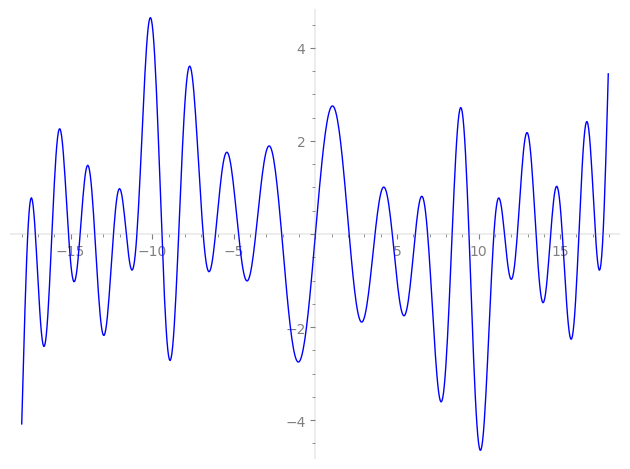
Imaginary part of the first few zeros on the critical line
−11.58919969594918050551796988914, −10.94090340543816612823132155837, −9.411861381373861602127097351333, −8.379897767540695395048909000221, −6.87815820450074482452996400605, −6.12269072356017555667023878577, −4.71173199163839998983899424061, −3.65440873970314037680443084777, −2.06780598717021587554843533770, 0,
2.06780598717021587554843533770, 3.65440873970314037680443084777, 4.71173199163839998983899424061, 6.12269072356017555667023878577, 6.87815820450074482452996400605, 8.379897767540695395048909000221, 9.411861381373861602127097351333, 10.94090340543816612823132155837, 11.58919969594918050551796988914