| L(s) = 1 | + (1.53 − 2.65i)5-s − 2.06·7-s + 6.45·11-s + (−0.5 − 0.866i)13-s + (0.694 − 1.20i)17-s + (−3.75 − 2.20i)19-s + (1.53 + 2.65i)23-s + (−2.19 − 3.80i)25-s + (−1.75 − 3.04i)29-s + 9.45·31-s + (−3.16 + 5.47i)35-s − 2.38·37-s + (5.06 − 8.77i)41-s + (−3.03 + 5.25i)43-s + (−3 − 5.19i)47-s + ⋯ |
| L(s) = 1 | + (0.685 − 1.18i)5-s − 0.780·7-s + 1.94·11-s + (−0.138 − 0.240i)13-s + (0.168 − 0.291i)17-s + (−0.862 − 0.506i)19-s + (0.319 + 0.553i)23-s + (−0.438 − 0.760i)25-s + (−0.326 − 0.565i)29-s + 1.69·31-s + (−0.534 + 0.925i)35-s − 0.392·37-s + (0.790 − 1.36i)41-s + (−0.462 + 0.800i)43-s + (−0.437 − 0.757i)47-s + ⋯ |
\[\begin{aligned}\Lambda(s)=\mathstrut & 1368 ^{s/2} \, \Gamma_{\C}(s) \, L(s)\cr =\mathstrut & (0.204 + 0.978i)\, \overline{\Lambda}(2-s) \end{aligned}\]
\[\begin{aligned}\Lambda(s)=\mathstrut & 1368 ^{s/2} \, \Gamma_{\C}(s+1/2) \, L(s)\cr =\mathstrut & (0.204 + 0.978i)\, \overline{\Lambda}(1-s) \end{aligned}\]
Particular Values
| \(L(1)\) |
\(\approx\) |
\(1.807000954\) |
| \(L(\frac12)\) |
\(\approx\) |
\(1.807000954\) |
| \(L(\frac{3}{2})\) |
|
not available |
| \(L(1)\) |
|
not available |
\(L(s) = \displaystyle \prod_{p} F_p(p^{-s})^{-1} \)
| $p$ | $F_p(T)$ |
|---|
| bad | 2 | \( 1 \) |
| 3 | \( 1 \) |
| 19 | \( 1 + (3.75 + 2.20i)T \) |
| good | 5 | \( 1 + (-1.53 + 2.65i)T + (-2.5 - 4.33i)T^{2} \) |
| 7 | \( 1 + 2.06T + 7T^{2} \) |
| 11 | \( 1 - 6.45T + 11T^{2} \) |
| 13 | \( 1 + (0.5 + 0.866i)T + (-6.5 + 11.2i)T^{2} \) |
| 17 | \( 1 + (-0.694 + 1.20i)T + (-8.5 - 14.7i)T^{2} \) |
| 23 | \( 1 + (-1.53 - 2.65i)T + (-11.5 + 19.9i)T^{2} \) |
| 29 | \( 1 + (1.75 + 3.04i)T + (-14.5 + 25.1i)T^{2} \) |
| 31 | \( 1 - 9.45T + 31T^{2} \) |
| 37 | \( 1 + 2.38T + 37T^{2} \) |
| 41 | \( 1 + (-5.06 + 8.77i)T + (-20.5 - 35.5i)T^{2} \) |
| 43 | \( 1 + (3.03 - 5.25i)T + (-21.5 - 37.2i)T^{2} \) |
| 47 | \( 1 + (3 + 5.19i)T + (-23.5 + 40.7i)T^{2} \) |
| 53 | \( 1 + (5.29 + 9.16i)T + (-26.5 + 45.8i)T^{2} \) |
| 59 | \( 1 + (5.59 - 9.69i)T + (-29.5 - 51.0i)T^{2} \) |
| 61 | \( 1 + (2.56 + 4.44i)T + (-30.5 + 52.8i)T^{2} \) |
| 67 | \( 1 + (1.72 + 2.99i)T + (-33.5 + 58.0i)T^{2} \) |
| 71 | \( 1 + (-3.36 + 5.83i)T + (-35.5 - 61.4i)T^{2} \) |
| 73 | \( 1 + (-4.56 + 7.90i)T + (-36.5 - 63.2i)T^{2} \) |
| 79 | \( 1 + (-0.790 + 1.36i)T + (-39.5 - 68.4i)T^{2} \) |
| 83 | \( 1 - 17.6T + 83T^{2} \) |
| 89 | \( 1 + (-5.22 - 9.05i)T + (-44.5 + 77.0i)T^{2} \) |
| 97 | \( 1 + (3.36 - 5.83i)T + (-48.5 - 84.0i)T^{2} \) |
| show more | |
| show less | |
\(L(s) = \displaystyle\prod_p \ \prod_{j=1}^{2} (1 - \alpha_{j,p}\, p^{-s})^{-1}\)
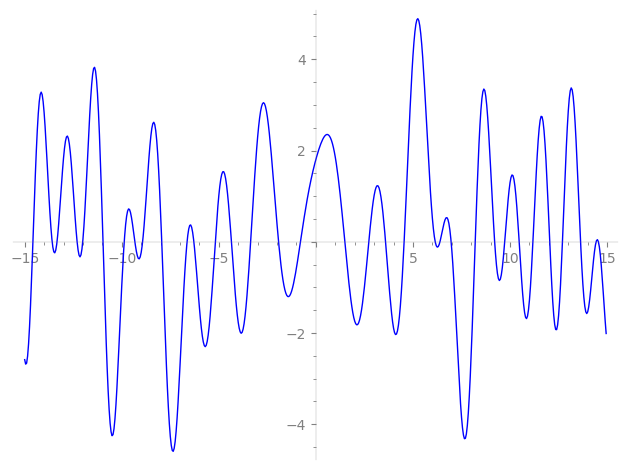
Imaginary part of the first few zeros on the critical line
−9.324526853071403354609042561737, −8.926513923688828341322268895543, −7.940412089166861513392469589594, −6.63565009444622167399973272032, −6.28665218104516879475013906624, −5.18173306242334255396841507591, −4.35133154099774654818488091527, −3.36104643187903926829099184267, −1.92264641989444094445282057784, −0.795024086808873161380527557363,
1.48990395070094719059366673024, 2.72461051280171794247916858762, 3.58813435629921523393983516132, 4.54377455418055608054767599199, 6.14515950194102320189883226790, 6.39040408783257216095135483618, 6.96475489631035546838155460711, 8.206180811015168249646915493803, 9.207071016716004642866145968743, 9.725314856379548701678154694645