| L(s) = 1 | + (−4.89 − 2.82i)5-s + (1.5 + 2.59i)7-s + (−4.89 + 2.82i)11-s + (8.5 − 14.7i)13-s + 28.2i·17-s − 11·19-s + (34.2 + 19.7i)23-s + (3.49 + 6.06i)25-s + (−29.3 + 16.9i)29-s + (25 − 43.3i)31-s − 16.9i·35-s − 33·37-s + (−29.3 − 16.9i)41-s + (5 + 8.66i)43-s + (73.4 − 42.4i)47-s + ⋯ |
| L(s) = 1 | + (−0.979 − 0.565i)5-s + (0.214 + 0.371i)7-s + (−0.445 + 0.257i)11-s + (0.653 − 1.13i)13-s + 1.66i·17-s − 0.578·19-s + (1.49 + 0.860i)23-s + (0.139 + 0.242i)25-s + (−1.01 + 0.585i)29-s + (0.806 − 1.39i)31-s − 0.484i·35-s − 0.891·37-s + (−0.716 − 0.413i)41-s + (0.116 + 0.201i)43-s + (1.56 − 0.902i)47-s + ⋯ |
\[\begin{aligned}\Lambda(s)=\mathstrut & 1296 ^{s/2} \, \Gamma_{\C}(s) \, L(s)\cr =\mathstrut & (0.642 + 0.766i)\, \overline{\Lambda}(3-s) \end{aligned}\]
\[\begin{aligned}\Lambda(s)=\mathstrut & 1296 ^{s/2} \, \Gamma_{\C}(s+1) \, L(s)\cr =\mathstrut & (0.642 + 0.766i)\, \overline{\Lambda}(1-s) \end{aligned}\]
Particular Values
| \(L(\frac{3}{2})\) |
\(\approx\) |
\(1.368100176\) |
| \(L(\frac12)\) |
\(\approx\) |
\(1.368100176\) |
| \(L(2)\) |
|
not available |
| \(L(1)\) |
|
not available |
\(L(s) = \displaystyle \prod_{p} F_p(p^{-s})^{-1} \)
| $p$ | $F_p(T)$ |
|---|
| bad | 2 | \( 1 \) |
| 3 | \( 1 \) |
| good | 5 | \( 1 + (4.89 + 2.82i)T + (12.5 + 21.6i)T^{2} \) |
| 7 | \( 1 + (-1.5 - 2.59i)T + (-24.5 + 42.4i)T^{2} \) |
| 11 | \( 1 + (4.89 - 2.82i)T + (60.5 - 104. i)T^{2} \) |
| 13 | \( 1 + (-8.5 + 14.7i)T + (-84.5 - 146. i)T^{2} \) |
| 17 | \( 1 - 28.2iT - 289T^{2} \) |
| 19 | \( 1 + 11T + 361T^{2} \) |
| 23 | \( 1 + (-34.2 - 19.7i)T + (264.5 + 458. i)T^{2} \) |
| 29 | \( 1 + (29.3 - 16.9i)T + (420.5 - 728. i)T^{2} \) |
| 31 | \( 1 + (-25 + 43.3i)T + (-480.5 - 832. i)T^{2} \) |
| 37 | \( 1 + 33T + 1.36e3T^{2} \) |
| 41 | \( 1 + (29.3 + 16.9i)T + (840.5 + 1.45e3i)T^{2} \) |
| 43 | \( 1 + (-5 - 8.66i)T + (-924.5 + 1.60e3i)T^{2} \) |
| 47 | \( 1 + (-73.4 + 42.4i)T + (1.10e3 - 1.91e3i)T^{2} \) |
| 53 | \( 1 + 11.3iT - 2.80e3T^{2} \) |
| 59 | \( 1 + (24.4 + 14.1i)T + (1.74e3 + 3.01e3i)T^{2} \) |
| 61 | \( 1 + (-20.5 - 35.5i)T + (-1.86e3 + 3.22e3i)T^{2} \) |
| 67 | \( 1 + (-41.5 + 71.8i)T + (-2.24e3 - 3.88e3i)T^{2} \) |
| 71 | \( 1 - 22.6iT - 5.04e3T^{2} \) |
| 73 | \( 1 - 127T + 5.32e3T^{2} \) |
| 79 | \( 1 + (-9.5 - 16.4i)T + (-3.12e3 + 5.40e3i)T^{2} \) |
| 83 | \( 1 + (-107. + 62.2i)T + (3.44e3 - 5.96e3i)T^{2} \) |
| 89 | \( 1 + 84.8iT - 7.92e3T^{2} \) |
| 97 | \( 1 + (83.5 + 144. i)T + (-4.70e3 + 8.14e3i)T^{2} \) |
| show more | |
| show less | |
\(L(s) = \displaystyle\prod_p \ \prod_{j=1}^{2} (1 - \alpha_{j,p}\, p^{-s})^{-1}\)
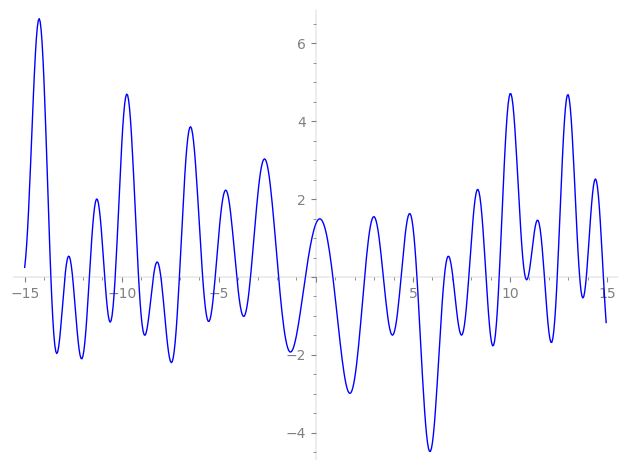
Imaginary part of the first few zeros on the critical line
−9.135438766906181745330022786070, −8.372753472235891070374922964435, −7.985153824736990318520372944338, −7.03197743846962860341741142518, −5.83292315469408645343065882535, −5.18701614925823394195770655072, −4.07499466928882617590053310518, −3.36836370806873358183697973886, −1.92134590302240437343837800140, −0.54343932436196388978073348990,
0.873567905221876954757267982984, 2.51018752575288961567318869472, 3.47483429540856317523389963956, 4.38831378027628942185028226903, 5.20530504622256874051400203919, 6.61391876036426786144006287422, 7.05463252906143742833772718375, 7.87456159848416658139906215457, 8.765599358594176484823685972165, 9.440423777645045228228259847106