magma: G := PermutationGroup< 13 | (1,2)(4,5)(6,7)(8,9)(10,11,12), (2,3,4,6,8,7,9)(11,12,13) >;
gap: G := Group( (1,2)(4,5)(6,7)(8,9)(10,11,12), (2,3,4,6,8,7,9)(11,12,13) );
sage: G = PermutationGroup(['(1,2)(4,5)(6,7)(8,9)(10,11,12)', '(2,3,4,6,8,7,9)(11,12,13)'])
Group information
Description: $A_4\times \SL(2,8)$ Order: \(6048\)\(\medspace = 2^{5} \cdot 3^{3} \cdot 7 \)
magma: Order(G);
gap: Order(G);
sage: G.order()
sage_gap: G.Order()
Exponent: \(126\)\(\medspace = 2 \cdot 3^{2} \cdot 7 \)
magma: Exponent(G);
gap: Exponent(G);
sage: G.exponent()
sage_gap: G.Exponent()
Automorphism group :$S_4\times {}^2G(2,3)$ , of order \(36288\)\(\medspace = 2^{6} \cdot 3^{4} \cdot 7 \)
gap: AutomorphismGroup(G);
magma: AutomorphismGroup(G);
sage_gap: G.AutomorphismGroup()
Composition factors :$C_2$ x 2 , $C_3$ , $\SL(2,8)$
magma: CompositionFactors(G);
gap: CompositionSeries(G);
sage: G.composition_series()
sage_gap: G.CompositionSeries()
Derived length: $2$
magma: DerivedLength(G);
gap: DerivedLength(G);
sage_gap: G.DerivedLength()
This group is nonabelian , an A-group , and nonsolvable .
magma: IsAbelian(G);
gap: IsAbelian(G);
sage: G.is_abelian()
sage_gap: G.IsAbelian()
magma: IsCyclic(G);
gap: IsCyclic(G);
sage: G.is_cyclic()
sage_gap: G.IsCyclic()
magma: IsNilpotent(G);
gap: IsNilpotentGroup(G);
sage: G.is_nilpotent()
sage_gap: G.IsNilpotentGroup()
magma: IsSolvable(G);
gap: IsSolvableGroup(G);
sage: G.is_solvable()
sage_gap: G.IsSolvableGroup()
gap: IsSupersolvableGroup(G);
sage: G.is_supersolvable()
sage_gap: G.IsSupersolvableGroup()
magma: IsSimple(G);
gap: IsSimpleGroup(G);
sage_gap: G.IsSimpleGroup()
Group statistics
magma: // Magma code to output the first two rows of the group statistics table
element_orders := [Order(g) : g in G];
orders := Set(element_orders);
printf "Orders: %o\n", orders;
printf "Elements: %o %o\n", [#[x : x in element_orders | x eq n] : n in orders], Order(G);
cc_orders := [cc[1] : cc in ConjugacyClasses(G)];
printf "Conjugacy classes: %o %o\n", [#[x : x in cc_orders | x eq n] : n in orders], #cc_orders;
gap: # Gap code to output the first two rows of the group statistics table
element_orders := List(Elements(G), g -> Order(g));
orders := Set(element_orders);
Print("Orders: ", orders, "\n");
element_counts := List(orders, n -> Length(Filtered(element_orders, x -> x = n)));
Print("Elements: ", element_counts, " ", Size(G), "\n");
cc_orders := List(ConjugacyClasses(G), cc -> Order(Representative(cc)));
cc_counts := List(orders, n -> Length(Filtered(cc_orders, x -> x = n)));
Print("Conjugacy classes: ", cc_counts, " ", Length(ConjugacyClasses(G)), "\n");
sage: # Sage code to output the first two rows of the group statistics table
element_orders = [g.order() for g in G]
orders = sorted(list(set(element_orders)))
print("Orders:", orders)
print("Elements:", [element_orders.count(n) for n in orders], G.order())
cc_orders = [cc[0].order() for cc in G.conjugacy_classes()]
print("Conjugacy classes:", [cc_orders.count(n) for n in orders], len(cc_orders))
magma: // Outputs [<d_1,c_1>, <d_2,c_2>, ...] where c_i is the number of irr. complex chars. of G with degree d_i
CharacterDegrees(G);
gap: # Outputs [[d_1,c_1], [d_2,c_2], ...] where c_i is the number of irr. complex chars. of G with degree d_i
CharacterDegrees(G);
sage: # Outputs [[d_1,c_1], [d_2,c_2], ...] where c_i is the number of irr. complex chars. of G with degree d_i
character_degrees = [c[0] for c in G.character_table()]
[[n, character_degrees.count(n)] for n in set(character_degrees)]
sage_gap: G.CharacterDegrees()
Minimal presentations
Constructions
Permutation group :Degree $13$
$\langle(1,2)(4,5)(6,7)(8,9)(10,11,12), (2,3,4,6,8,7,9)(11,12,13)\rangle$
magma: G := PermutationGroup< 13 | (1,2)(4,5)(6,7)(8,9)(10,11,12), (2,3,4,6,8,7,9)(11,12,13) >;
gap: G := Group( (1,2)(4,5)(6,7)(8,9)(10,11,12), (2,3,4,6,8,7,9)(11,12,13) );
sage: G = PermutationGroup(['(1,2)(4,5)(6,7)(8,9)(10,11,12)', '(2,3,4,6,8,7,9)(11,12,13)'])
Transitive group :36T6813 more information
Direct product :$A_4$ $\, \times\, $ $\SL(2,8)$
Semidirect product :$(C_2^2\times \SL(2,8))$ $\,\rtimes\,$ $C_3$ $C_2^2$ $\,\rtimes\,$ $(C_3\times \SL(2,8))$ more information
Trans. wreath product :not isomorphic to a non-trivial transitive wreath product
Elements of the group are displayed as permutations of degree 13.
Homology
Abelianization : $C_{3} $
magma: quo< G | CommutatorSubgroup(G) >;
gap: FactorGroup(G, DerivedSubgroup(G));
sage: G.quotient(G.commutator())
Schur multiplier :$C_{2}$
gap: AbelianInvariantsMultiplier(G);
sage: G.homology(2)
sage_gap: G.AbelianInvariantsMultiplier()
Commutator length :$1$
gap: CommutatorLength(G);
sage_gap: G.CommutatorLength()
Subgroups
magma: Subgroups(G);
gap: AllSubgroups(G);
sage: G.subgroups()
sage_gap: G.AllSubgroups()
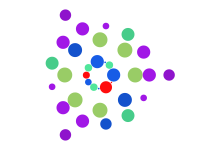
There are 7954 subgroups in 84 conjugacy classes , 6 normal , and all normal subgroups are characteristic.
Characteristic subgroups are shown in this color .
Special subgroups
Hi
diagram
profile
all subgroups
normal subgroups
up to conjugacy
up to automorphism
Classes of subgroups up to conjugation
Classes of subgroups up to automorphism
Normal subgroups
Normal subgroups up to automorphism
Classes of subgroups up to conjugation
Order 6048: $A_4\times \SL(2,8)$ Order 2016: $C_2^2\times \SL(2,8)$ Order 1512: $C_3\times \SL(2,8)$ Order 1008: $C_2\times \SL(2,8)$ Order 672: $A_4\times F_8$ Order 504: $\SL(2,8)$ Order 224: $C_2^2\times F_8$ Order 216: $A_4\times D_9$ Order 168: $A_4\times D_7$ , $C_3\times F_8$ Order 112: $C_2\times F_8$ Order 108: $C_9\times A_4$ Order 96: $C_2^3\times A_4$ Order 84: $C_7\times A_4$ Order 72: $S_3\times A_4$ , $C_2\times D_{18}$ Order 56: $C_2\times D_{14}$ , $F_8$ Order 54: $C_3\times D_9$ Order 48: $C_2^2\times A_4$ Order 42: $C_3\times D_7$ Order 36: $D_{18}$ x 2, $C_2\times C_{18}$ , $C_2^2:C_9$ , $C_3\times A_4$ Order 32: $C_2^5$ Order 28: $D_{14}$ x 2, $C_2\times C_{14}$ Order 27: $C_3\times C_9$ Order 24: $C_2^2\times C_6$ , $C_2\times D_6$ , $C_2\times A_4$ Order 21: $C_{21}$ Order 18: $D_9$ x 2, $C_3\times S_3$ , $C_{18}$ Order 16: $C_2^4$ x 3 Order 14: $D_7$ x 2, $C_{14}$ Order 12: $C_2\times C_6$ x 2, $D_6$ x 2, $A_4$ x 2 Order 9: $C_9$ x 2, $C_3^2$ Order 8: $C_2^3$ x 9 Order 7: $C_7$ Order 6: $C_6$ x 2, $S_3$ x 2 Order 4: $C_2^2$ x 9 Order 3: $C_3$ x 3 Order 2: $C_2$ x 3 Order 1: $C_1$
Classes of subgroups up to automorphism
Order 6048: $A_4\times \SL(2,8)$ Order 2016: $C_2^2\times \SL(2,8)$ Order 1512: $C_3\times \SL(2,8)$ Order 1008: $C_2\times \SL(2,8)$ Order 672: $A_4\times F_8$ Order 504: $\SL(2,8)$ Order 224: $C_2^2\times F_8$ Order 216: $A_4\times D_9$ Order 168: $A_4\times D_7$ , $C_3\times F_8$ Order 112: $C_2\times F_8$ Order 108: $C_9\times A_4$ Order 96: $C_2^3\times A_4$ Order 84: $C_7\times A_4$ Order 72: $S_3\times A_4$ , $C_2\times D_{18}$ Order 56: $C_2\times D_{14}$ , $F_8$ Order 54: $C_3\times D_9$ Order 48: $C_2^2\times A_4$ Order 42: $C_3\times D_7$ Order 36: $D_{18}$ x 2, $C_2\times C_{18}$ , $C_2^2:C_9$ , $C_3\times A_4$ Order 32: $C_2^5$ Order 28: $D_{14}$ x 2, $C_2\times C_{14}$ Order 27: $C_3\times C_9$ Order 24: $C_2^2\times C_6$ , $C_2\times D_6$ , $C_2\times A_4$ Order 21: $C_{21}$ Order 18: $D_9$ x 2, $C_3\times S_3$ , $C_{18}$ Order 16: $C_2^4$ x 3 Order 14: $D_7$ x 2, $C_{14}$ Order 12: $C_2\times C_6$ x 2, $D_6$ x 2, $A_4$ x 2 Order 9: $C_9$ x 2, $C_3^2$ Order 8: $C_2^3$ x 6 Order 7: $C_7$ Order 6: $C_6$ x 2, $S_3$ x 2 Order 4: $C_2^2$ x 6 Order 3: $C_3$ x 3 Order 2: $C_2$ x 3 Order 1: $C_1$
Normal subgroups (quotient in parentheses)
Normal subgroups up to automorphism (quotient in parentheses)
Series
Derived series
$A_4\times \SL(2,8)$
$\rhd$
$C_2^2\times \SL(2,8)$
$\rhd$
$\SL(2,8)$
magma: DerivedSeries(G);
gap: DerivedSeriesOfGroup(G);
sage: G.derived_series()
sage_gap: G.DerivedSeriesOfGroup()
Chief series
$A_4\times \SL(2,8)$
$\rhd$
$A_4$
$\rhd$
$C_2^2$
$\rhd$
$C_1$
magma: ChiefSeries(G);
gap: ChiefSeries(G);
sage_gap: G.ChiefSeries()
Lower central series
$A_4\times \SL(2,8)$
$\rhd$
$C_2^2\times \SL(2,8)$
magma: LowerCentralSeries(G);
gap: LowerCentralSeriesOfGroup(G);
sage: G.lower_central_series()
sage_gap: G.LowerCentralSeriesOfGroup()
Upper central series
$C_1$
magma: UpperCentralSeries(G);
gap: UpperCentralSeriesOfGroup(G);
sage: G.upper_central_series()
sage_gap: G.UpperCentralSeriesOfGroup()
Supergroups
This group is a maximal subgroup of 5 larger groups in the database.
This group is a maximal quotient of 2 larger groups in the database.
Character theory
magma: CharacterTable(G); // Output not guaranteed to exactly match the LMFDB table
gap: CharacterTable(G); # Output not guaranteed to exactly match the LMFDB table
sage: G.character_table() # Output not guaranteed to exactly match the LMFDB table
sage_gap: G.CharacterTable() # Output not guaranteed to exactly match the LMFDB table
See the $36 \times 36$ character table .
Alternatively, you may search for characters of this group with desired properties.
1A 2A 2B 2C 3A 3B 3C 6A 6B 7A 9A 9B 14A 18A 21A
Size
1
3
63
189
8
56
448
168
504
216
168
1344
648
504
1728
2 P 1A
1A
1A
1A
3A
3B
3C
3B
3A
7A
9A
9B
7A
9A
21A
3 P 1A
2A
2B
2C
1A
1A
1A
2A
2B
7A
3B
3B
14A
6A
7A
7 P 1A
2A
2B
2C
3A
3B
3C
6A
6B
1A
9A
9B
2A
18A
3A
6048.s.1a
1 1 1 1 1 1 1 1 1 1 1 1 1 1 1
6048.s.1b
2 2 2 2 − 1 2 − 1 2 − 1 2 2 − 1 2 2 − 1
6048.s.3a
3 − 1 3 − 1 0 3 0 − 1 0 3 3 0 − 1 − 1 0
6048.s.7a
7 7 − 1 − 1 7 − 2 − 2 − 2 − 1 0 1 1 0 1 0
6048.s.7b
14 14 − 2 − 2 − 7 − 4 2 − 4 1 0 2 − 1 0 2 0
6048.s.7c
21 21 − 3 − 3 21 3 3 3 − 3 0 0 0 0 0 0
6048.s.7d
42 42 − 6 − 6 − 21 6 − 3 6 3 0 0 0 0 0 0
6048.s.8a
8 8 0 0 8 − 1 − 1 − 1 0 1 − 1 − 1 1 − 1 1
6048.s.8b
16 16 0 0 − 8 − 2 1 − 2 0 2 − 2 1 2 − 2 − 1
6048.s.9a
27 27 3 3 27 0 0 0 3 − 1 0 0 − 1 0 − 1
6048.s.9b
54 54 6 6 − 27 0 0 0 − 3 − 2 0 0 − 2 0 1
6048.s.21a
21 − 7 − 3 1 0 − 6 0 2 0 0 3 0 0 − 1 0
6048.s.21b
63 − 21 − 9 3 0 9 0 − 3 0 0 0 0 0 0 0
6048.s.24a
24 − 8 0 0 0 − 3 0 1 0 3 − 3 0 − 1 1 0
6048.s.27a
81 − 27 9 − 3 0 0 0 0 0 − 3 0 0 1 0 0