
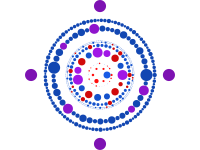
Properties

Label 1119744.ej
Order \( 2^{9} \cdot 3^{7} \)
Exponent \( 2^{2} \cdot 3^{2} \)
Nilpotent no
Solvable yes
$\card{G^{\mathrm{ab}}}$ \( 2^{2} \)
$\card{Z(G)}$ \( 2 \)
$\card{\Aut(G)}$ \( 2^{13} \cdot 3^{7} \)
$\card{\mathrm{Out}(G)}$ \( 2^{5} \)
Perm deg. $30$
Trans deg. $36$
Rank $2$

Related objects

Downloads

Learn more

Show commands: Gap / Magma / SageMath

Copy content comment:Define the group as a permutation group
 
Copy content magma:G := PermutationGroup< 30 | (1,3,6)(2,4,7)(5,8,9)(10,11,13,16,12,15)(14,17)(18,20,23,24,25,26)(19,21,22)(27,29,30,28), (1,2)(3,5)(4,6)(7,9)(10,11,12,14)(13,16,17,15)(18,19)(20,22)(21,23)(25,26)(27,28)(29,30) >;
 
Copy content gap:G := Group( (1,3,6)(2,4,7)(5,8,9)(10,11,13,16,12,15)(14,17)(18,20,23,24,25,26)(19,21,22)(27,29,30,28), (1,2)(3,5)(4,6)(7,9)(10,11,12,14)(13,16,17,15)(18,19)(20,22)(21,23)(25,26)(27,28)(29,30) );
 
Copy content sage:G = PermutationGroup(['(1,3,6)(2,4,7)(5,8,9)(10,11,13,16,12,15)(14,17)(18,20,23,24,25,26)(19,21,22)(27,29,30,28)', '(1,2)(3,5)(4,6)(7,9)(10,11,12,14)(13,16,17,15)(18,19)(20,22)(21,23)(25,26)(27,28)(29,30)'])
 
Copy content sage_gap:# This uses Sage's interface to GAP, as Sage (currently) has no native support for PC groups G = gap.new('PcGroupCode(27173699841255673910201227331760957114610514811820094268252012308919752436355248510312728411974948041288742778250716017024013317993888283912008410281046668230283263447513317913475059181128321556347210095811292274198324994690105412319859006889735149268027428316884018749845258983329333647877511816113333935007057112702081388798846335403878553502954691664053452009425933019544633784083565934387467257468100665168298487891162352283493371173125710864112637483519387362131093577337181898336538182592847835464332731803708148010270545485959851,1119744)'); a = G.1; b = G.2; c = G.5; d = G.6; e = G.8; f = G.10; g = G.12; h = G.14; i = G.16;
 

Group information

Description:$C_6^3.C_6^3:S_4$
Order: \(1119744\)\(\medspace = 2^{9} \cdot 3^{7} \)
Copy content comment:Order of the group
 
Copy content magma:Order(G);
 
Copy content gap:Order(G);
 
Copy content sage:G.order()
 
Copy content sage_gap:G.Order()
 
Exponent: \(36\)\(\medspace = 2^{2} \cdot 3^{2} \)
Copy content comment:Exponent of the group
 
Copy content magma:Exponent(G);
 
Copy content gap:Exponent(G);
 
Copy content sage:G.exponent()
 
Copy content sage_gap:G.Exponent()
 
Automorphism group:$C_3^6.C_2^6.C_6.C_2^6$, of order \(17915904\)\(\medspace = 2^{13} \cdot 3^{7} \)
Copy content comment:Automorphism group
 
Copy content gap:AutomorphismGroup(G);
 
Copy content magma:AutomorphismGroup(G);
 
Copy content sage_gap:G.AutomorphismGroup()
 
Composition factors:$C_2$ x 9, $C_3$ x 7
Copy content comment:Composition factors of the group
 
Copy content magma:CompositionFactors(G);
 
Copy content gap:CompositionSeries(G);
 
Copy content sage:G.composition_series()
 
Copy content sage_gap:G.CompositionSeries()
 
Derived length:$4$
Copy content comment:Derived length of the group
 
Copy content magma:DerivedLength(G);
 
Copy content gap:DerivedLength(G);
 
Copy content sage_gap:G.DerivedLength()
 

This group is nonabelian and solvable. Whether it is monomial has not been computed.

Copy content comment:Determine if the group G is abelian
 
Copy content magma:IsAbelian(G);
 
Copy content gap:IsAbelian(G);
 
Copy content sage:G.is_abelian()
 
Copy content sage_gap:G.IsAbelian()
 
Copy content comment:Determine if the group G is cyclic
 
Copy content magma:IsCyclic(G);
 
Copy content gap:IsCyclic(G);
 
Copy content sage:G.is_cyclic()
 
Copy content sage_gap:G.IsCyclic()
 
Copy content comment:Determine if the group G is nilpotent
 
Copy content magma:IsNilpotent(G);
 
Copy content gap:IsNilpotentGroup(G);
 
Copy content sage:G.is_nilpotent()
 
Copy content sage_gap:G.IsNilpotentGroup()
 
Copy content comment:Determine if the group G is solvable
 
Copy content magma:IsSolvable(G);
 
Copy content gap:IsSolvableGroup(G);
 
Copy content sage:G.is_solvable()
 
Copy content sage_gap:G.IsSolvableGroup()
 
Copy content comment:Determine if the group G is supersolvable
 
Copy content gap:IsSupersolvableGroup(G);
 
Copy content sage:G.is_supersolvable()
 
Copy content sage_gap:G.IsSupersolvableGroup()
 
Copy content comment:Determine if the group G is simple
 
Copy content magma:IsSimple(G);
 
Copy content gap:IsSimpleGroup(G);
 
Copy content sage_gap:G.IsSimpleGroup()
 

Group statistics

Copy content comment:Compute statistics for the group G
 
Copy content magma:// Magma code to output the first two rows of the group statistics table element_orders := [Order(g) : g in G]; orders := Set(element_orders); printf "Orders: %o\n", orders; printf "Elements: %o %o\n", [#[x : x in element_orders | x eq n] : n in orders], Order(G); cc_orders := [cc[1] : cc in ConjugacyClasses(G)]; printf "Conjugacy classes: %o %o\n", [#[x : x in cc_orders | x eq n] : n in orders], #cc_orders;
 
Copy content gap:# Gap code to output the first two rows of the group statistics table element_orders := List(Elements(G), g -> Order(g)); orders := Set(element_orders); Print("Orders: ", orders, "\n"); element_counts := List(orders, n -> Length(Filtered(element_orders, x -> x = n))); Print("Elements: ", element_counts, " ", Size(G), "\n"); cc_orders := List(ConjugacyClasses(G), cc -> Order(Representative(cc))); cc_counts := List(orders, n -> Length(Filtered(cc_orders, x -> x = n))); Print("Conjugacy classes: ", cc_counts, " ", Length(ConjugacyClasses(G)), "\n");
 
Copy content sage:# Sage code to output the first two rows of the group statistics table element_orders = [g.order() for g in G] orders = sorted(list(set(element_orders))) print("Orders:", orders) print("Elements:", [element_orders.count(n) for n in orders], G.order()) cc_orders = [cc[0].order() for cc in G.conjugacy_classes()] print("Conjugacy classes:", [cc_orders.count(n) for n in orders], len(cc_orders))
 

Order 1 2 3 4 6 9 12 18 36
Elements 1 12991 11096 81216 159944 82944 564192 82944 124416 1119744
Conjugacy classes   1 23 26 20 608 5 140 5 4 832
Divisions 1 23 24 19 465 5 85 5 2 629
Autjugacy classes 1 19 24 13 346 3 54 3 1 464

Minimal presentations

Permutation degree:$30$
Transitive degree:$36$
Rank: $2$
Inequivalent generating pairs: not computed

Minimal degrees of faithful linear representations

Over $\mathbb{C}$ Over $\mathbb{R}$ Over $\mathbb{Q}$
Irreducible 12 not computed not computed
Arbitrary not computed not computed not computed

Constructions

Show commands: Gap / Magma / SageMath


Presentation: ${\langle a, b, c, d, e, f, g, h, i \mid b^{12}=c^{2}=d^{6}=e^{6}=f^{6}=g^{6}= \!\cdots\! \rangle}$ Copy content Toggle raw display
Copy content comment:Define the group with the given generators and relations
 
Copy content magma:G := PCGroup([16, 2, 2, 2, 3, 2, 2, 3, 2, 3, 2, 3, 2, 3, 2, 3, 3, 3499776, 34226625, 81, 19028546, 130, 59863555, 13444, 5120660, 12516036, 208852, 23045, 43138965, 2988901, 264725, 1029, 277, 21510, 37158934, 193574, 9289782, 966, 24735751, 49445399, 32992551, 16222903, 7751, 375, 165896, 30357528, 22519336, 13872440, 6984, 101352969, 2576665, 19324841, 3754617, 28889, 4921, 473, 156930058, 16922, 39232554, 4282, 25434, 4346, 60576779, 18722331, 6356779, 920507, 5391435, 207451, 34683, 571, 53194764, 489244, 13129004, 107388, 7907404, 179804, 30076, 240597517, 98633501, 35801517, 13239805, 2935373, 1451613, 242045, 669, 154275854, 75502110, 53579566, 26133182, 2557518, 1244254, 207486, 133595151, 80658463, 49410095, 27887679, 5382223, 3981407, 663679]); a,b,c,d,e,f,g,h,i := Explode([G.1, G.2, G.5, G.6, G.8, G.10, G.12, G.14, G.16]); AssignNames(~G, ["a", "b", "b2", "b4", "c", "d", "d2", "e", "e2", "f", "f2", "g", "g2", "h", "h2", "i"]);
 
Copy content gap:G := PcGroupCode(27173699841255673910201227331760957114610514811820094268252012308919752436355248510312728411974948041288742778250716017024013317993888283912008410281046668230283263447513317913475059181128321556347210095811292274198324994690105412319859006889735149268027428316884018749845258983329333647877511816113333935007057112702081388798846335403878553502954691664053452009425933019544633784083565934387467257468100665168298487891162352283493371173125710864112637483519387362131093577337181898336538182592847835464332731803708148010270545485959851,1119744); a := G.1; b := G.2; c := G.5; d := G.6; e := G.8; f := G.10; g := G.12; h := G.14; i := G.16;
 
Copy content sage:# This uses Sage's interface to GAP, as Sage (currently) has no native support for PC groups G = gap.new('PcGroupCode(27173699841255673910201227331760957114610514811820094268252012308919752436355248510312728411974948041288742778250716017024013317993888283912008410281046668230283263447513317913475059181128321556347210095811292274198324994690105412319859006889735149268027428316884018749845258983329333647877511816113333935007057112702081388798846335403878553502954691664053452009425933019544633784083565934387467257468100665168298487891162352283493371173125710864112637483519387362131093577337181898336538182592847835464332731803708148010270545485959851,1119744)'); a = G.1; b = G.2; c = G.5; d = G.6; e = G.8; f = G.10; g = G.12; h = G.14; i = G.16;
 
Copy content sage_gap:# This uses Sage's interface to GAP, as Sage (currently) has no native support for PC groups G = gap.new('PcGroupCode(27173699841255673910201227331760957114610514811820094268252012308919752436355248510312728411974948041288742778250716017024013317993888283912008410281046668230283263447513317913475059181128321556347210095811292274198324994690105412319859006889735149268027428316884018749845258983329333647877511816113333935007057112702081388798846335403878553502954691664053452009425933019544633784083565934387467257468100665168298487891162352283493371173125710864112637483519387362131093577337181898336538182592847835464332731803708148010270545485959851,1119744)'); a = G.1; b = G.2; c = G.5; d = G.6; e = G.8; f = G.10; g = G.12; h = G.14; i = G.16;
 
Permutation group:Degree $30$ $\langle(1,3,6)(2,4,7)(5,8,9)(10,11,13,16,12,15)(14,17)(18,20,23,24,25,26)(19,21,22) \!\cdots\! \rangle$ Copy content Toggle raw display
Copy content comment:Define the group as a permutation group
 
Copy content magma:G := PermutationGroup< 30 | (1,3,6)(2,4,7)(5,8,9)(10,11,13,16,12,15)(14,17)(18,20,23,24,25,26)(19,21,22)(27,29,30,28), (1,2)(3,5)(4,6)(7,9)(10,11,12,14)(13,16,17,15)(18,19)(20,22)(21,23)(25,26)(27,28)(29,30) >;
 
Copy content gap:G := Group( (1,3,6)(2,4,7)(5,8,9)(10,11,13,16,12,15)(14,17)(18,20,23,24,25,26)(19,21,22)(27,29,30,28), (1,2)(3,5)(4,6)(7,9)(10,11,12,14)(13,16,17,15)(18,19)(20,22)(21,23)(25,26)(27,28)(29,30) );
 
Copy content sage:G = PermutationGroup(['(1,3,6)(2,4,7)(5,8,9)(10,11,13,16,12,15)(14,17)(18,20,23,24,25,26)(19,21,22)(27,29,30,28)', '(1,2)(3,5)(4,6)(7,9)(10,11,12,14)(13,16,17,15)(18,19)(20,22)(21,23)(25,26)(27,28)(29,30)'])
 
Transitive group: 36T36611 more information
Direct product: not isomorphic to a non-trivial direct product
Semidirect product: not computed
Trans. wreath product: not isomorphic to a non-trivial transitive wreath product
Possibly split product: $C_6^3$ . $(S_3^3:S_4)$ $C_6^3$ . $(C_6^3:S_4)$ $C_3^6$ . $(C_2^6:D_{12})$ $(C_3^6.C_2^5:S_4)$ . $C_2$ all 37

Elements of the group are displayed as permutations of degree 30.

Homology

Abelianization: $C_{2}^{2} $
Copy content comment:The abelianization of the group
 
Copy content magma:quo< G | CommutatorSubgroup(G) >;
 
Copy content gap:FactorGroup(G, DerivedSubgroup(G));
 
Copy content sage:G.quotient(G.commutator())
 
Schur multiplier: $C_{2}^{5}$
Copy content comment:The Schur multiplier of the group
 
Copy content gap:AbelianInvariantsMultiplier(G);
 
Copy content sage:G.homology(2)
 
Copy content sage_gap:G.AbelianInvariantsMultiplier()
 
Commutator length: $2$
Copy content comment:The commutator length of the group
 
Copy content gap:CommutatorLength(G);
 
Copy content sage_gap:G.CommutatorLength()
 

Subgroups

Copy content comment:List of subgroups of the group
 
Copy content magma:Subgroups(G);
 
Copy content gap:AllSubgroups(G);
 
Copy content sage:G.subgroups()
 
Copy content sage_gap:G.AllSubgroups()
 

There are 47 normal subgroups (43 characteristic).

Characteristic subgroups are shown in this color. Normal (but not characteristic) subgroups are shown in this color.

Special subgroups

Center: $Z \simeq$ $C_2$ $G/Z \simeq$ $C_3^6.C_2^5:S_4$
Copy content comment:Center of the group
 
Copy content magma:Center(G);
 
Copy content gap:Center(G);
 
Copy content sage:G.center()
 
Copy content sage_gap:G.Center()
 
Commutator: $G' \simeq$ $C_3^6.C_2^6.C_6$ $G/G' \simeq$ $C_2^2$
Copy content comment:Commutator subgroup of the group G
 
Copy content magma:CommutatorSubgroup(G);
 
Copy content gap:DerivedSubgroup(G);
 
Copy content sage:G.commutator()
 
Copy content sage_gap:G.DerivedSubgroup()
 
Frattini: $\Phi \simeq$ $C_2^3$ $G/\Phi \simeq$ $C_3^3.C_6^3:S_4$
Copy content comment:Frattini subgroup of the group G
 
Copy content magma:FrattiniSubgroup(G);
 
Copy content gap:FrattiniSubgroup(G);
 
Copy content sage:G.frattini_subgroup()
 
Copy content sage_gap:G.FrattiniSubgroup()
 
Fitting: $\operatorname{Fit} \simeq$ $C_3\times C_6^5$ $G/\operatorname{Fit} \simeq$ $C_2\times S_4$
Copy content comment:Fitting subgroup of the group G
 
Copy content magma:FittingSubgroup(G);
 
Copy content gap:FittingSubgroup(G);
 
Copy content sage:G.fitting_subgroup()
 
Copy content sage_gap:G.FittingSubgroup()
 
Radical: $R \simeq$ $C_6^3.C_6^3:S_4$ $G/R \simeq$ $C_1$
Copy content comment:Radical of the group G
 
Copy content magma:Radical(G);
 
Copy content gap:SolvableRadical(G);
 
Copy content sage_gap:G.SolvableRadical()
 
Socle: $\operatorname{soc} \simeq$ $C_3^3\times C_6^3$ $G/\operatorname{soc} \simeq$ $C_2^3:S_4$
Copy content comment:Socle of the group G
 
Copy content magma:Socle(G);
 
Copy content gap:Socle(G);
 
Copy content sage:G.socle()
 
Copy content sage_gap:G.Socle()
 
2-Sylow subgroup: $P_{ 2 } \simeq$ $C_2^7.C_2^2$
3-Sylow subgroup: $P_{ 3 } \simeq$ $C_3^2\wr C_3$

Subgroup diagram and profile

Series

Derived series $C_6^3.C_6^3:S_4$ $\rhd$ $C_3^6.C_2^6.C_6$ $\rhd$ $C_2\times C_3^6.C_2^5$ $\rhd$ $C_3^6$ $\rhd$ $C_1$
Copy content comment:Derived series of the group GF
 
Copy content magma:DerivedSeries(G);
 
Copy content gap:DerivedSeriesOfGroup(G);
 
Copy content sage:G.derived_series()
 
Copy content sage_gap:G.DerivedSeriesOfGroup()
 
Chief series $C_6^3.C_6^3:S_4$ $\rhd$ $C_3^6.C_2^5:S_4$ $\rhd$ $C_3^6.C_2^6.C_6$ $\rhd$ $C_3^6.C_2^6.C_3$ $\rhd$ $C_2\times C_3^6.C_2^5$ $\rhd$ $C_3^6.C_2^4$ $\rhd$ $C_3^4\times C_6^2$ $\rhd$ $C_3^6$ $\rhd$ $C_3^3$ $\rhd$ $C_1$
Copy content comment:Chief series of the group G
 
Copy content magma:ChiefSeries(G);
 
Copy content gap:ChiefSeries(G);
 
Copy content sage_gap:G.ChiefSeries()
 
Lower central series $C_6^3.C_6^3:S_4$ $\rhd$ $C_3^6.C_2^6.C_6$ $\rhd$ $C_3^6.C_2^6.C_3$
Copy content comment:The lower central series of the group G
 
Copy content magma:LowerCentralSeries(G);
 
Copy content gap:LowerCentralSeriesOfGroup(G);
 
Copy content sage:G.lower_central_series()
 
Copy content sage_gap:G.LowerCentralSeriesOfGroup()
 
Upper central series $C_1$ $\lhd$ $C_2$
Copy content comment:The upper central series of the group G
 
Copy content magma:UpperCentralSeries(G);
 
Copy content gap:UpperCentralSeriesOfGroup(G);
 
Copy content sage:G.upper_central_series()
 
Copy content sage_gap:G.UpperCentralSeriesOfGroup()
 

Supergroups

This group is a maximal subgroup of 7 larger groups in the database.

This group is a maximal quotient of 2 larger groups in the database.

Character theory

Copy content comment:Character table
 
Copy content magma:CharacterTable(G); // Output not guaranteed to exactly match the LMFDB table
 
Copy content gap:CharacterTable(G); # Output not guaranteed to exactly match the LMFDB table
 
Copy content sage:G.character_table() # Output not guaranteed to exactly match the LMFDB table
 
Copy content sage_gap:G.CharacterTable() # Output not guaranteed to exactly match the LMFDB table
 

Complex character table

The $832 \times 832$ character table is not available for this group.

Rational character table

The $629 \times 629$ rational character table is not available for this group.