| L(s) = 1 | + (1.95 − 2.04i)2-s − 3i·3-s + (−0.332 − 7.99i)4-s − 14.3·5-s + (−6.12 − 5.87i)6-s + (−4.16 + 18.0i)7-s + (−16.9 − 14.9i)8-s − 9·9-s + (−28.1 + 29.3i)10-s + 20.6·11-s + (−23.9 + 0.996i)12-s − 55.3·13-s + (28.6 + 43.8i)14-s + 43.1i·15-s + (−63.7 + 5.31i)16-s + 35.0i·17-s + ⋯ |
| L(s) = 1 | + (0.692 − 0.721i)2-s − 0.577i·3-s + (−0.0415 − 0.999i)4-s − 1.28·5-s + (−0.416 − 0.399i)6-s + (−0.224 + 0.974i)7-s + (−0.749 − 0.661i)8-s − 0.333·9-s + (−0.890 + 0.928i)10-s + 0.566·11-s + (−0.576 + 0.0239i)12-s − 1.18·13-s + (0.547 + 0.836i)14-s + 0.742i·15-s + (−0.996 + 0.0829i)16-s + 0.500i·17-s + ⋯ |
\[\begin{aligned}\Lambda(s)=\mathstrut & 168 ^{s/2} \, \Gamma_{\C}(s) \, L(s)\cr =\mathstrut & (-0.581 - 0.813i)\, \overline{\Lambda}(4-s) \end{aligned}\]
\[\begin{aligned}\Lambda(s)=\mathstrut & 168 ^{s/2} \, \Gamma_{\C}(s+3/2) \, L(s)\cr =\mathstrut & (-0.581 - 0.813i)\, \overline{\Lambda}(1-s) \end{aligned}\]
Particular Values
| \(L(2)\) |
\(\approx\) |
\(0.208966 + 0.406441i\) |
| \(L(\frac12)\) |
\(\approx\) |
\(0.208966 + 0.406441i\) |
| \(L(\frac{5}{2})\) |
|
not available |
| \(L(1)\) |
|
not available |
\(L(s) = \displaystyle \prod_{p} F_p(p^{-s})^{-1} \)
| $p$ | $F_p(T)$ |
|---|
| bad | 2 | \( 1 + (-1.95 + 2.04i)T \) |
| 3 | \( 1 + 3iT \) |
| 7 | \( 1 + (4.16 - 18.0i)T \) |
| good | 5 | \( 1 + 14.3T + 125T^{2} \) |
| 11 | \( 1 - 20.6T + 1.33e3T^{2} \) |
| 13 | \( 1 + 55.3T + 2.19e3T^{2} \) |
| 17 | \( 1 - 35.0iT - 4.91e3T^{2} \) |
| 19 | \( 1 + 45.4iT - 6.85e3T^{2} \) |
| 23 | \( 1 + 14.3iT - 1.21e4T^{2} \) |
| 29 | \( 1 + 223. iT - 2.43e4T^{2} \) |
| 31 | \( 1 + 186.T + 2.97e4T^{2} \) |
| 37 | \( 1 + 57.0iT - 5.06e4T^{2} \) |
| 41 | \( 1 + 29.1iT - 6.89e4T^{2} \) |
| 43 | \( 1 + 461.T + 7.95e4T^{2} \) |
| 47 | \( 1 - 101.T + 1.03e5T^{2} \) |
| 53 | \( 1 - 342. iT - 1.48e5T^{2} \) |
| 59 | \( 1 + 621. iT - 2.05e5T^{2} \) |
| 61 | \( 1 - 877.T + 2.26e5T^{2} \) |
| 67 | \( 1 + 633.T + 3.00e5T^{2} \) |
| 71 | \( 1 + 28.6iT - 3.57e5T^{2} \) |
| 73 | \( 1 + 575. iT - 3.89e5T^{2} \) |
| 79 | \( 1 + 596. iT - 4.93e5T^{2} \) |
| 83 | \( 1 + 1.02e3iT - 5.71e5T^{2} \) |
| 89 | \( 1 - 968. iT - 7.04e5T^{2} \) |
| 97 | \( 1 - 1.57e3iT - 9.12e5T^{2} \) |
| show more | |
| show less | |
\(L(s) = \displaystyle\prod_p \ \prod_{j=1}^{2} (1 - \alpha_{j,p}\, p^{-s})^{-1}\)
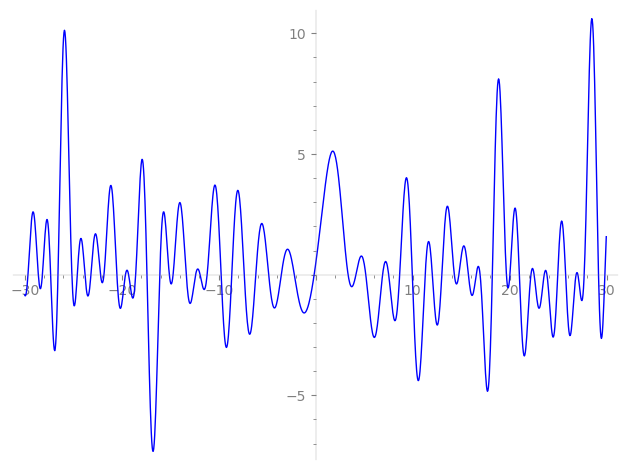
Imaginary part of the first few zeros on the critical line
−11.92053514056689498462947583995, −11.19477297027050434091341146552, −9.750330907803068936622788164276, −8.652446303273910310298009271433, −7.36795287000230222615719485375, −6.17817570341956264696627798686, −4.84831800176367063597486322728, −3.54955670140553960378885235620, −2.20420790378863945067616704619, −0.16080569470567079748565439012,
3.33778361775441125565942550866, 4.14313694710982616960524311207, 5.15924637606295904478203992478, 6.89370559628449480138302834861, 7.51873640853693207463882497713, 8.653416042908866717127991945329, 9.954960405784669011243274247781, 11.28197787282277086793647502588, 12.02008405787398228894776130870, 12.99793889844094483712380785659