| L(s) = 1 | + (0.993 − 2.64i)2-s + 3i·3-s + (−6.02 − 5.26i)4-s − 7.23·5-s + (7.94 + 2.97i)6-s + (18.0 + 3.94i)7-s + (−19.9 + 10.7i)8-s − 9·9-s + (−7.18 + 19.1i)10-s − 64.1·11-s + (15.7 − 18.0i)12-s − 24.8·13-s + (28.4 − 44.0i)14-s − 21.7i·15-s + (8.64 + 63.4i)16-s + 125. i·17-s + ⋯ |
| L(s) = 1 | + (0.351 − 0.936i)2-s + 0.577i·3-s + (−0.753 − 0.657i)4-s − 0.647·5-s + (0.540 + 0.202i)6-s + (0.977 + 0.212i)7-s + (−0.880 + 0.474i)8-s − 0.333·9-s + (−0.227 + 0.606i)10-s − 1.75·11-s + (0.379 − 0.434i)12-s − 0.530·13-s + (0.542 − 0.840i)14-s − 0.373i·15-s + (0.135 + 0.990i)16-s + 1.79i·17-s + ⋯ |
\[\begin{aligned}\Lambda(s)=\mathstrut & 168 ^{s/2} \, \Gamma_{\C}(s) \, L(s)\cr =\mathstrut & (-0.276 - 0.961i)\, \overline{\Lambda}(4-s) \end{aligned}\]
\[\begin{aligned}\Lambda(s)=\mathstrut & 168 ^{s/2} \, \Gamma_{\C}(s+3/2) \, L(s)\cr =\mathstrut & (-0.276 - 0.961i)\, \overline{\Lambda}(1-s) \end{aligned}\]
Particular Values
| \(L(2)\) |
\(\approx\) |
\(0.274652 + 0.364742i\) |
| \(L(\frac12)\) |
\(\approx\) |
\(0.274652 + 0.364742i\) |
| \(L(\frac{5}{2})\) |
|
not available |
| \(L(1)\) |
|
not available |
\(L(s) = \displaystyle \prod_{p} F_p(p^{-s})^{-1} \)
| $p$ | $F_p(T)$ |
|---|
| bad | 2 | \( 1 + (-0.993 + 2.64i)T \) |
| 3 | \( 1 - 3iT \) |
| 7 | \( 1 + (-18.0 - 3.94i)T \) |
| good | 5 | \( 1 + 7.23T + 125T^{2} \) |
| 11 | \( 1 + 64.1T + 1.33e3T^{2} \) |
| 13 | \( 1 + 24.8T + 2.19e3T^{2} \) |
| 17 | \( 1 - 125. iT - 4.91e3T^{2} \) |
| 19 | \( 1 + 17.7iT - 6.85e3T^{2} \) |
| 23 | \( 1 - 59.8iT - 1.21e4T^{2} \) |
| 29 | \( 1 - 70.5iT - 2.43e4T^{2} \) |
| 31 | \( 1 + 16.0T + 2.97e4T^{2} \) |
| 37 | \( 1 + 332. iT - 5.06e4T^{2} \) |
| 41 | \( 1 - 57.4iT - 6.89e4T^{2} \) |
| 43 | \( 1 + 204.T + 7.95e4T^{2} \) |
| 47 | \( 1 + 417.T + 1.03e5T^{2} \) |
| 53 | \( 1 + 546. iT - 1.48e5T^{2} \) |
| 59 | \( 1 - 273. iT - 2.05e5T^{2} \) |
| 61 | \( 1 - 768.T + 2.26e5T^{2} \) |
| 67 | \( 1 + 592.T + 3.00e5T^{2} \) |
| 71 | \( 1 + 256. iT - 3.57e5T^{2} \) |
| 73 | \( 1 + 264. iT - 3.89e5T^{2} \) |
| 79 | \( 1 + 517. iT - 4.93e5T^{2} \) |
| 83 | \( 1 - 902. iT - 5.71e5T^{2} \) |
| 89 | \( 1 + 1.07e3iT - 7.04e5T^{2} \) |
| 97 | \( 1 - 1.00e3iT - 9.12e5T^{2} \) |
| show more | |
| show less | |
\(L(s) = \displaystyle\prod_p \ \prod_{j=1}^{2} (1 - \alpha_{j,p}\, p^{-s})^{-1}\)
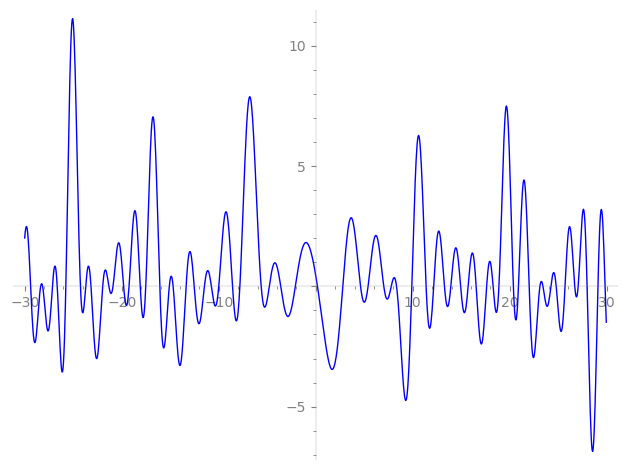
Imaginary part of the first few zeros on the critical line
−12.52743550259871791135676258900, −11.47390310034126363189651392276, −10.75949634542730938920144344710, −9.995068996938689827529303071169, −8.574825386979413818818565696111, −7.82005218058710309914365047819, −5.62234365000084093233963975534, −4.78587583695961620786725614116, −3.60800731807884942961667802125, −2.10110527527715967902078681789,
0.17952545900545232534865822414, 2.78921555024042821886535996847, 4.62155981975178316307019492071, 5.39414560209044500880466172043, 7.01789125769021497516216427584, 7.78261628560008355440635051531, 8.332497483533060067709469439067, 9.904804033761702007727025593176, 11.37578121300916436636773573175, 12.15636046190077533393295664093